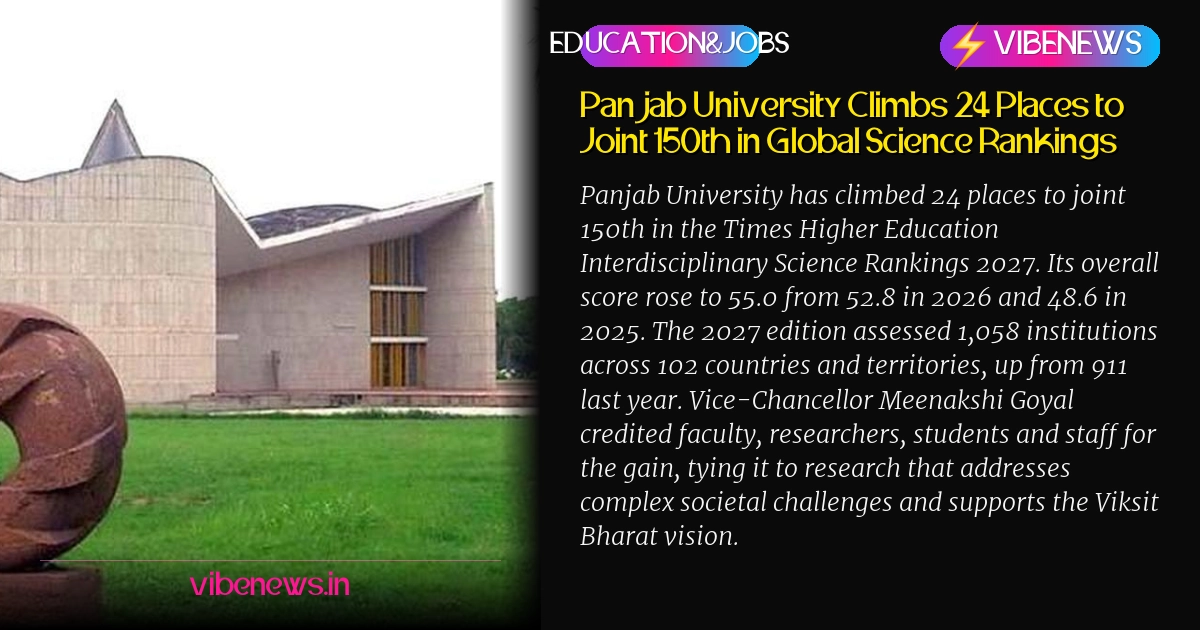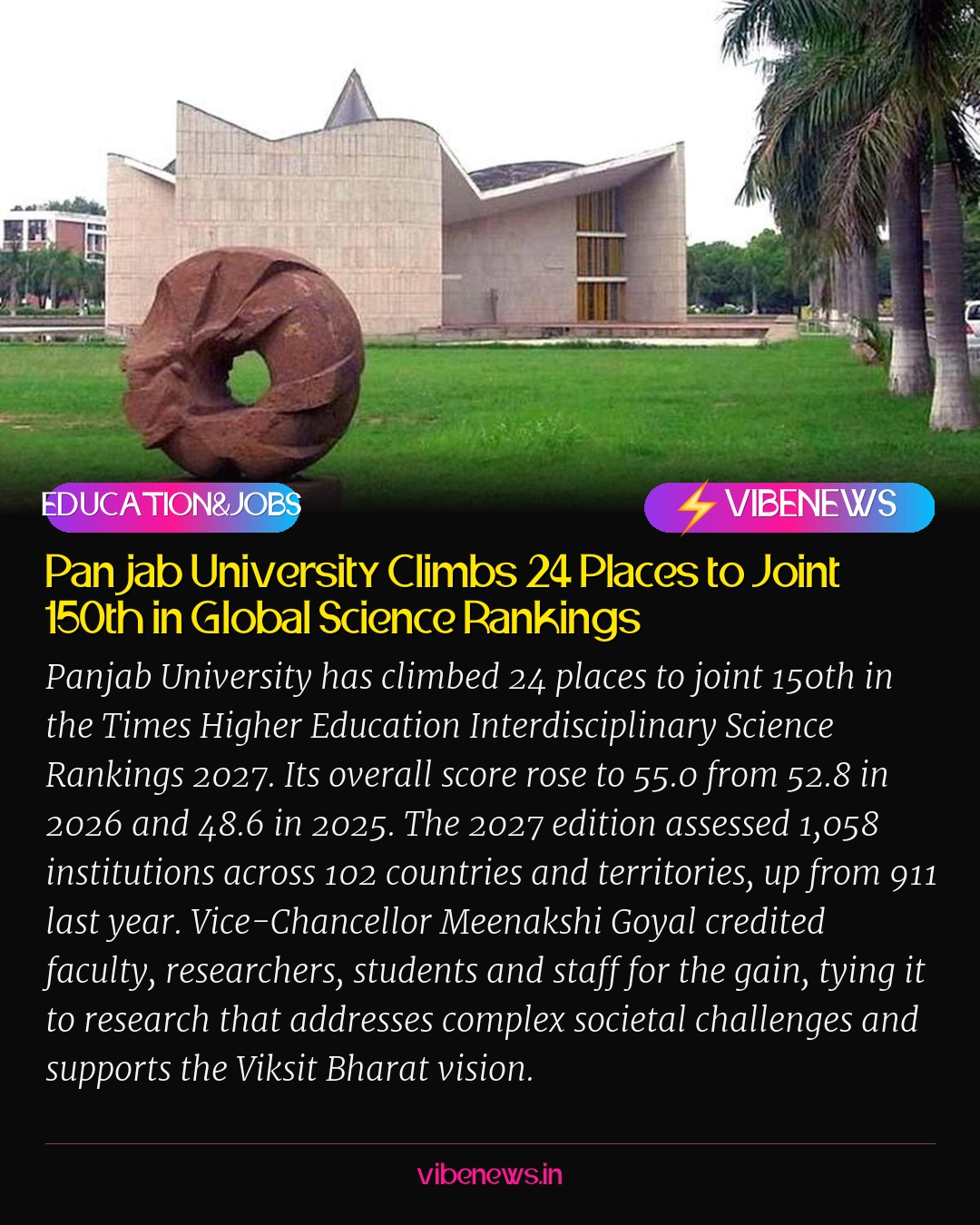
Chandigarh-based Panjab University has moved up 24 places to share the 150th position in the Times Higher Education (THE) Interdisciplinary Science Rankings 2027, a jump that the university says reflects years of work across departments and disciplines.
The university’s overall score climbed to 55.0 from 52.8 in 2026 and 48.6 in 2025. Put another way, the score has risen by 2.2 points in a single year and by 6.4 points over two years. In the rankings table, a 24-place climb means the university was previously placed 174th.
The university announced the result in a statement on Wednesday, November 18, 2026. Vice-Chancellor Meenakshi Goyal framed the improvement as a collective achievement rather than the work of one office or one leadership team.
This improvement in Panjab University’s global standing reflects our continued commitment to strengthening interdisciplinary research and academic collaboration.
Goyal said the result came from the combined effort of faculty, researchers, students and staff. She also pointed to the next step: building a research ecosystem that encourages collaboration across disciplines and supports innovation. The aim, in her words, is to address complex societal challenges aimed at Viksit Bharat through knowledge and research.
What the rankings measure
The Interdisciplinary Science Rankings look at something different from the more familiar lists that focus on a single field. They assess how much universities contribute to research that pulls together knowledge and methods from different academic disciplines to tackle problems that do not fit neatly inside one department.
The rankings cover collaborations between several scientific disciplines. They also include research that combines science with fields such as social sciences, education, psychology, law, economics, and clinical and health studies. For a university, that means a strong position depends on whether its researchers actually work across boundaries, not just whether they publish strong work in isolation.
A bigger field, and a more crowded race
The 2027 edition was produced by Times Higher Education in association with Schmidt Science Fellows. It assessed 1,058 institutions across 102 countries and territories. The 2026 edition covered 911 institutions. That is 147 more universities competing for placement in a single year.
Asia is a large part of that growth. A total of 565 Asian institutions were ranked this year, compared with 478 last year, an increase of 87. Panjab University’s climb therefore came in a field that is expanding quickly, and the university moved up while many more institutions joined the table.
Why the result matters for students and alumni
For current students, a rise in an international research ranking can be a signal about the kind of work being done on campus. Interdisciplinary research often shapes which projects get funding, which collaborations get formed, and which students get exposure to work that goes beyond a single subject. For alumni, a move up the table is a reminder that the institution they studied at is still gaining ground on the global stage.
The university has not announced specific programmes or funding changes tied to this result in the statement. What it has put forward is a commitment to keep building collaboration across disciplines and to support innovation. Whether that commitment translates into the next leap will show up in future editions of the rankings.
The 150th position is a shared spot, not a solo one, which means the university sits level with other institutions in the table. Still, a 24-place gain in a single edition is a clear move, and it comes after a rise in overall score across the last two years. That two-year trend gives the story more weight than a single good year would.
TL;DR
- Panjab University climbed 24 places to joint 150th in the THE Interdisciplinary Science Rankings 2027.
- Its overall score rose to 55.0, up from 52.8 in 2026 and 48.6 in 2025.
- The 2027 rankings assessed 1,058 institutions across 102 countries and territories.
- A total of 565 Asian institutions were ranked, up from 478 last year.
- Vice-Chancellor Meenakshi Goyal credited faculty, researchers, students and staff for the improvement.