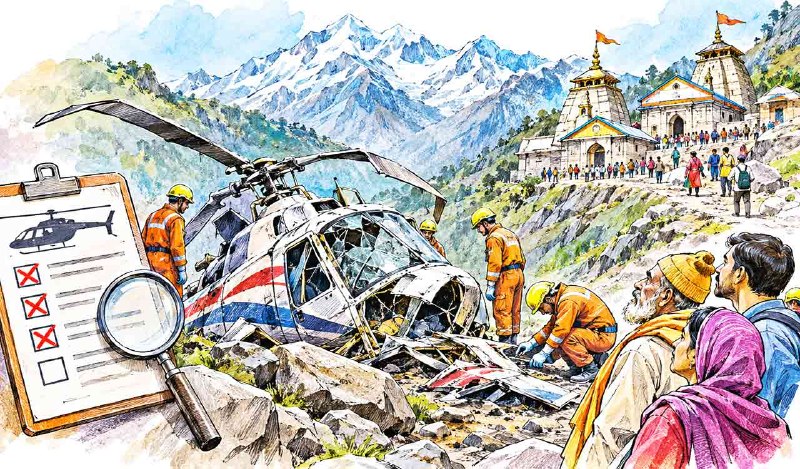
A helicopter crash near Joshimath in Uttarakhand killed six people, and the tragedy has put the safety of Char Dham pilgrimage flights under harsh scrutiny. The crash is, by the account of the source editorial, yet another grim reminder of poor safety standards in India.
The ecologically fragile Himalayan region has seen a mushrooming of private helicopter services over the last few decades. As the Char Dham pilgrimage has become highly commercialised, concerns have grown over what the editorial describes as blatant disregard for safety protocols. The same commercial push is also causing ecological damage across the region.
India’s commercial airline sector has generally maintained a strong international safety record. The helicopter sector is a different story. Pilgrimage-related operations in Uttarakhand have come under increasing scrutiny, and the numbers behind that scrutiny are hard to ignore.
The numbers behind the crashes
According to data from the Ministry of Civil Aviation, 12 helicopter crashes were reported across the country between 2020 and 2025. Seven of them occurred in Uttarakhand, a state that is home to several holy sites. Those seven crashes claimed 21 lives.
The Char Dham routes and terrain are extremely tricky, and the editorial argues that the region’s conditions leave little margin for error. Weather, wind and visibility in the Himalayas are highly unpredictable, which makes mountain flying a specialised task rather than a routine one.
A training gap that should have been closed long ago
The Parliamentary Standing Committee on Transport, Tourism and Culture, in its report last year, highlighted the absence of terrain-specific mountain-flying training and certification facilities for helicopter pilots. The committee’s finding is damning because such facilities should have been a basic requirement for flying in the Himalayan region.
The gap is not a minor paperwork issue. It goes to the core of whether a pilot is prepared for the conditions that Himalayan flying throws up on a daily basis. Without terrain-specific training, the people at the controls are being asked to handle one of the hardest flying environments in the country with less preparation than the environment demands.
Aircraft built for the wrong job
Rotary-wing aviation poses a unique set of difficulties, largely because of the environment in which these flights operate. Many helicopters used for pilgrimage operations are single-engine aircraft without onboard weather radars. In a region where weather can turn quickly, flying without a weather radar removes one of the basic tools a crew would use to avoid trouble.
Experts note that the concentration of flights, coupled with difficult terrain and unpredictable Himalayan weather, creates exceptional operational risks. The Char Dham Yatra has led to a sharp increase in helicopter traffic, and that surge has compressed the airspace that operators share.
Pressure on pilots and the SOP problem
Growing pressure on pilots from helicopter operators, VIPs and pilgrims alike has been combined with violations of Standard Operating Protocols. The editorial says this combination has made helicopter services dangerous. When the people who book the flights and the people who fly them are pushing in the same direction, the rules become the first casualty.
The scale of the demand problem is stark. Only about 2,000 pilgrims can be flown in a day, and even that figure applies only when the weather is clear. Demand often exceeds 10,000 owing to VIP requests and public pressure. That is a gap of several times over between what can be safely delivered and what is being asked for.
In 2025 alone, four helicopter accidents were reported during the Char Dham Yatra season. Those four incidents came in a single season, which means the warning signs were already visible before this latest crash.
The editorial makes a point that sits at the heart of the debate. Strict enforcement of SOPs can significantly reduce the risk of accidents. But enforcing them would also substantially reduce the number of flights. That runs directly against commercial interests and public demand, and it is why the problem has been so hard to fix.
Strict enforcement of SOPs can significantly reduce the risk of accidents, but it would also substantially reduce the number of flights, something that goes against commercial interests and public demand.
The ecological cost of a pilgrimage boom
The danger is not limited to the sky. There are growing concerns about the likely impact of pilgrimage on the ecology of the region. The massive influx of pilgrims has placed enormous pressure on the fragile Himalayan ecosystem around Kedarnath and on its carrying capacity. Experts have also pointed out the possibility of earthquakes in the Himalayan region, which adds another layer of risk to an already stressed landscape of hills and river valleys.
The source notes that more than 12.7 lakh devotees have visited Kedarnath this season. Numbers on that scale make the management problem plain, and the editorial argues that managing them has become increasingly difficult.
Regulators also face a political and emotional obstacle. The subject is deeply emotional and religious, which makes regulatory enforcement sensitive. That sensitivity is a reason authorities may hesitate, but it is not a reason to accept unsafe operations.
What needs to change
The editorial lays out a list of measures needed to improve safety standards. These include installing autopilots, weather radars and enhanced vision systems. They also include mandatory mountain-flying certification, regular operator audits, continuous monitoring and rigorous safety management systems.
None of these measures is exotic. Most of them are standard tools in aviation safety, and the editorial’s argument is that they should have been required for pilgrimage flying in the Himalayas long before another crash forced the question. Every item on that list has a cost, and every item would cut into the flight volume that the commercial pilgrimage market depends on.
The six lives lost near Joshimath are the latest entry in a record that now runs through seven crashes in Uttarakhand since 2020. The question for regulators is no longer whether the gaps exist. The record has already answered that. The question is how many more flights will go up before the rules are enforced as written.
TL;DR
- Six people died in a helicopter crash near Joshimath in Uttarakhand.
- Seven of the 12 helicopter crashes India recorded from 2020 to 2025 happened in Uttarakhand, killing 21 people.
- A Parliamentary panel flagged the absence of terrain-specific mountain-flying training and certification for pilots.
- Many pilgrimage helicopters are single-engine aircraft without onboard weather radars.
- Pilgrim demand often exceeds 10,000 a day, though only about 2,000 can be flown, and only in clear weather.
- Four helicopter accidents were reported during the 2025 Char Dham Yatra season.