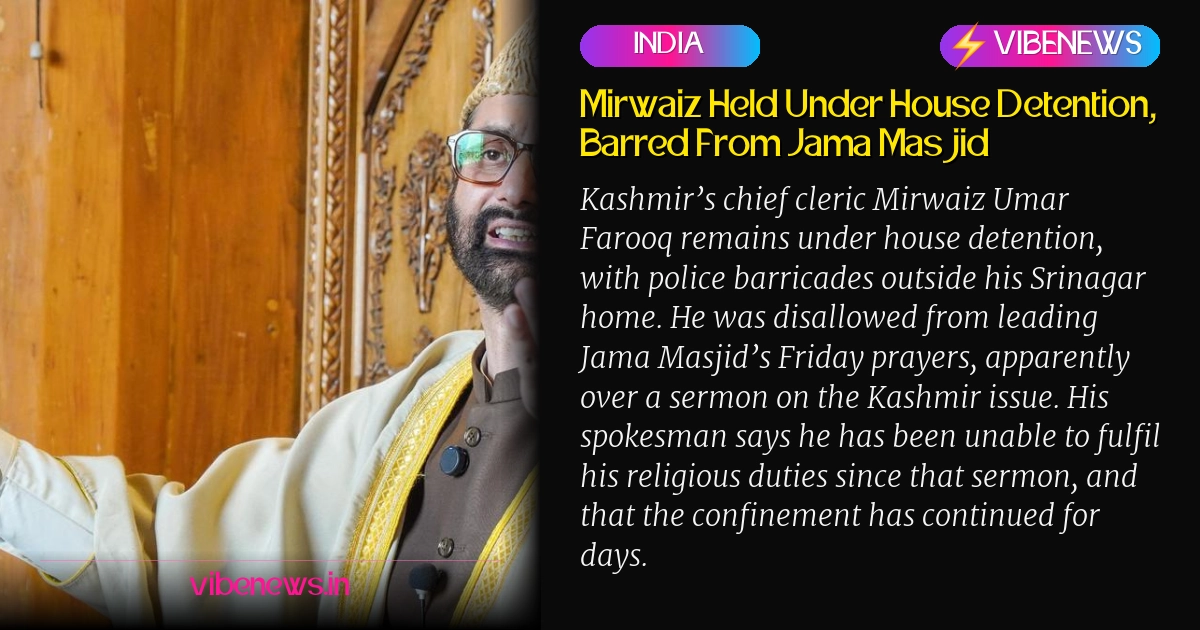
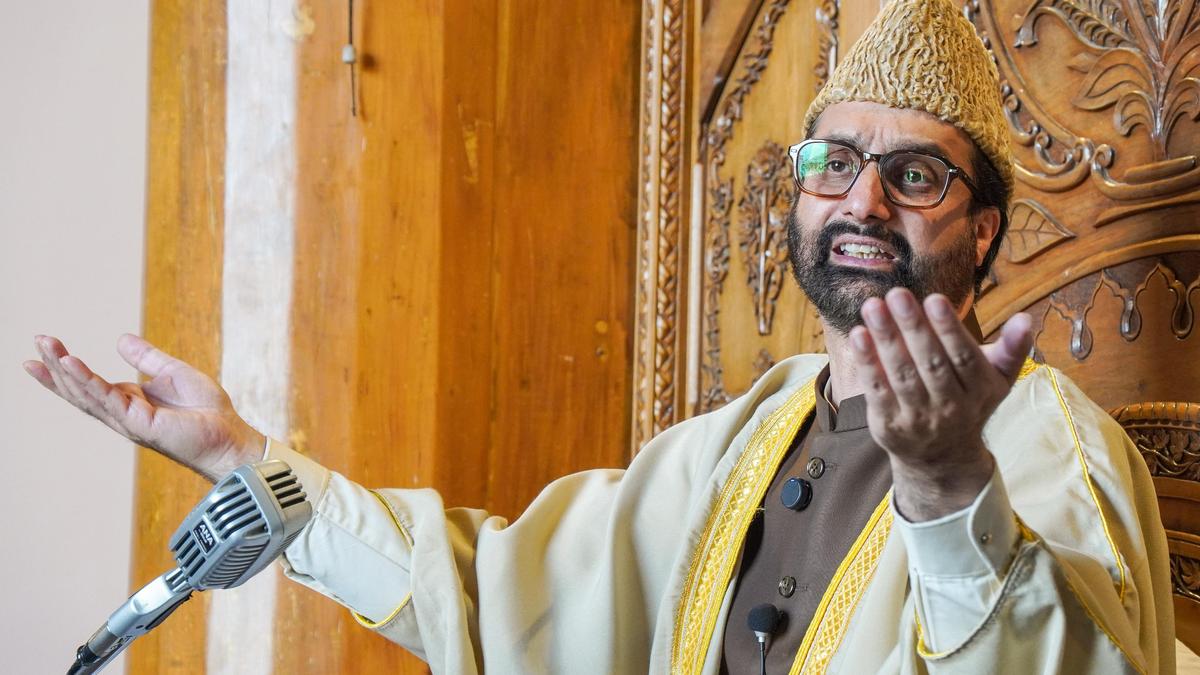
Kashmir’s chief cleric Mirwaiz Umar Farooq has been barred from leading Friday congregation prayers at Jama Masjid in Srinagar, and he remains under house detention with police barricades around his home. He announced on Friday, November 6, 2026, that he would not be able to deliver the sermon at the mosque that day.
In a post on X, the Mirwaiz said his confinement had lasted for about a week, with police deployment and barricades in place outside his residence in Srinagar’s Nigeen area. He shared videos of the barricading by security forces. The detention has now stretched into its sixth day.
The sermon that triggered the crackdown
The Mirwaiz had used his sermon the previous Friday to discuss the findings of the International Crisis Group report on Jammu and Kashmir. He raised concerns over political prisoners, civil liberties, and the need for meaningful political engagement and reconciliation. Authorities appear to have responded to those remarks. The Mirwaiz has not been permitted to lead the congregation at Jama Masjid since, and the restrictions have made it impossible for him to address scheduled religious gatherings.
A spokesman for the Mirwaiz put the impact plainly. Since the previous sermon, the cleric has remained confined to his residence, unable to carry out the religious responsibilities that define his role. For a religious leader who leads one of the most prominent congregations in the Valley, that is not a small matter. It is a direct interruption of worship and of his public duties.
A charge of arbitrary power
The Mirwaiz did not soften his language. He described the move as “arbitrary and authoritarian measures,” and argued that the goal was to restrict movement and speech. The phrasing matters because it goes to the heart of the dispute. The cleric is not only saying that he was stopped from preaching. He is saying that the state is using its security apparatus to silence a voice that raised questions about political prisoners and civil liberties.
He also argued that the measures undercut the government’s own message. According to the Mirwaiz, the restrictions betray the official narrative of “normalcy” in Kashmir. If the valley is calm and returning to routine, he suggested, then a cleric being held in his home for days, with barricades at his gate, does not fit that picture.
“It was aimed to curtail freedom of movement and speech, and also betray the official narrative of ‘normalcy’ in Kashmir.”
Why the religious angle is central
What makes this case stand out is the specific freedom being restricted. This is not a general political rally being banned or a protest being dispersed. It is a Friday sermon at Jama Masjid, a weekly act of worship that draws a congregation and carries deep religious and community meaning. Blocking a religious leader from leading that prayer, and holding him in place for days, turns a security decision into a question of religious freedom.
The concern is not limited to one Friday. The statement from the Mirwaiz’s spokesman describes a continuing pattern. Scheduled religious gatherings have been affected, and the congregation at Jama Masjid has been denied its leader. Each week the restriction holds, the gap between the state’s language of normalcy and the reality on the ground grows wider.
The reporting also underlines the content that appears to have prompted the response. The Mirwaiz was not inciting violence in the account provided. He was discussing a published international report and speaking about prisoners and rights. That is precisely the kind of civic and religious commentary that a functioning democracy is expected to tolerate, even when officials disagree with it.
What is still unclear
The available account does not include an official statement from the authorities explaining the detention or setting out a legal basis for it. The reasons offered come from the Mirwaiz himself and from his spokesman, who link the restrictions to the sermon. Readers should weigh that context carefully. What is documented is the sequence of events: a sermon, a prohibition on leading prayers, police deployment and barricades outside his home, and a detention that has now run for six days.
What is also clear is the human cost in the present tense. A religious leader is confined to his house, a congregation is left without its usual sermon, and a public figure says his ability to speak and move has been deliberately curtailed. Each of those outcomes is serious on its own. Together, they describe a situation that demands answers from the authorities about how long the restrictions will last and on what grounds they were imposed.
TL;DR
- Mirwaiz Umar Farooq was disallowed from leading Jama Masjid’s Friday prayers on November 6, 2026.
- He says his house detention has continued for a week, with police deployment and barricades outside his Srinagar residence.
- The restrictions appear to follow his previous Friday sermon on the Kashmir issue.
- The sermon cited an International Crisis Group report and concerns over political prisoners and civil liberties.
- He calls the measures arbitrary and authoritarian, aimed at curbing freedom of movement and speech.
- His spokesman says he has been unable to fulfil his religious responsibilities since the sermon.