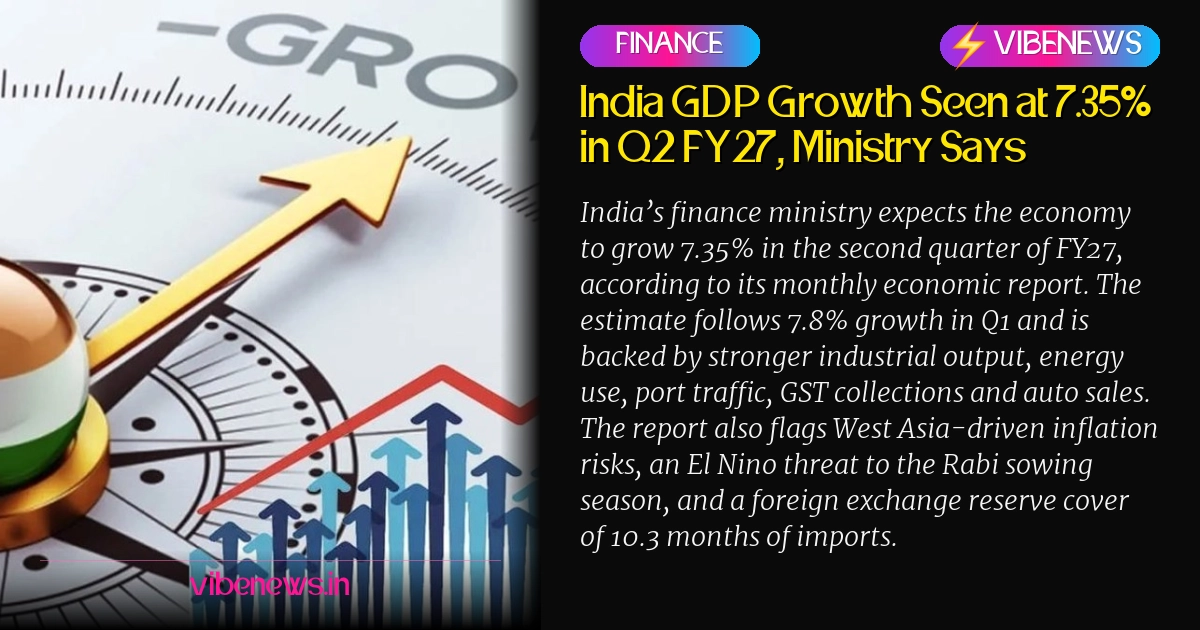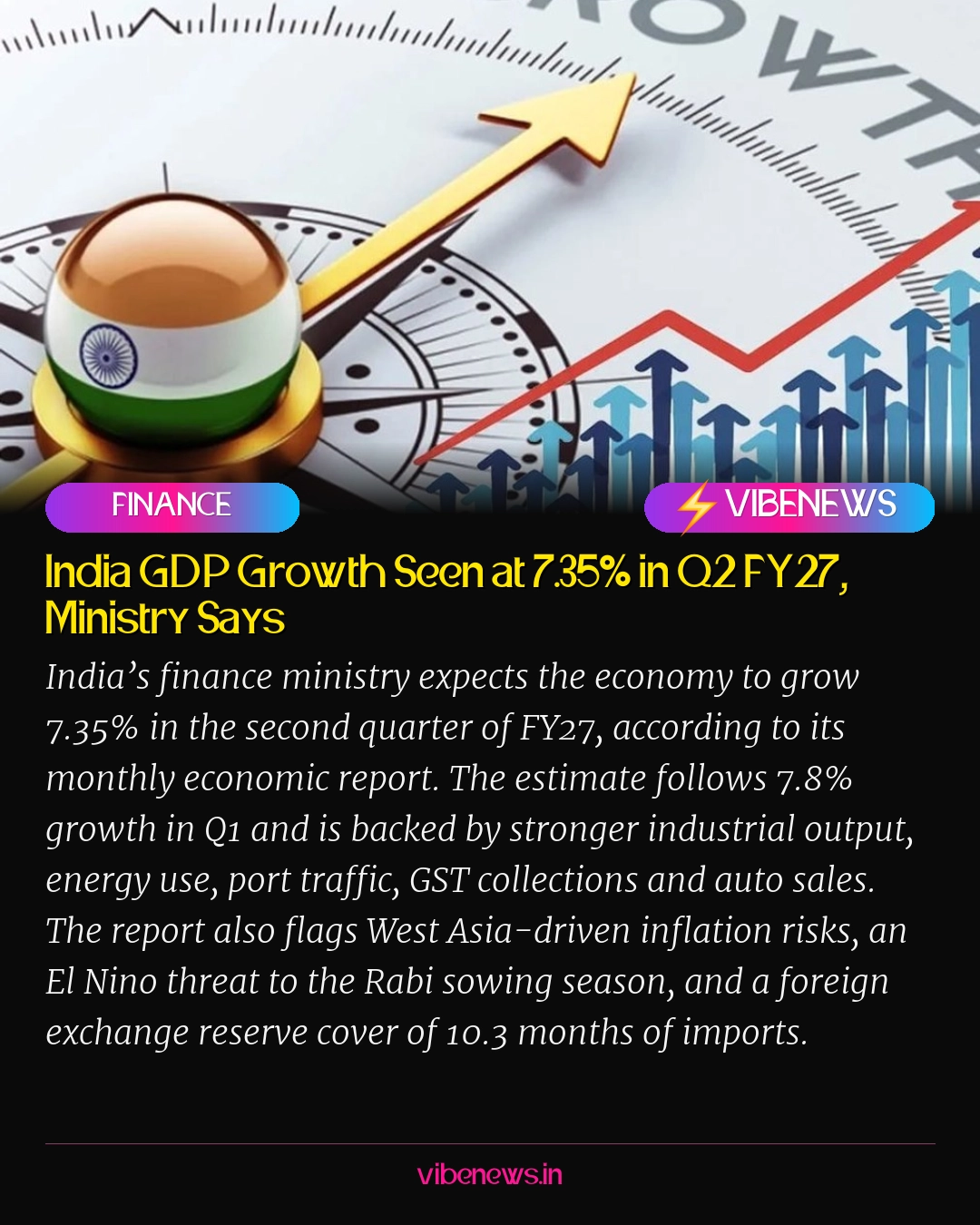
India’s economy is tracking 7.35% real GDP growth in the second quarter of FY27, the finance ministry said in its monthly economic report published on Thursday.
The figure comes from the department’s nowcasting model, a tool introduced in the Economic Survey 2025-26 to estimate growth in near real time before official data is released. The model is built on the back of a strong first quarter. Real GDP grew 7.8% in Q1 FY27, and the ministry’s latest read suggests momentum has carried into the next quarter.
Following real GDP growth of 7.8 per cent in Q1 FY27, the Department’s nowcasting model, introduced in the Economic Survey 2025-26, nowcasts real GDP growth of 7.35 per cent in Q2 FY27.
The ministry pointed to a broad set of hard indicators behind that call. Industrial output, energy consumption, port traffic, GST collections and automobile sales all gave the model strong readings. Those are the kinds of numbers that show factories running, goods moving through ports, businesses paying taxes and households buying vehicles.
Not every data point was rosy. India’s industrial growth slowed to 6.7% in September from 8% in August, a step down that the model still absorbed while holding its overall estimate above 7%.
The 7.35% figure also sits above the forecasts from major institutions. The IMF has raised its FY27 growth forecast for India to 7.0%, while the World Bank, the OECD and the RBI project growth at 7.1%. If the ministry’s nowcast holds, India would be running ahead of those projections.
The global headwinds are getting louder
The report is not a one-way story. It warns that a slowdown in AI-related investment could weigh on global trade, given how much imported content that spending carries. Trade is where India’s export engine runs, so a cooling global tech cycle is a risk worth watching.
The West Asia crisis is the bigger worry for prices. The ministry said the conflict continues to fuel global inflation, and it has revised its headline inflation projection for calendar year 2026 up to 4.7% from an earlier 3.7%. Higher inflation can erode real incomes and push central banks toward tighter policy. That, in turn, can dampen demand and slow global trade.
For households and businesses, the chain is familiar. Costlier energy and freight feed into prices, and prices feed into interest rates and spending decisions.
How the government plans to keep prices in check
On the domestic side, the ministry said near-term inflation will be shaped by three forces: food supply management, global energy volatility and liquidity conditions in the financial system. On food, it pointed to several interventions. These include Kharif onion releases through the ‘Kanda Express’ initiative, stockholding limits on sugar dealers, and cuts in Basic Customs Duty on crude edible oils. The aim is to ease pressure on everyday kitchen staples.
The risks have not disappeared. The report warned of an intensifying El Nino event that threatens soil moisture ahead of the upcoming Rabi sowing season. Demand pressure during the festive period could also push prices up. Externally, high crude oil prices and maritime freight disruptions along West Asian transit routes present ongoing upside risks to input costs.
The RBI has also acted on the currency front. Recent measures to supply direct dollar liquidity to public-sector oil marketing companies, along with steps to curb currency speculation, may help cushion extreme exchange rate swings and limit imported inflation, the report said.
There is one more variable. The efficacy of the recent rate hike in containing secondary inflation effects will depend on how actively the central bank manages liquidity. In other words, the rate move alone will not settle the matter. Execution will.
External position holds steady
India’s external position remains stable, according to the ministry. Robust merchandise export growth and a steady services surplus have cushioned the trade balance. Strong capital inflows, particularly banking capital, financed the wider current account deficit during April to August FY27.
The rupee is still under external strain, but the reserve picture is solid. The ministry said India’s foreign exchange reserves are adequate by standard reserve adequacy metrics, providing an import cover of 10.3 months. That is a cushion that gives policymakers room to manage shocks without scrambling.
The ministry’s conclusion was direct. Taken together, these developments provide a supportive foundation for external sector stability, even as global uncertainties and crude oil price risks continue.
For investors, businesses and anyone tracking where the economy is heading, the message is clear. Growth is running hot, the reserve buffer is deep, and the government is actively managing food prices and currency flows. The risks from West Asia, crude oil and a weather shock are real, and they will decide whether this momentum lasts through the festive season and beyond.
TL;DR
- Finance ministry nowcasts India’s real GDP growth at 7.35% in Q2 FY27.
- Growth follows 7.8% real GDP expansion in Q1 FY27, per the monthly economic report.
- Estimate is above IMF’s 7.0% and the 7.1% projections from World Bank, OECD and RBI.
- West Asia crisis lifts global inflation outlook; CY2026 headline inflation revised to 4.7%.
- Food measures include Kanda Express onion releases and sugar stockholding limits.
- Foreign exchange reserves cover 10.3 months of imports, supporting external stability.