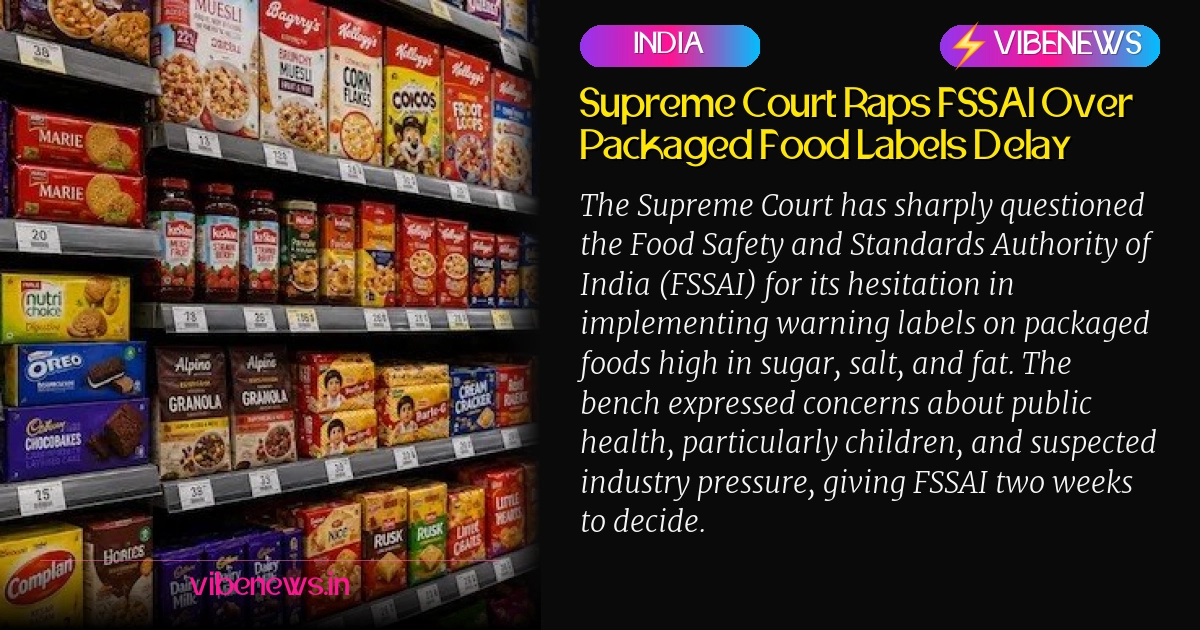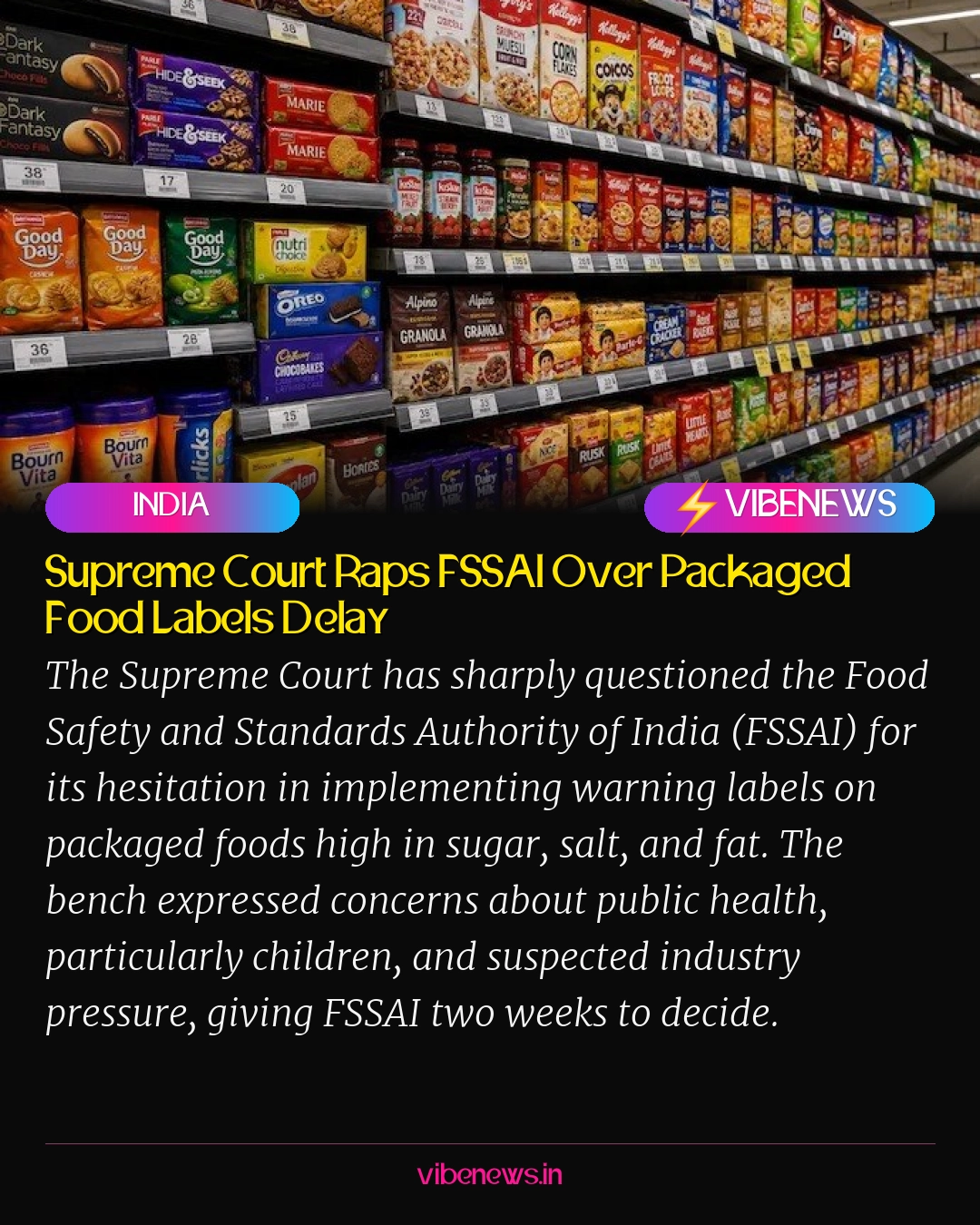
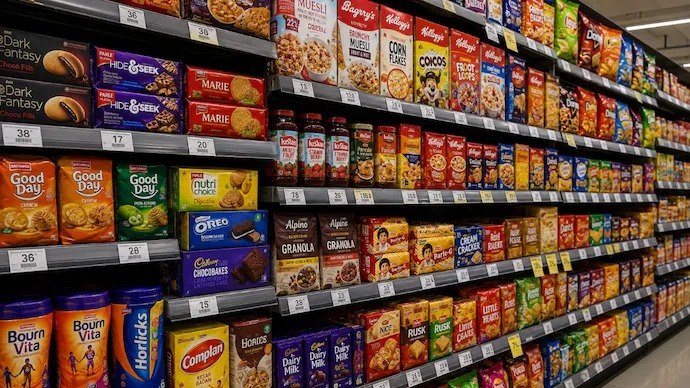
The Supreme Court of India has delivered a sharp rebuke to the Food Safety and Standards Authority of India (FSSAI), questioning its prolonged hesitation to introduce mandatory warning labels on packaged food products high in sugar, salt, and saturated fat. A bench comprising Justices JB Pardiwala and KV Viswanathan expressed profound concern over the regulator’s apparent reluctance, directly asking if the FSSAI was prioritizing commercial interests over the health of the nation’s citizens, particularly its growing children.
During a recent hearing, the apex court did not mince words, suggesting that the FSSAI might be succumbing to pressure from the powerful food industry. The judges queried, "Are you taking the court for a toss? You don’t want people of this country to remain healthy?" This stern questioning underscores the judiciary’s increasing focus on public health and consumer rights in the face of rising lifestyle diseases.
A Judicial Scrutiny of Food Safety
The Supreme Court’s intervention stems from a Public Interest Litigation (PIL) advocating for clear, front-of-pack (FOP) labelling on packaged foods. The PIL aims to empower consumers with easily understandable information about the nutritional risks associated with products before purchase, enabling informed dietary choices.
The bench made it unequivocally clear that its objective was not to target specific food products or manufacturers but to ensure transparency and adequate consumer information. "What have you done so far? We know the pressure on you. Will you do it on your own or should we pass an order?" the court pressed, demanding a definitive action plan from the FSSAI within two weeks.
The Regulatory Dilemma
Representing the Centre and FSSAI, Additional Solicitor General Brijender Chahar presented arguments highlighting the complexities involved. Chahar contended that applying universal warning labels could pose difficulties, especially given that several traditional Indian foods naturally contain relatively high amounts of salt or fat, which might inadvertently fall under such labelling criteria.
The FSSAI had previously indicated a lack of consensus on the proposed labelling framework. Its expert committee had considered various models, including the Indian Nutrition Rating (INR) system, and had received over 14,000 comments from diverse stakeholders. This extensive consultation process, however, has been perceived by the Supreme Court as a delaying tactic rather than a genuine effort towards resolution.
Global Trends in Nutritional Labelling
The debate over front-of-pack labelling is not unique to India. Globally, many countries have adopted or are in the process of implementing similar systems to combat the growing burden of non-communicable diseases (NCDs) linked to unhealthy diets. Nations like Chile, Mexico, and the UK have introduced various forms of FOPL, including warning labels, traffic light systems, or nutrient profiling models, to guide consumer choices effectively.
These international precedents highlight a global shift towards greater transparency in food labelling, driven by public health imperatives. The World Health Organization (WHO) has also consistently advocated for mandatory, easy-to-understand FOPL as a critical tool in preventing diet-related NCDs such as obesity, diabetes, and cardiovascular diseases, which are increasingly prevalent in India.
The Health Imperative in India
India faces a significant public health challenge with the rapid increase in consumption of ultra-processed foods, often high in sugar, salt, and unhealthy fats. This dietary shift, particularly among urban populations and children, is contributing to an alarming rise in obesity, type 2 diabetes, and heart disease. Clear nutritional labelling is seen by public health advocates as a crucial intervention to mitigate these trends.
The court’s concern for "growing children" is particularly pertinent. Children are often primary consumers of packaged snacks and beverages, and early exposure to high levels of unhealthy ingredients can establish lifelong dietary patterns that predispose them to chronic health conditions. Empowering parents and children with clear information is therefore a vital step towards fostering healthier eating habits from a young age.
The Path Forward for Public Health
The Supreme Court’s directive places the FSSAI at a critical juncture. Its decision in the next two weeks will not only determine the future of front-of-pack labelling in India but also signal its commitment to regulatory independence and public health. The court’s firm stance suggests a low tolerance for further delays or industry-influenced compromises.
While the food industry’s concerns about business impact are acknowledged, the court emphasized that consumers would still retain the ultimate choice to purchase products, even those carrying warnings. The core principle remains the right to information, allowing individuals to make informed decisions about what they consume, rather than being swayed solely by marketing or convenience.
Editorial Context: A Landmark for Consumer Rights
This development marks a potentially significant turning point for consumer rights and public health policy in India. The Supreme Court’s direct intervention underscores the judiciary’s role as a guardian of fundamental rights, including the right to health and information. Should the FSSAI implement robust warning labels, it would represent a monumental victory for public health advocates and a crucial step in combating the rising tide of diet-related non-communicable diseases across the country.
The long-term implications extend beyond individual purchasing decisions. It could compel food manufacturers to reformulate products, reducing unhealthy ingredients to avoid warning labels, thereby fostering a healthier food ecosystem. Furthermore, it sets a precedent for regulatory bodies to prioritize public welfare over commercial pressures, potentially influencing policy-making in other sectors where industry interests often clash with broader societal well-being. This judicial push could catalyze a much-needed transformation in India’s approach to food safety and public health.
TL;DR
- The Supreme Court strongly criticized the FSSAI for its delay in implementing warning labels on packaged foods.
- Justices JB Pardiwala and KV Viswanathan questioned FSSAI’s commitment to public health, especially for children.
- The court expressed suspicion that pressure from the food industry might be influencing the regulator’s stance.
- FSSAI cited challenges with applying labels to traditional Indian foods and a lack of consensus among stakeholders.
- The Supreme Court has given the FSSAI a two-week deadline to present its final decision on the matter.
- The ongoing legal battle stems from a Public Interest Litigation advocating for clear front-of-pack nutritional labelling.