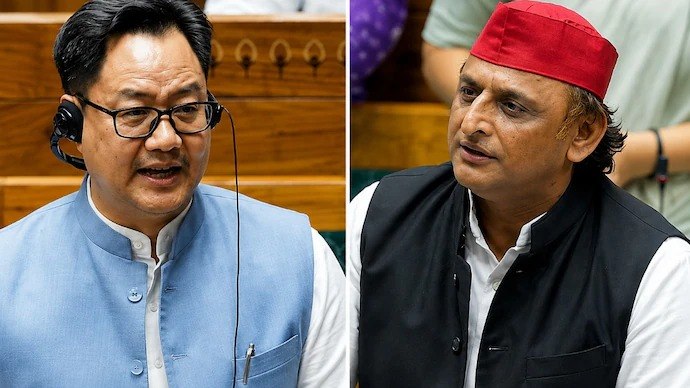
A significant legislative debate unfolded in the Indian Parliament this week, centering on the proposed Foreign Contribution (Regulation) Act (FCRA) Amendment Bill, 2026. The contentious legislation sparked a direct confrontation between Samajwadi Party chief Akhilesh Yadav and Union Minister of Parliamentary Affairs Kiren Rijiju.
During the parliamentary session, Akhilesh Yadav vociferously criticized the Centre, alleging that the FCRA Bill contained provisions detrimental to minority communities. He challenged the government to identify any bill it had introduced that was not, in his view, against minorities, reiterating the Opposition’s demand for the bill’s complete withdrawal.
Union Minister Kiren Rijiju swiftly countered these accusations, firmly stating that not a single provision within the FCRA Bill targets any religion or civil society group. He challenged Yadav to substantiate his claims, asserting that the bill is a necessary regulatory framework for foreign funds entering the country and does not discriminate.
Understanding the FCRA
The Foreign Contribution (Regulation) Act, commonly known as FCRA, is a crucial piece of legislation governing the receipt and utilization of foreign donations by various organizations in India. Enacted initially in 1976 during the Emergency, its primary objective was to regulate foreign funding to prevent its use in activities deemed detrimental to national interest, public order, or other legally protected spheres. Over the decades, the law has undergone several amendments, reflecting evolving concerns about national security and financial transparency.
Organisations, including NGOs, charitable trusts, and educational institutions, that wish to receive foreign contributions are mandated to register under the FCRA. This registration entails strict compliance with rules regarding the receipt, utilization, and disclosure of such funds, ensuring accountability and oversight by the government.
Key Provisions and Mounting Concerns
The proposed FCRA Amendment Bill, 2026, seeks to further tighten these existing regulations, introducing new safeguards and expanding the government’s oversight capabilities. A key and particularly contentious proposal within this amendment is the establishment of a "Designated Authority." This authority would be empowered to take over the management of foreign contributions and assets created from such funds if an organization’s FCRA registration is cancelled, surrendered, or not renewed.
This specific provision has become the focal point of the Opposition’s and various civil society groups’ concerns. They argue that granting the government such extensive powers could lead to undue control over non-governmental organizations and institutions heavily reliant on foreign donations for their operations. Many fear that assets built over decades, such as schools, hospitals, and charitable infrastructure, could be vulnerable to government seizure if an organization’s registration status is revoked.
Critics highlight that such a measure could stifle independent civil society work, particularly for organizations engaged in advocacy, human rights, or those providing essential services in remote areas. The potential for arbitrary cancellation or non-renewal of registration, coupled with the asset takeover clause, raises serious questions about the autonomy and long-term sustainability of the non-profit sector in India.
Historical Precedents and Government Rationale
Historically, the FCRA has been a subject of debate, with previous amendments also drawing criticism for increasing bureaucratic hurdles and perceived government overreach. For instance, the 2020 amendments, which prohibited sub-granting of foreign funds and mandated Aadhar for FCRA registration, also faced significant pushback from NGOs, who argued they hampered their operational efficiency and reach.
The government, however, consistently maintains that these measures are essential for national security and to ensure that foreign funds are not diverted for illicit purposes or activities that could destabilize the country. They emphasize the need for transparency and accountability in the flow of international donations, especially in a complex geopolitical landscape.
The Path Forward
Following the heated exchange, the Centre decided to refer the controversial FCRA Bill to a 21-member Joint Parliamentary Committee (JPC). This move indicates a recognition of the need for further deliberation and scrutiny, allowing for a more detailed examination of the bill’s provisions and potential implications before it proceeds for final parliamentary approval.
Editorial Context
The ongoing parliamentary debate surrounding the FCRA Amendment Bill, 2026, transcends a mere legislative skirmish; it represents a critical juncture for India’s civil society and democratic fabric. The proposed changes, particularly the creation of a Designated Authority with powers to seize assets, could fundamentally alter the operational landscape for thousands of non-governmental organizations across the country.
In the long term, this legislation has the potential to reshape the relationship between the state and independent social welfare, advocacy, and research organizations. While the government cites national security and transparency as paramount, critics argue that such stringent controls could inadvertently shrink the space for dissent, independent thought, and crucial service delivery, especially in sectors where government reach is limited.
The implications extend beyond just foreign-funded entities. A chilling effect could permeate the entire non-profit sector, making it harder for organizations to attract talent, secure funding, and operate without constant apprehension. The balance between legitimate national security concerns and the constitutional right to freedom of association and expression is at stake, making this bill a significant indicator of the future trajectory of civil society engagement in India.
TL;DR
- Samajwadi Party chief Akhilesh Yadav accused the proposed FCRA Amendment Bill, 2026, of containing "anti-minority" provisions during a parliamentary debate.
- Union Minister Kiren Rijiju vehemently denied these allegations, challenging Yadav to identify any such clause and asserting the bill’s regulatory necessity.
- The Foreign Contribution (Regulation) Act (FCRA) governs foreign donations to NGOs and associations in India, aiming to prevent misuse against national interests.
- The 2026 amendment proposes a "Designated Authority" empowered to manage assets of organizations whose FCRA registration is cancelled or not renewed.
- Opposition parties and civil society groups express significant concerns over the potential for excessive government control over NGOs and their long-standing assets.
- The controversial bill has been referred to a 21-member Joint Parliamentary Committee for further review and deliberation.