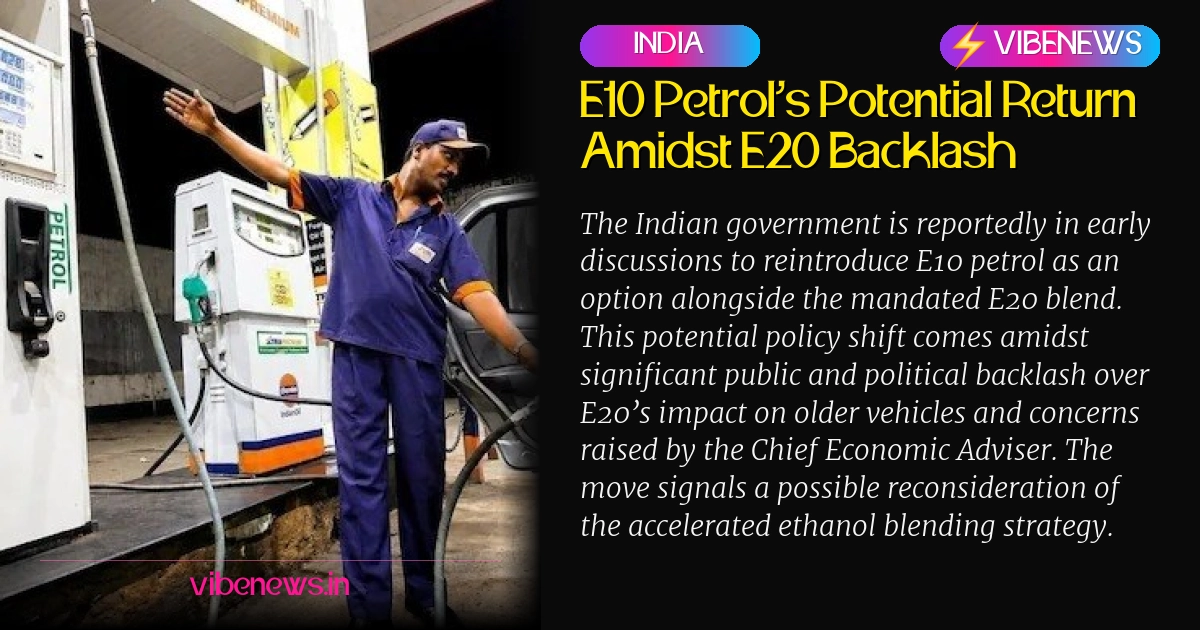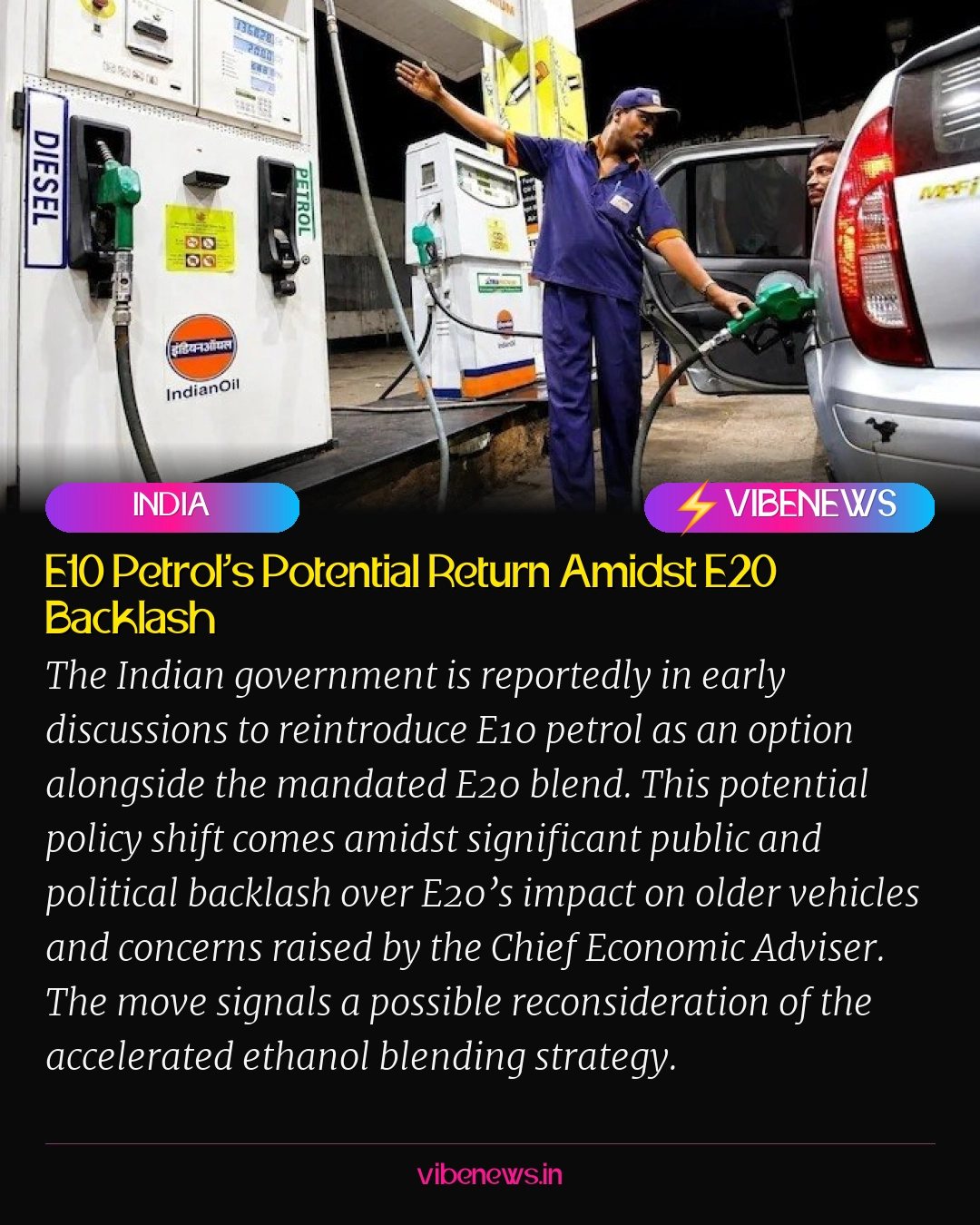
The Indian government is reportedly engaged in preliminary discussions regarding the reintroduction of E10 petrol as an additional fuel option. This potential policy shift comes amidst growing public and political pressure, particularly from owners of older vehicles, who have voiced significant concerns over the mandated E20 ethanol blend.
Until recently, the Centre had firmly ruled out any return to E10, emphasizing a forward-looking approach to fuel policy. However, the recent backing for E10 by Chief Economic Adviser V. Anantha Nageswaran appears to have prompted a re-evaluation within government circles.
The E20 Mandate and Public Discontent
India’s ambitious ethanol blending program saw the government mandate the sale of E20 petrol, containing 20% ethanol and 80% petrol, significantly ahead of its original 2030 target. This initiative was primarily driven by objectives to reduce the nation’s substantial crude oil import bill, mitigate carbon emissions, and provide an additional income stream for farmers.
Despite these stated benefits, the rapid rollout of E20 triggered widespread apprehension among a large segment of vehicle owners. A critical issue arose from the fact that over 80% of the vehicles on Indian roads, particularly those manufactured before 2023, were not designed to be E20-compliant.
Owners of these older vehicles reported concerns ranging from reduced fuel efficiency to potential long-term damage to engine components, especially the fuel injection system and rubber seals. Many have consistently demanded the continued availability of E10 petrol, which contains 10% ethanol, until their vehicles reach the end of their operational life.
A Shift in Official Stance
The government’s previous position, articulated as recently as July 23 by the Petroleum Ministry, was unequivocal. It stated that there was "no proposal to revert to E0/E10 petrol," asserting that public policy aimed to advance with a "superior fuel" rather than regress to an "inferior standard."
Officials had also argued against maintaining different petrol grades, citing the additional logistical and infrastructure requirements this would entail. The current discussions, therefore, represent a notable departure from this previously rigid stance, indicating a potential responsiveness to mounting criticism.
The Chief Economic Adviser’s Intervention
A pivotal moment in this evolving debate was the public intervention by Chief Economic Adviser V. Anantha Nageswaran. In an opinion piece co-authored with Akash Poojari, Nageswaran strongly advocated for offering E10 as an option for consumers, particularly those with older vehicles, even as India progresses with its broader ethanol-blending agenda.
Nageswaran specifically highlighted the plight of the estimated 75 to 80 million older two-wheelers in India, whose components, such as rubber seals, were not rated for higher ethanol blends. He suggested that E10 availability could serve as a protective measure for the existing fleet while a comprehensive retrofit program for such vehicles is developed, acknowledging that such a program would take years to implement effectively.
His intervention was particularly significant given his position within the government, challenging the official narrative from within. Reports indicated that some government officials were initially surprised by his public call, raising questions about internal consensus and the practicalities of implementing a dual-fuel system.
Political Repercussions and Advocacy
The E20 rollout has also become a point of contention in the political arena. Opposition leaders, including Samajwadi Party chief Akhilesh Yadav and Congress MP Randeep Singh Surjewala, have seized upon Nageswaran’s comments to criticize the Centre’s policy.
Yadav questioned the government’s consistency, while Surjewala accused the administration of "imposing E20 without preparation" and subjecting citizens to a "forced experiment." These political voices have amplified the public’s demand for choice and accountability.
Beyond political parties, citizen pressure groups like Team Bharat, led by political commentator Tehseen Poonawalla, have actively campaigned against the mandatory E20 blend. While not opposing ethanol blending itself, the group has stressed the importance of consumer choice and the availability of E10 for compatible vehicles, organizing meetings with the Petroleum Ministry and announcing protests to press their demands.
Logistical Hurdles and Broader Implications
Reintroducing E10 alongside E20 presents considerable logistical and infrastructural challenges for the government and oil companies. It would necessitate separate arrangements for storage, transportation, and dispensing of two distinct petrol blends, potentially impacting pricing and distribution networks.
Furthermore, Nageswaran’s counsel extended beyond immediate fuel options, urging the Centre to meticulously assess the broader trade-offs involving food, feed, land, and water resources before further escalating ethanol blending targets to E27 or E30. This highlights a deeper concern about the sustainability and holistic impact of aggressive biofuel policies.
Editorial Context
The ongoing discussions about reintroducing E10 petrol signify more than just a potential change in fuel policy; they represent a critical juncture in India’s approach to large-scale national reforms. This development underscores the importance of policy flexibility and responsiveness to ground realities, even when pursuing ambitious environmental and economic objectives. The initial rigid stance on E20, followed by a reconsideration prompted by expert advice and public outcry, illustrates the complex interplay between policy formulation, scientific validation, consumer experience, and political will.
In the long term, this episode could set a precedent for how future transformative policies are implemented and adjusted. It highlights the necessity for comprehensive impact assessments that consider the diverse segments of the population and existing infrastructure, rather than solely focusing on macro-level benefits. The government’s eventual decision will reflect its commitment to balancing national strategic goals with the practical concerns and economic well-being of its citizens, particularly those who might be disproportionately affected by rapid policy shifts. It also reinforces the crucial role of independent expert voices within the government in shaping more nuanced and sustainable policy outcomes.
TL;DR
- The Indian government is currently discussing the reintroduction of E10 petrol as an additional option alongside the mandated E20 blend.
- This reconsideration follows significant public and political backlash against the E20 mandate, particularly from owners of older vehicles.
- Chief Economic Adviser V. Anantha Nageswaran publicly advocated for the return of E10, citing concerns for older vehicles not designed for E20.
- Concerns among motorists include reduced fuel efficiency and potential long-term damage to engine components in pre-2023 vehicles.
- The move marks a potential reversal from the government’s previous firm stance against offering E10, which it had deemed an ‘inferior standard’.
- Implementing a dual-fuel system (E10 and E20) would require significant logistical and infrastructural adjustments for oil companies.