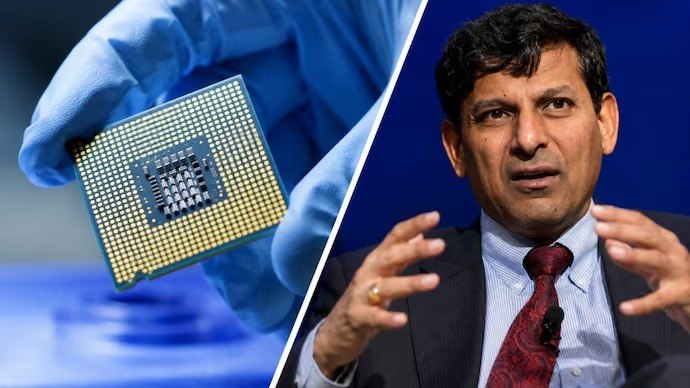
Raghuram Rajan’s ‘Smuggle Chips’ Idea Sparks Satirical Fury
In a move that has left many scratching their heads and others reaching for their sarcasm meters, former Reserve Bank of India (RBI) Governor Raghuram Rajan has offered a rather unconventional solution to India’s semiconductor ambitions: why build, when you can just... smuggle?
Rajan, speaking in an interview with Frontline magazine published on September 1, questioned the rationale behind New Delhi pouring "billions" into developing a domestic semiconductor industry. His reasoning? Chipsets are "the most easily smuggled thing on Earth," a feat he claims China and Russia are already mastering en masse. Apparently, those tiny silicon marvels are just too slippery for customs.
India, meanwhile, has been rather earnestly pushing to set up its own chipset ecosystem since 2021, launching the Rs 76,000-crore Semicon India Programme and later expanding it with Semicon India 2.0, involving a total outlay of over Rs 1.275-lakh-crore. This strategic drive has already attracted over Rs 1.64 lakh crore in investment commitments, with projects by Tata Electronics and Micron underway. The government’s logic is simple: from smartphones to fighter jets, semiconductors are the lifeblood of modern economies and militaries, and relying on a handful of global producers who can cut off supply at will (remember the 2021 auto sector hit?) isn’t exactly a recipe for national security.
But according to Rajan, such concerns are perhaps overblown. He argued that India could never achieve full self-sufficiency anyway, given the global nature of raw materials and machinery. And if all else fails, he suggested, India’s "more than 35 million Indians in our global diaspora community" could simply procure these chips for us. Because, clearly, a global network of chip mules is a more sustainable and less costly strategy than domestic manufacturing.
Unsurprisingly, Rajan’s comments on the ease of chip smuggling and the utility of the diaspora as a procurement network have not been met with universal acclaim. Social media, ever the arbiter of public sentiment, erupted in a wave of satirical trolling.
"Air hostess arrested in Kerala after Nvidia Blackwell chip was found in her rectum," posted investment expert Viraj Raundal on X, saying such would be "news headlines if the diaspora starts listening to Raghuram Rajan".
Entrepreneur Ashutosh Malik quipped sarcastically on X, "Absolutely brilliant from Raghuram! Why didn’t we think of it before – smuggle cars, trucks, rockets, satellites, smuggle computers.....and, of course, smuggle chips! Why bother developing any IP, manufacturing capability, ability to scale etc? This fellow was made RBI Governor!!" Another user humorously suggested, "Fertility decline is not really a problem – we can just steal other people’s children, opined the famous opinion maker."
Even author Rajeev Mantri joined the chorus, suggesting Rajan "should personally stuff some chips... demonstrate how smuggling can be done. He can then write a detailed paper about his experiences." Apparently, a new ‘jugaad’ technique for national chip supply is just what India needs.
While Rajan cited Russia and China’s experiences with procuring chips, he perhaps overlooked a minor detail: both nations resorted to such measures due to suffocating Western sanctions and US restrictions, not as a cost-saving alternative to domestic production. In fact, their predicaments arguably bolster India’s case for developing its own robust semiconductor industry, ensuring strategic independence rather than relying on the clandestine efforts of a global diaspora or the dubious art of chip-smuggling.
Perhaps the former RBI Governor’s broader point about focusing on fundamentals like education, healthcare, and infrastructure holds merit. But when it comes to national strategic assets, one might hope for a plan that doesn’t sound like it was brainstormed in a dimly lit back alley.
TL;DR
- Former RBI Governor Raghuram Rajan questioned India’s semiconductor push, suggesting chips are "most easily smuggled."
- Rajan argued India should focus on fundamentals like education and healthcare, not pour "billions" into chip manufacturing.
- He cited China and Russia’s chip procurement methods and suggested India’s diaspora could also source chips.
- His comments sparked widespread satirical backlash and trolling on social media platforms like X.
- Critics highlighted the absurdity of smuggling as a national strategy for critical technology.
- The examples of Russia and China, forced to smuggle due to sanctions, actually strengthen the argument for India’s domestic self-sufficiency.