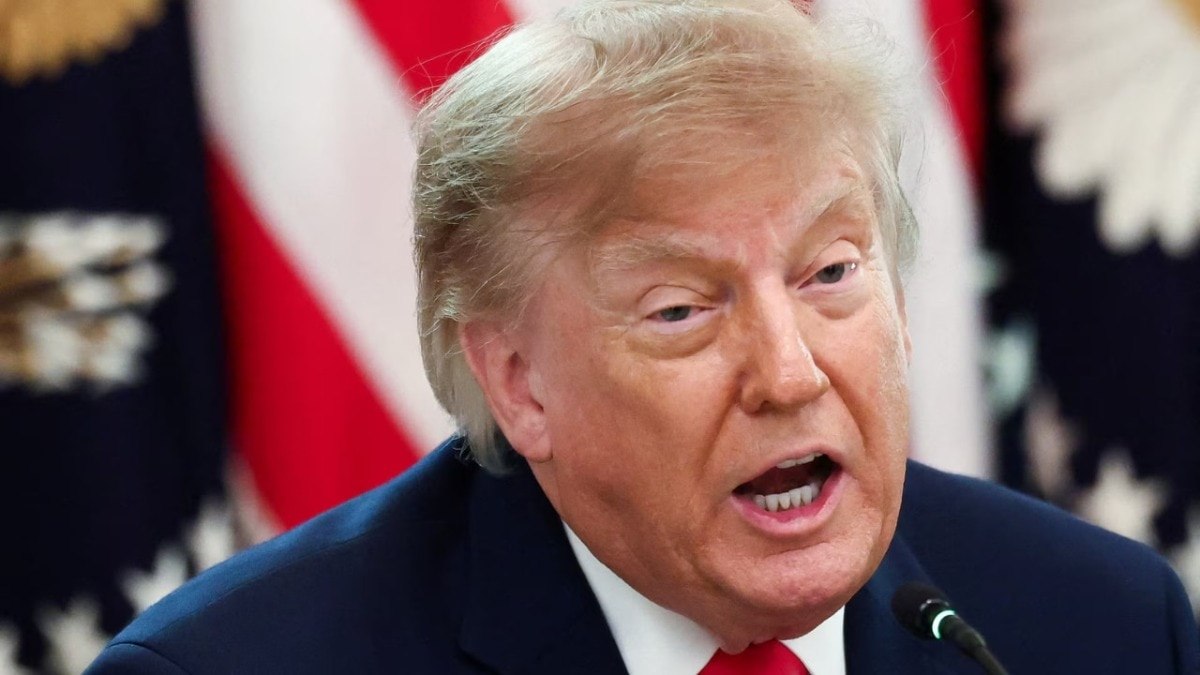
US President Donald Trump has claimed that Israel and the entire Middle East would not exist today if he had not stopped Iran from acquiring nuclear weapons, and he made the statement as Washington weighs a new round of military action against Tehran. Trump posted the claim on his social media platform Truth Social, at a moment when the United States is actively considering renewed strikes on Iran.
In the post, Trump wrote: "If I had not stopped Iran from acquiring nuclear weapons, Israel and indeed the entire Middle East would not exist today. Nobody wants to talk about it, but everyone knows it is true."
If I had not stopped Iran from acquiring nuclear weapons, Israel and indeed the entire Middle East would not exist today. Nobody wants to talk about it, but everyone knows it is true.
The statement is one of the most explicit claims Trump has made about Iran’s nuclear programme in recent months. He has repeatedly described the programme as a major concern for his administration, and he argues that US military action has weakened Tehran’s nuclear capability.
What the US and Israel did
The United States and Israel carried out large attacks on Iranian nuclear and military sites in 2025 and again in 2026. A central aim of those strikes, according to the reporting, was to prevent Iran from building a nuclear weapon.
How much those strikes actually damaged Iran’s ability to build a bomb is still unclear. An October report from the Congressional Research Service, the research arm of the US Congress, said the effects of the attacks were not fully established. The same report said earlier assessments had not confirmed that Iran had tried to build a nuclear bomb.
The report also cited a US assessment that Iran halted its nuclear weapons programme in 2003. According to the document, no solid evidence has emerged that the programme was restarted.
The uranium question
Iran’s uranium enrichment is the core of the concern. According to an October report that cited the International Atomic Energy Agency, Iran may hold more than 200 kilograms of uranium enriched up to 60 per cent. The material is believed to be stored in tunnels dug underground at Isfahan.
Weapons-grade uranium is typically enriched to around 90 per cent. Uranium at 60 per cent is well below that threshold, but it can be enriched further, which is why it worries nuclear inspectors and Western governments alike.
The IAEA has also said it cannot fully determine where Iran’s enriched uranium and centrifuges are located after the strikes. That gap in verification is central to the debate over whether Trump’s account can be tested.
Tehran’s position
Iran has consistently said its nuclear programme serves peaceful purposes and has denied seeking nuclear weapons. Trump’s claim that he prevented Iran from building a bomb therefore rests on his own assertion. It has not been independently confirmed by the IAEA or by US intelligence assessments.
Washington moves toward possible new strikes
Trump met his national security team on Thursday to discuss possible military action against Iran. US Central Command is also increasing preparations for a new wave of strikes, according to the reporting.
The US has not yet issued a formal order to restart a major military campaign. Still, the White House held key meetings on Iran on Wednesday and Thursday.
Speaking to reporters in the Oval Office, Trump said the United States would soon decide whether to carry out further attacks on Iran’s nuclear programme.
The timing of the post matters. Trump’s statement came as the administration weighs whether to order strikes that could reshape the security situation across the Middle East, and his language about the region’s survival raises the stakes of that decision. Israel, which has been one of the main partners in the campaign against Iran’s nuclear sites, is directly named in his claim.
For international audiences in the United States, Britain and Australia, the central question is less about rhetoric than about evidence. Trump says a catastrophe was averted. Independent monitors have not verified that account, and the agency tasked with tracking Iran’s uranium still cannot say where much of it is. Any decision on new strikes will be made against that backdrop of uncertainty, with the risk of escalation sitting alongside the risk of a nuclear Iran.
The coming days will show whether Washington moves from deliberation to action. Until then, the gap between Trump’s certainty and the incomplete public record will remain the defining tension in the story.
TL;DR
- US President Donald Trump claims Israel and the Middle East would not exist if he had not stopped Iran from getting nuclear weapons.
- The claim was posted on Truth Social as the US weighs fresh military strikes on Iran.
- The IAEA says Iran may hold over 200 kg of uranium enriched up to 60 per cent, and its location is unclear.
- A US Congressional Research Service report said the impact of the 2025 and 2026 strikes is not fully clear.
- Iran insists its nuclear programme is peaceful and denies seeking nuclear weapons.
- Trump’s national security team met Thursday as US Central Command increases preparations for possible new strikes.