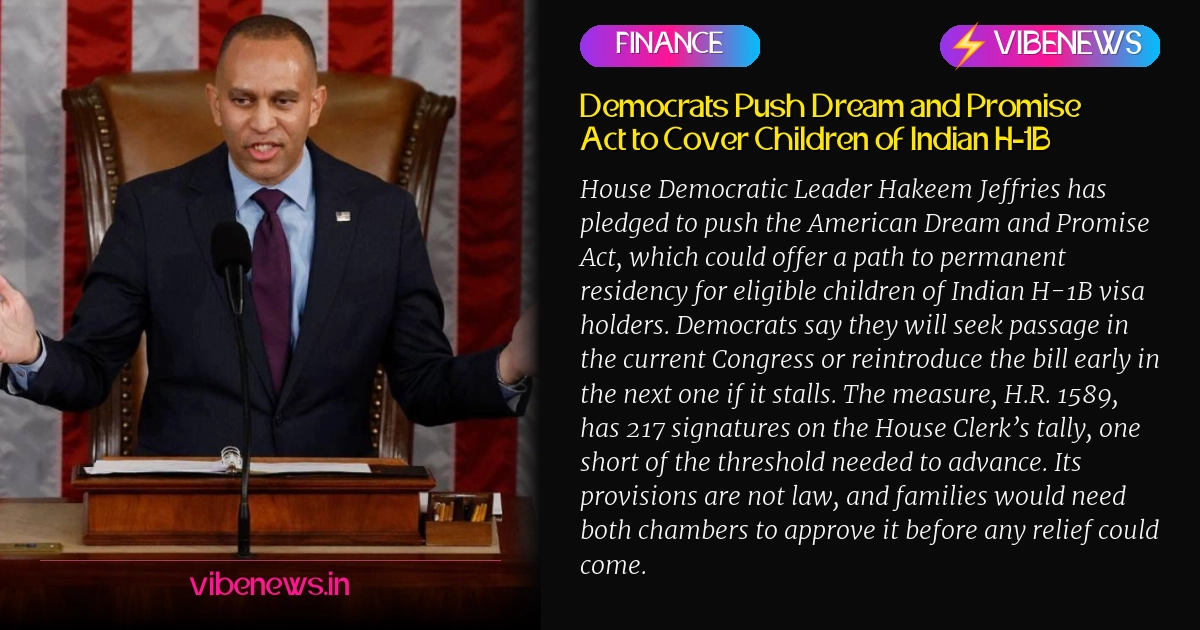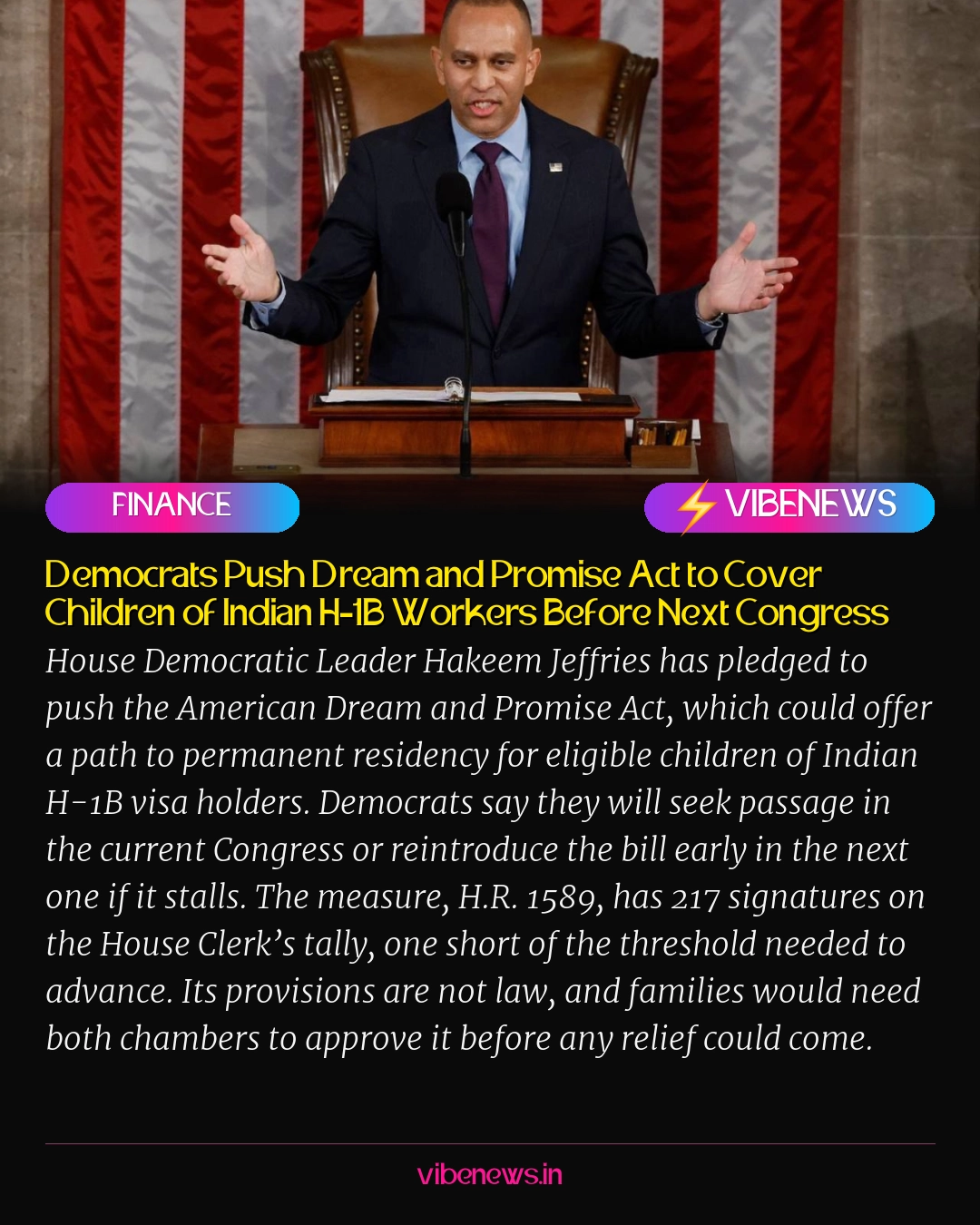
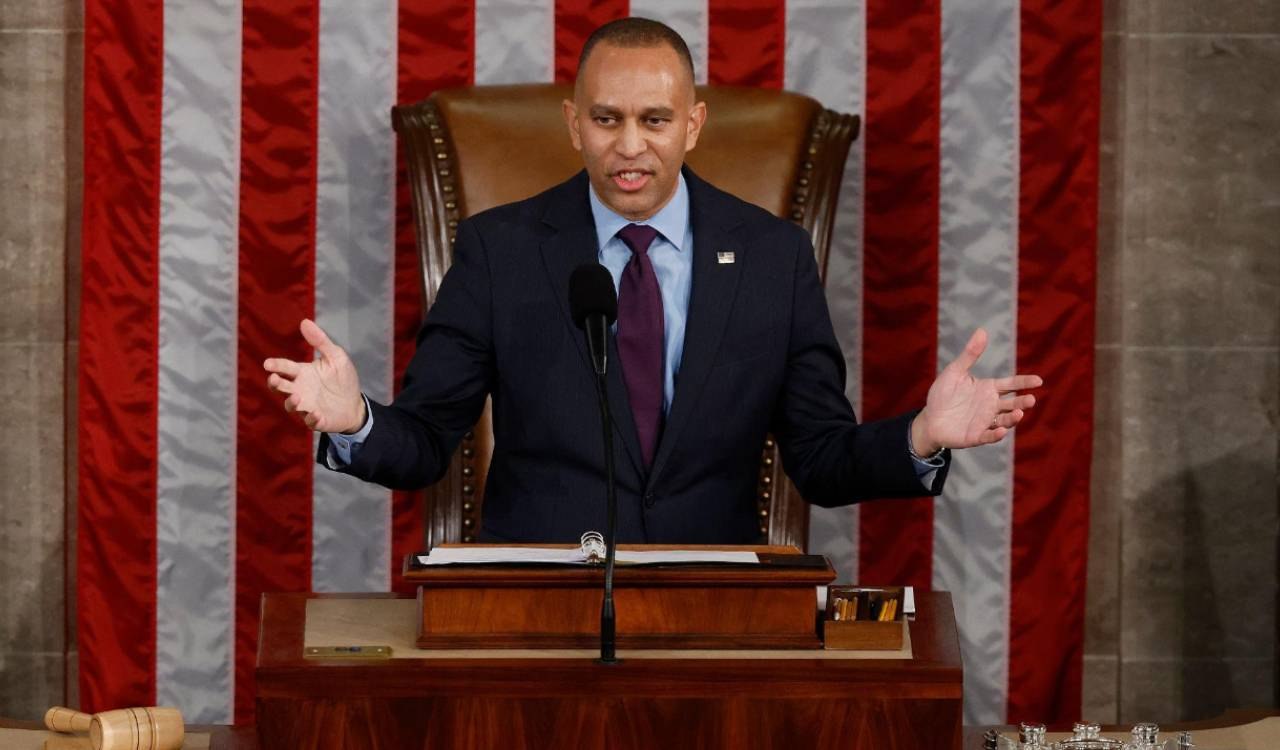
House Democratic Leader Hakeem Jeffries pledged on Wednesday to advance immigration legislation that could give permanent residency to eligible children of Indian H-1B workers, and he warned that if Congress does not act now, Democrats will take it up early in the next session.
The bill in question is the American Dream and Promise Act. It would cover certain immigrants who were brought to the United States as children, including the sons and daughters of people admitted on H-1B and other specified temporary visas. For Indian families who have spent years waiting on employer-sponsored green cards, that inclusion is the detail that matters most.
Jeffries wants the measure passed during the current Congress. He pointed to an effort by Representative Sylvia Garcia of Texas to force a House vote, and he did not hide his frustration about the timing. He spoke to reporters at a news conference, and his words left little room for ambiguity.
“I can guarantee you that if that doesn’t happen, we’re going to move the Dream and Promise Act in the next Congress, early in the next Congress.”
Jeffries is likely to be the next Speaker of the House, which gives his promise more weight than a typical party commitment. He made the remark while answering a question about Temporary Protected Status for Salvadorans. He referred specifically to recipients of DACA, which stands for Deferred Action for Childhood Arrivals, and TPS. The link to H-1B families comes from provisions inside the existing bill, not from the question itself.
Asked separately whether he had spoken with President Donald Trump about a possible immigration agreement, Jeffries offered a short answer. “Haven’t heard from the President yet,” he said. That leaves any deal in the air, with no sign yet of a negotiated package.
Jeffries also framed the bill as a beginning rather than a finish line. “We should start with the Dream and Promise Act, but that’s the beginning. That’s not the end,” he said. He is signaling that Democrats want broader changes to immigration law, and this measure is only the first step.
For Indian families, the bill’s explicit mention of children of H-1B, L, E-1 and E-2 visa holders is the provision to watch. The text, identified as H.R. 1589, would generally require applicants to have been continuously and physically present in the United States since January 1, 2021. They would also need to have entered the country at age 18 or younger. Applicants would have to meet education-related requirements, along with criminal and national security checks.
If approved in its current form, the proposal would grant conditional permanent residence lasting 10 years. Applicants would then need to meet further requirements to remove those conditions. It is worth being clear here: none of these provisions are law at this point. They describe what the bill proposes, and nothing more.
The problem the bill aims to solve affects young people often called “Documented Dreamers.” These are children who grow up legally in the United States as dependents of temporary visa holders. Their status depends on their parents, and it can end when they turn 21. A young person who cannot secure another lawful status may have to leave, even after spending most of their childhood in the country.
The wait for green cards makes that risk worse for many families. The American Immigration Council, an immigration advocacy organisation, says employment-based green card backlogs are especially large for people born in India and China. That backlog stretches out the uncertainty for households that have already been waiting for years.
On the legislative side, the numbers are tight. H.R. 1589 is tied to a resolution that would allow consideration of the bill on the House floor. That resolution has 217 signatures on the House Clerk’s published tally. It is one signature short of the threshold required to advance through that procedure, so a single additional name could change the bill’s path.
Jeffries also called for bipartisan immigration reform. He said enforcement should be fair, just and humane, and that the border should be safe and secure. When asked whether Democrats wanted deportations stopped entirely, he said they support removing violent felons who harm Americans. He accused the administration of targeting law-abiding immigrant families, a charge that sets up a sharp political fight over how any deal would be framed.
The timeline is the hardest part for families to plan around. If the measure is not enacted before the current Congress ends, it must be reintroduced and start the legislative process again. Even if the bill moves forward, it would need approval from both the House and the Senate, followed by enactment, before any family could obtain relief. For now, the promise is clear, but the outcome depends on votes that have not yet been cast.
TL;DR
- House Democratic Leader Hakeem Jeffries pledged to push the American Dream and Promise Act, which could offer permanent residency to eligible children of Indian H-1B workers.
- Jeffries says Democrats will seek passage this Congress or reintroduce the bill early in the next one.
- H.R. 1589 has 217 House signatures, one short of the threshold needed to advance the resolution that would bring it to the floor.
- The bill would require applicants to have been continuously present in the US since January 1, 2021, and to have entered at age 18 or younger.
- Proposed conditional permanent residence would last 10 years. None of these provisions are law yet.
- The measure could help “Documented Dreamers” who risk losing status when they turn 21.