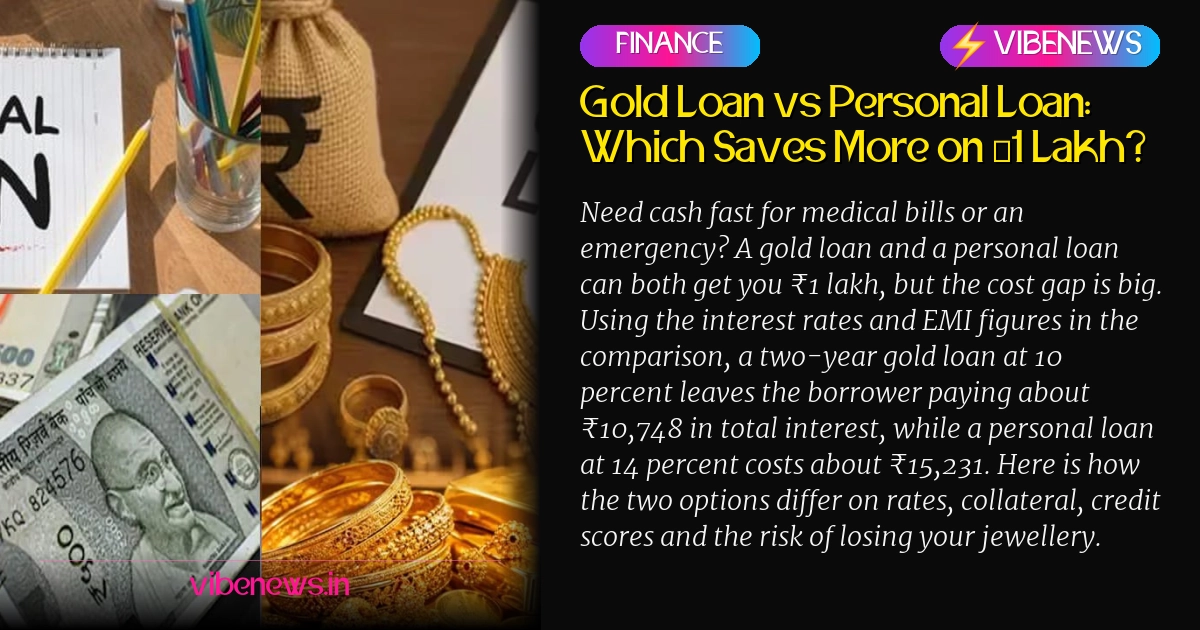
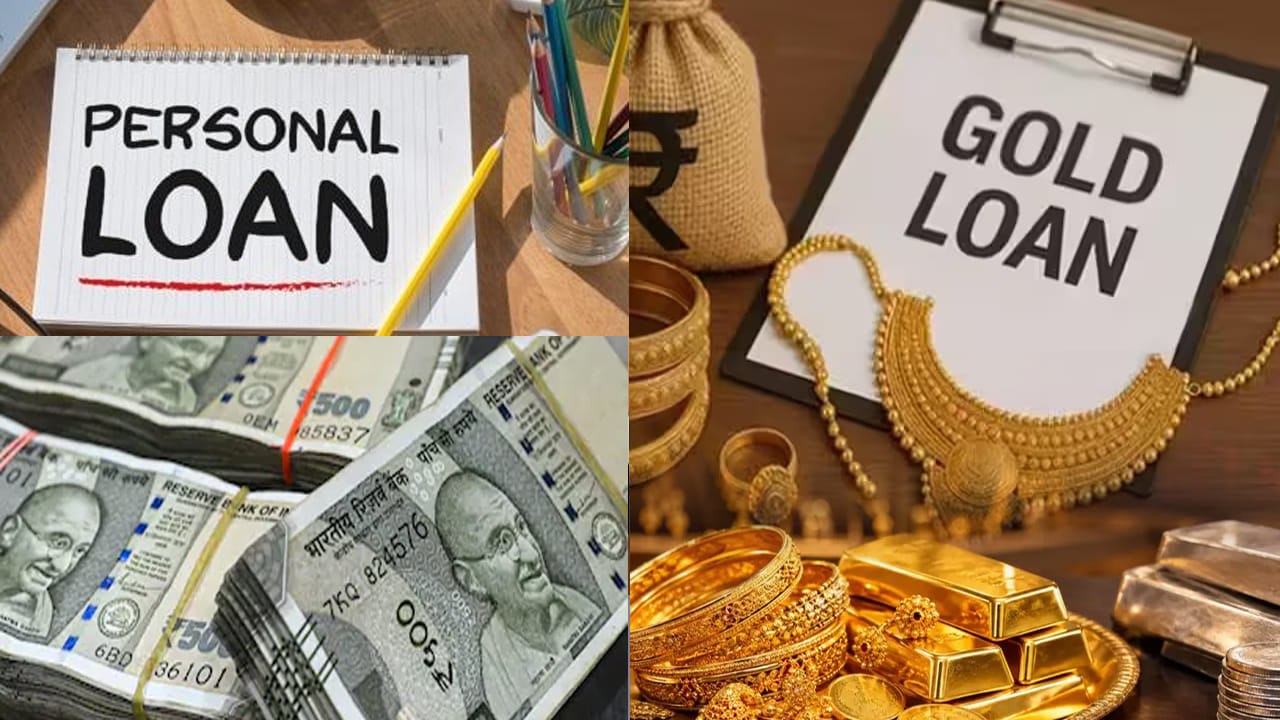
A gold loan costs less than a personal loan for the same ₹1 lakh over two years, based on the figures in a side-by-side comparison of the two options. At 10 percent on a gold loan, the monthly EMI is ₹4,614 and total interest comes to ₹10,748. The same amount as a personal loan at 14 percent brings the EMI to ₹4,801 and total interest to ₹15,231.
Rising prices are squeezing household budgets, and a medical treatment or another emergency can leave a family needing a large sum with little warning. The problem, as the comparison points out, is that there is no clear guide on how to raise a big amount suddenly. Taking a loan often looks like the simplest route, but the choice of loan decides how much that route costs.
Two options usually come up. One is a gold loan. The other is a personal loan. The cost, repayment terms and risk level of each are different. By comparing interest rates, processing fees and how comfortably you can repay, a borrower can work out which option fits their situation best.
How a gold loan works
A gold loan is secured against gold. To take one, you need gold jewellery in your possession, because that is what you put up as security. Without gold ornaments, there is nothing to pledge.
The lender checks the value of the jewellery, and the loan amount is set based on that value. Typically, borrowers can get between 75 and 90 percent of the pledged gold’s value as a loan. The more the gold is worth, the more you can borrow against it.
The trade-off is that your gold is the guarantee. If you cannot repay the loan, the gold is not returned to you. That is the core risk of this option, and it is the first thing a borrower should weigh before signing.
How a personal loan works
A personal loan is unsecured. You do not deposit gold, property or any other asset. That is the main reason its interest rate is usually higher than a gold loan’s. The lender has nothing physical to hold if payments stop.
Interest rates on personal loans generally fall between 10 and 20 percent. Where a borrower lands in that range depends largely on their credit score. A stronger score can bring the rate down, while a weaker one can push it up.
Lenders also look closely at the applicant’s income source and overall credit profile before setting the rate. For a borrower without gold to pledge, a personal loan may be the only route available. For a borrower who has gold, the choice becomes a question of cost versus risk.
The numbers on a ₹1 lakh loan
The comparison uses a simple scenario. Suppose someone suddenly needs ₹1 lakh and takes it for two years. A gold loan at 10 percent interest gives an EMI of ₹4,614, with total interest of ₹10,748 over the term.
Take the same ₹1 lakh as a personal loan at 14 percent, and the EMI rises to ₹4,801. Total interest jumps to ₹15,231. The monthly difference is about ₹187, but over two years it adds up to a gap of roughly ₹4,483 in interest. The source rounds this gap to about ₹5,000.
That gap is the money a borrower could keep in their pocket by choosing the cheaper option, assuming both rates are the ones they actually qualify for. The rates in this example are illustrative, so the real savings depend on the offers a lender makes.
The risk that is easy to overlook
Cost is only part of the decision. The two loans fail in different ways. With a gold loan, missing repayments can mean losing the jewellery you pledged. For many families, that jewellery carries personal and sentimental value on top of its market price.
A personal loan does not carry that specific risk, because there is no pledged asset to lose. But the borrower still owes the full amount, and the lender will consider factors such as income and credit score when deciding the terms. Missed payments still carry consequences, even without collateral.
So the question is not simply which loan is cheaper on paper. It is which loan you can repay on schedule, every month, for the full term. A cheaper loan that you cannot keep up with is not a bargain.
How to decide before you sign
Start by checking whether you own gold jewellery that you could pledge without serious hardship. If you do, compare the gold loan’s interest rate with the personal loan rate you would actually be offered, not just the advertised figure.
Next, look at the processing fee on each option. The comparison flags processing fees alongside interest rates as key numbers to check. A low interest rate paired with a high upfront fee can narrow the gap between the two loans.
Then test your repayment capacity. Work out the EMI against your monthly income and existing obligations. If the payment would strain your budget, a longer or more affordable structure may matter more than the lowest rate.
Finally, pick the low-interest loan only after weighing everything together, as the comparison advises. In this scenario, the gold loan comes out cheaper on interest. The decision still rests on whether you can afford the repayments and whether you are comfortable putting your gold on the line.
TL;DR
- A gold loan on a ₹1 lakh, two-year term at 10 percent costs about ₹10,748 in total interest.
- The same amount as a personal loan at 14 percent costs about ₹15,231 in total interest.
- Gold loans are secured by jewellery and typically offer 75 to 90 percent of the gold’s value.
- Personal loans are unsecured, usually priced between 10 and 20 percent, and depend on credit score.
- If a gold loan goes unpaid, the pledged gold is not returned, which is the main risk to weigh.