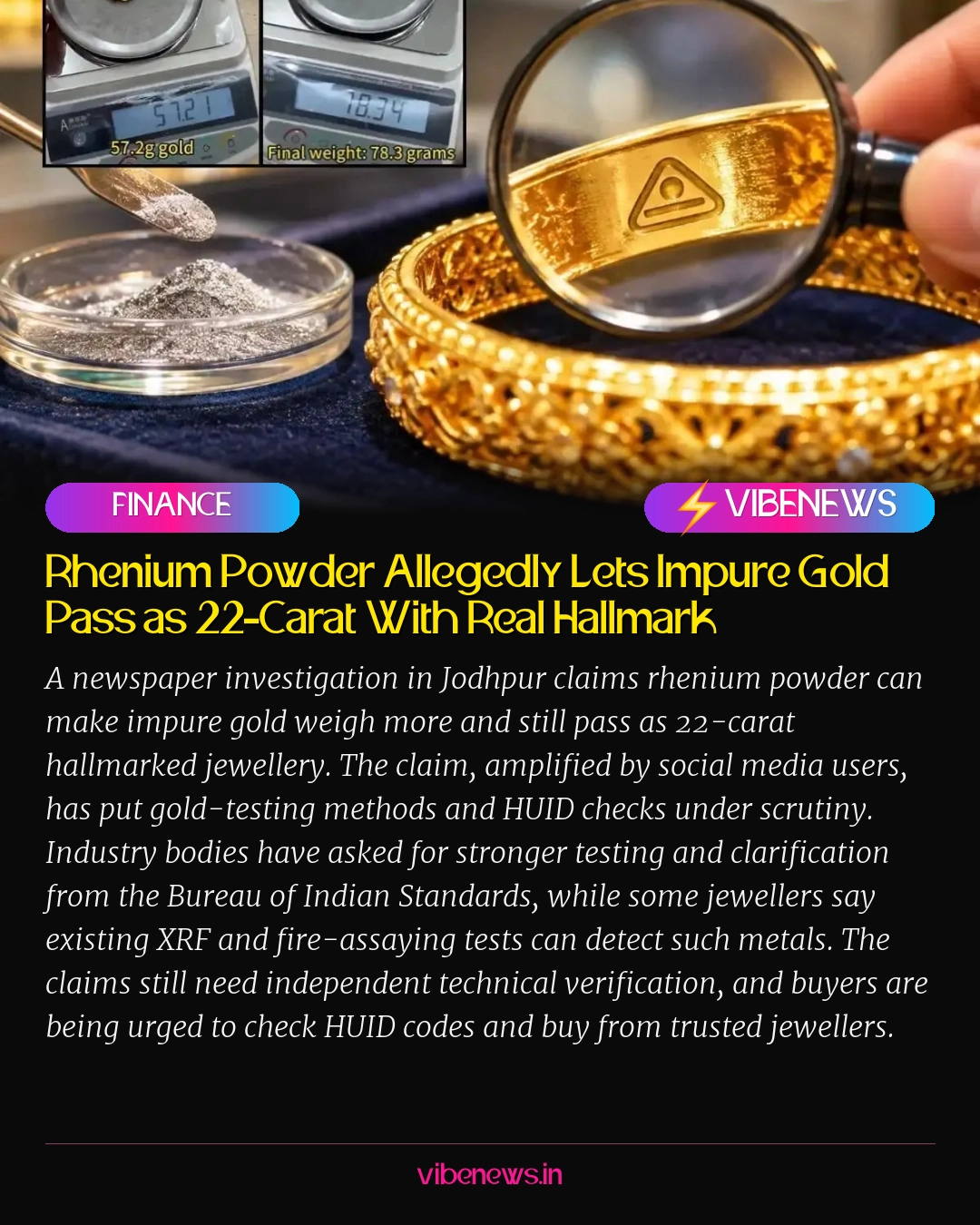
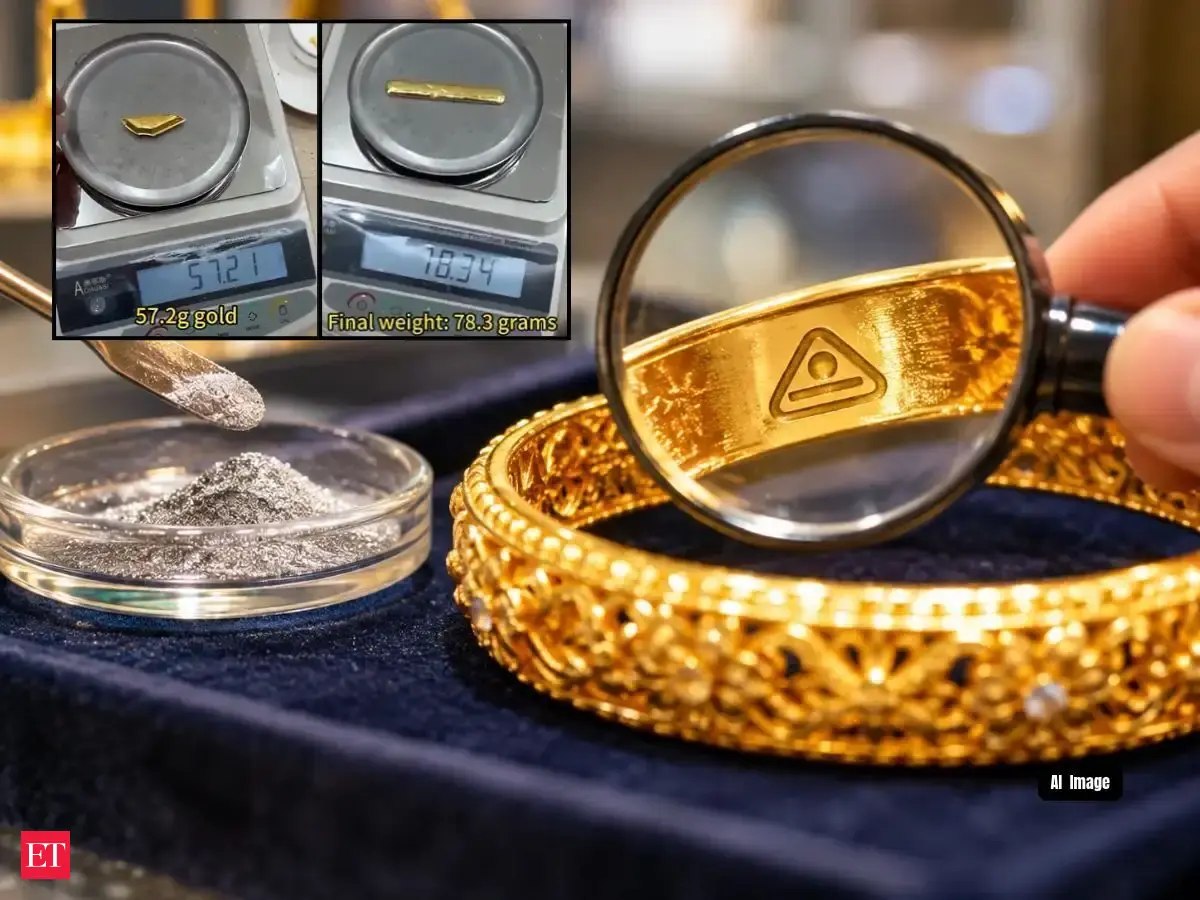
A newspaper investigation in Jodhpur has reported that a piece of jewellery carrying a 22-carat hallmark contained only around 81.7% actual gold, roughly 20-carat purity, after a metal powder was added during making. The claim has spread quickly on social media, where Vishal M Yadav and Sapna Singh have warned buyers about a substance Yadav calls ‘Mr India Powder’.
The metal at the centre of the claim is rhenium, a rare heavy metal used in jet engines and high-temperature components. It has a density of around 21 grams per cubic centimetre, compared with about 19.3 for pure gold. That gap is the basis of the alleged trick. A small amount of rhenium could add weight to an ornament without adding gold in proportion, letting a seller charge for more gold than the piece contains.
What the Jodhpur experiment found
The newspaper said it mixed 1 gram of rhenium with 7.83 grams of 24-carat gold and used the mixture to make an ornament. After more alloying material was added, the piece weighed 9.58 grams. It reportedly received a 22-carat hallmark and passed tests at several jewellery showrooms. The newspaper described this as a reported experiment, not proof that every hallmarking centre or testing machine can be fooled.
Questions over gold-testing machines
Most jewellery testers use X-ray fluorescence (XRF) technology to identify the elements in a metal and estimate its gold content. The results depend on the equipment, calibration and testing conditions. A reading taken from one surface area may not show the full composition of an ornament, which is why critics worry that an unusual metal mix could slip past routine checks.
The India Bullion and Jewellers Association (IBJA) has raised concerns about alleged malpractice in gold refining and hallmarking. It wants stronger testing procedures and surprise inspections of hallmarking centres. The Gem and Jewellery Export Promotion Council (GJEPC) has approached the Bureau of Indian Standards (BIS) for clarification on whether rhenium adulteration is possible and whether existing testing methods are adequate.
Industry pushback and a technical doubt
Not everyone in the trade accepts the claim. All Bullion and Jewellers Association president Yogesh Singla said adulteration with metals such as iridium, ruthenium and rhenium is not a new concern. He said hallmarking, XRF tests and fire-assaying systems can detect such impurities, and he questioned whether using these metals on a large scale makes commercial sense.
There is also a technical problem. Rhenium melts above 3,100 degrees Celsius, far higher than the 1,050 to 1,100 degrees Celsius typically used in jewellery manufacturing. That raises doubts about how the alleged mixing would work in practice. The source of the powder, how it is distributed and whether it can bypass testing all need independent technical verification.
What buyers should check before paying
Yadav has advised buyers to purchase from established and trusted jewellers and to check the six-character alphanumeric HUID code. Buyers can use the BIS Care app’s ‘Verify HUID’ feature to confirm that the details match the system. The guidance also asks buyers to check the BIS logo, purity mark and HUID, insist on a bill showing weight, purity and charges, and approach a BIS-recognised Assaying and Hallmarking Centre if they suspect adulteration.
A valid HUID helps verify hallmark-related details. It should not be treated as an independent guarantee that no unusual adulterant is present.
BIS guidelines also allow sampling through cutting, drilling or scraping during certain inspections. Such testing can give a more complete picture than a surface reading.
Key Facts
The Jodhpur experiment reportedly mixed 1 gram of rhenium with 7.83 grams of 24-carat gold.The resulting ornament weighed 9.58 grams and reportedly received a 22-carat hallmark.Rhenium has a density of around 21 g/cm3, versus about 19.3 g/cm3 for pure gold.Rhenium’s melting point exceeds 3,100 degrees Celsius, above typical jewellery-making temperatures of 1,050 to 1,100 degrees Celsius.Has the rhenium claim been proven?
No. The findings come from a reported experiment, and the sources say the claims need further independent technical verification.
Can a hallmark alone confirm that gold is pure?
Not on its own. A valid HUID helps verify hallmark details, but it is not an independent guarantee that no unusual adulterant is present.
TL;DR
- Newspaper investigation in Jodhpur claims rhenium powder can make impure gold weigh more and still carry a 22-carat hallmark.
- Experiment reportedly produced a 9.58-gram ornament with about 81.7% actual gold, roughly 20-carat purity.
- India Bullion and Jewellers Association wants stronger testing and surprise inspections of hallmarking centres.
- GJEPC has asked the Bureau of Indian Standards to clarify whether rhenium adulteration is possible.
- Industry leaders say XRF tests and fire-assaying can detect such metals, but the claims need independent verification.
- Buyers are advised to check the six-character HUID code using the BIS Care app.