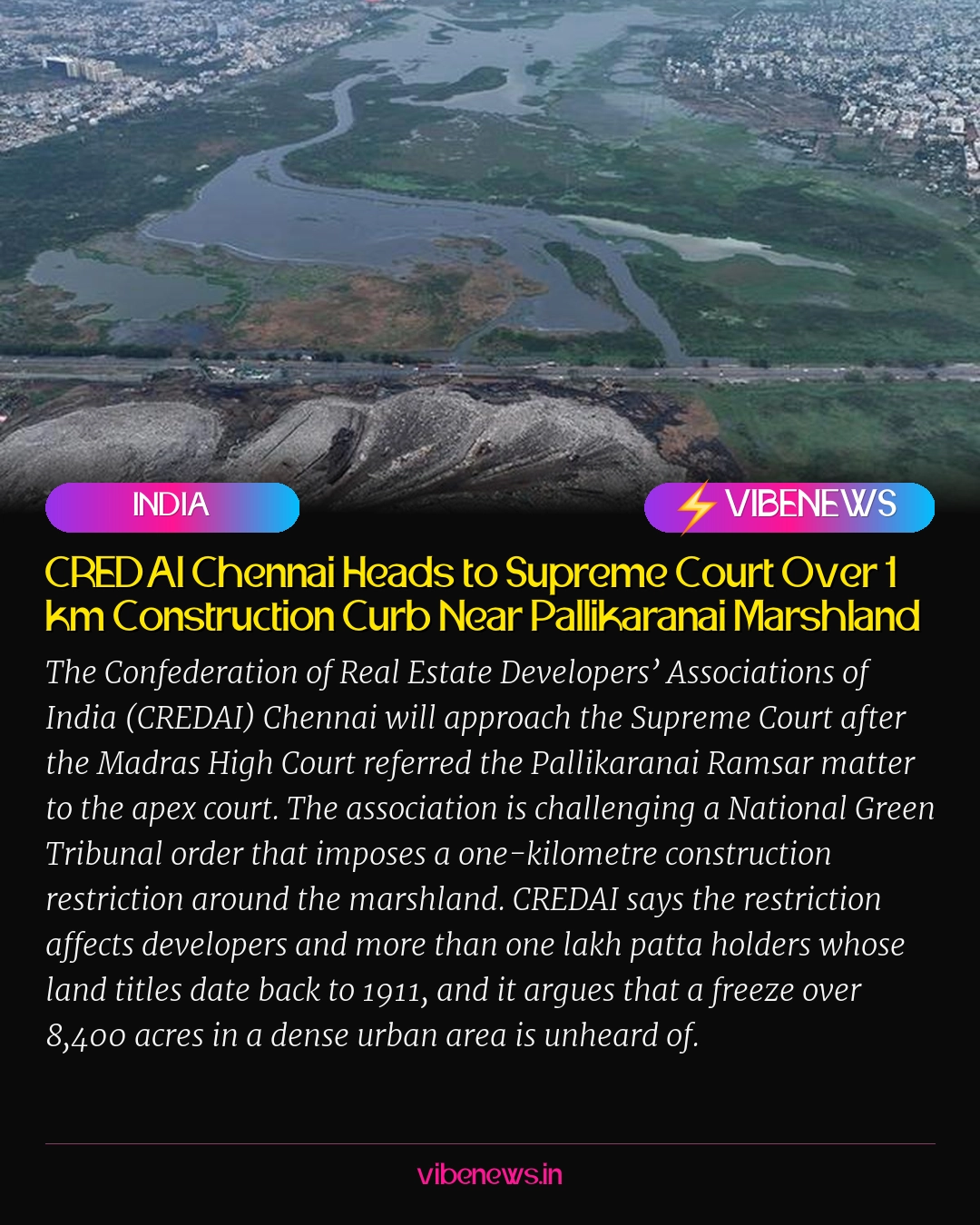
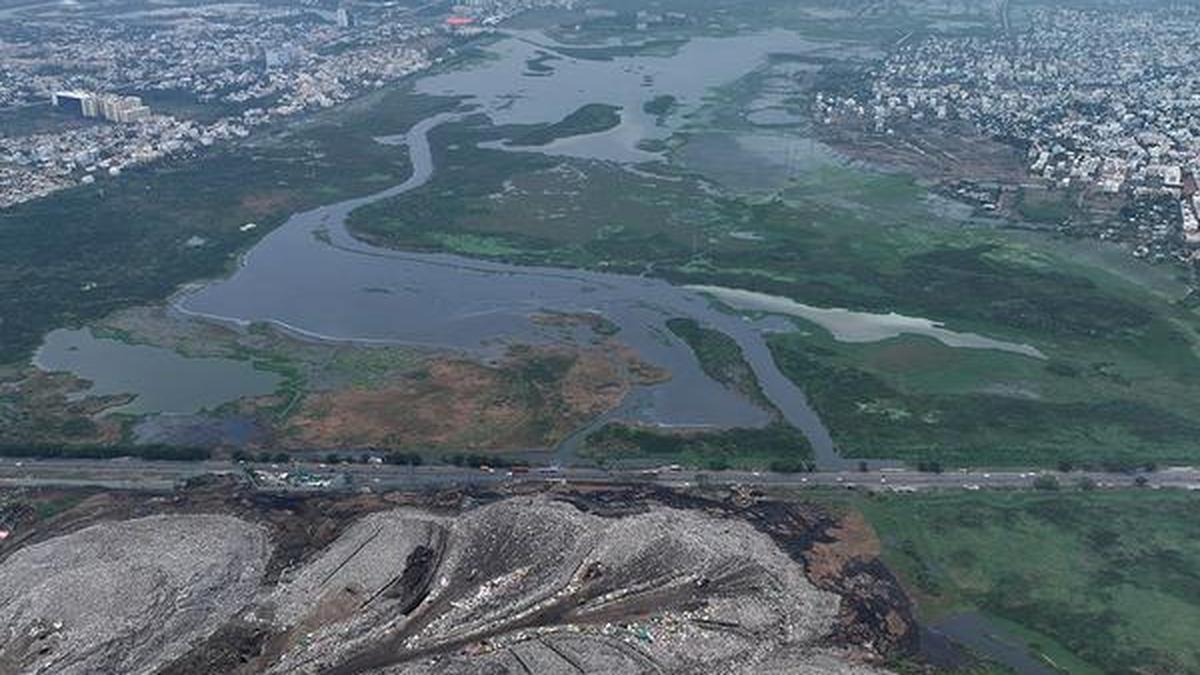
CREDAI Chennai says it will approach the Supreme Court after the Madras High Court referred the Pallikaranai Ramsar matter to the apex court, a decision the real estate body describes as a shock. The association wants relief from a National Green Tribunal order that imposes a one-kilometre construction restriction around the Pallikaranai marshland.
The restriction does not only hit developers. According to the association, it also affects more than one lakh patta holders whose land titles date back to as early as 1911, and CREDAI says the delay only prolongs their wait for justice.
Nine Months of Hearings End in a Referral
CREDAI said the court had heard the matter for over nine months before deciding to refer it, and that the association found the move difficult to comprehend. In its view, no new material was placed on record to justify the decision.
The association pointed out that when the petition was filed in February 2026, the court already knew that the exercise of identifying, demarcating and ground-truthing wetland boundaries across the country was being heard by the Supreme Court in WP(C) No.230 of 2001. CREDAI argues the petitioner could have been directed to seek relief from the Supreme Court during those initial hearings.
What the Wetland Authority Found
Following a direction from the court on September 7, 2026, the Wetland Authority re-examined the Zone of Influence. It considered hydrological connectivity, drainage pathways, satellite wetlands, land use and the wetland-urban interface. The interim Zone of Influence that emerged from that exercise identifies land parcels that could affect the hydrology of the Pallikaranai swamp area.
The authority has also proposed safeguards. There should be no blocking or obstruction of established inlet and outlet channels, natural drains or hydrological pathways. Untreated sewage or wastewater must not be discharged into water courses connected with the wetland.
The interim report came after a study carried out with technical agencies over two months, based on the High Court’s directions. According to CREDAI, the Tamil Nadu State Wetland Authority, known as TNSWA, has not reduced the Pallikaranai Swamp Ramsar site, which it says remains fully protected.
This kind of development freeze on a vast area of over 8,400 acres in a dense urban setting is unheard of.
That line, from CREDAI’s statement, sums up the association’s core complaint. It says the restriction covers a vast stretch of a dense city, and that the Zone of Influence regulation is about development under safeguards, not a ban on the swamp itself.
The Precedents CREDAI Is Citing
CREDAI said it had shown the High Court clear precedents for a 0 km Zone of Influence in dense urban areas. It cited Guindy National Park in Chennai, referenced in the Supreme Court case T.N. Godavarman Thirumulpad vs Union of India, and the East Kolkata wetlands, a Ramsar site.
The association says the High Court’s decision to send the matter to the Supreme Court came despite a detailed report based on a scientific study by a competent authority. That gap between the report and the referral is now the heart of its challenge.
Why the Outcome Matters for Chennai’s Growth
The case puts a hard question to the city. How far should a wetland’s influence reach into neighbourhoods that are already densely built? CREDAI’s answer is that the current limit is too wide. The Supreme Court will now decide whether the one-kilometre curb stands, and the answer will shape how land near the marshland can be developed.
Does the restriction stop development inside the Pallikaranai swamp itself?
According to CREDAI, citing the Wetland Authority’s findings, the Pallikaranai Swamp Ramsar site has not been reduced and continues to be fully protected. What is regulated is development within the Zone of Influence, subject to safeguards.
How large is the area affected by the freeze?
CREDAI describes the development freeze as covering over 8,400 acres in a dense urban setting.
TL;DR
- CREDAI Chennai will challenge the one-kilometre construction restriction around Pallikaranai marshland in the Supreme Court.
- The Madras High Court referred the Pallikaranai Ramsar matter to the apex court after more than nine months of hearings.
- The NGT order affects developers and over one lakh patta holders whose land titles date back to as early as 1911, CREDAI says.
- The Wetland Authority’s interim Zone of Influence proposes safeguards but does not reduce the Ramsar site.
- CREDAI says the development freeze covers over 8,400 acres in a dense urban setting, which it calls unheard of.