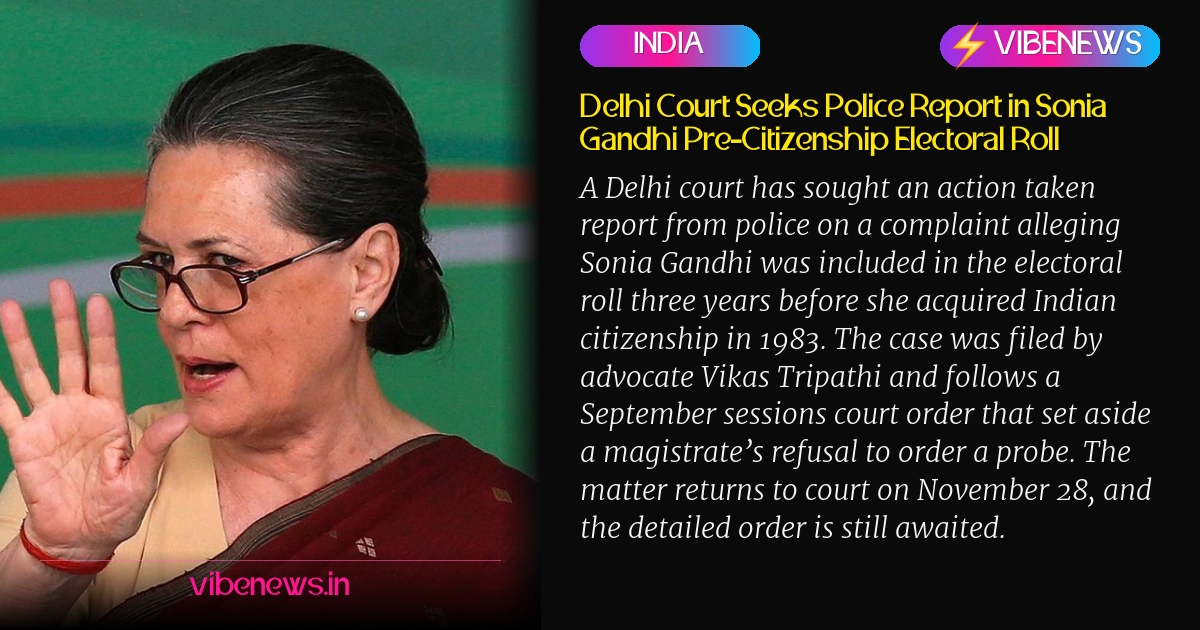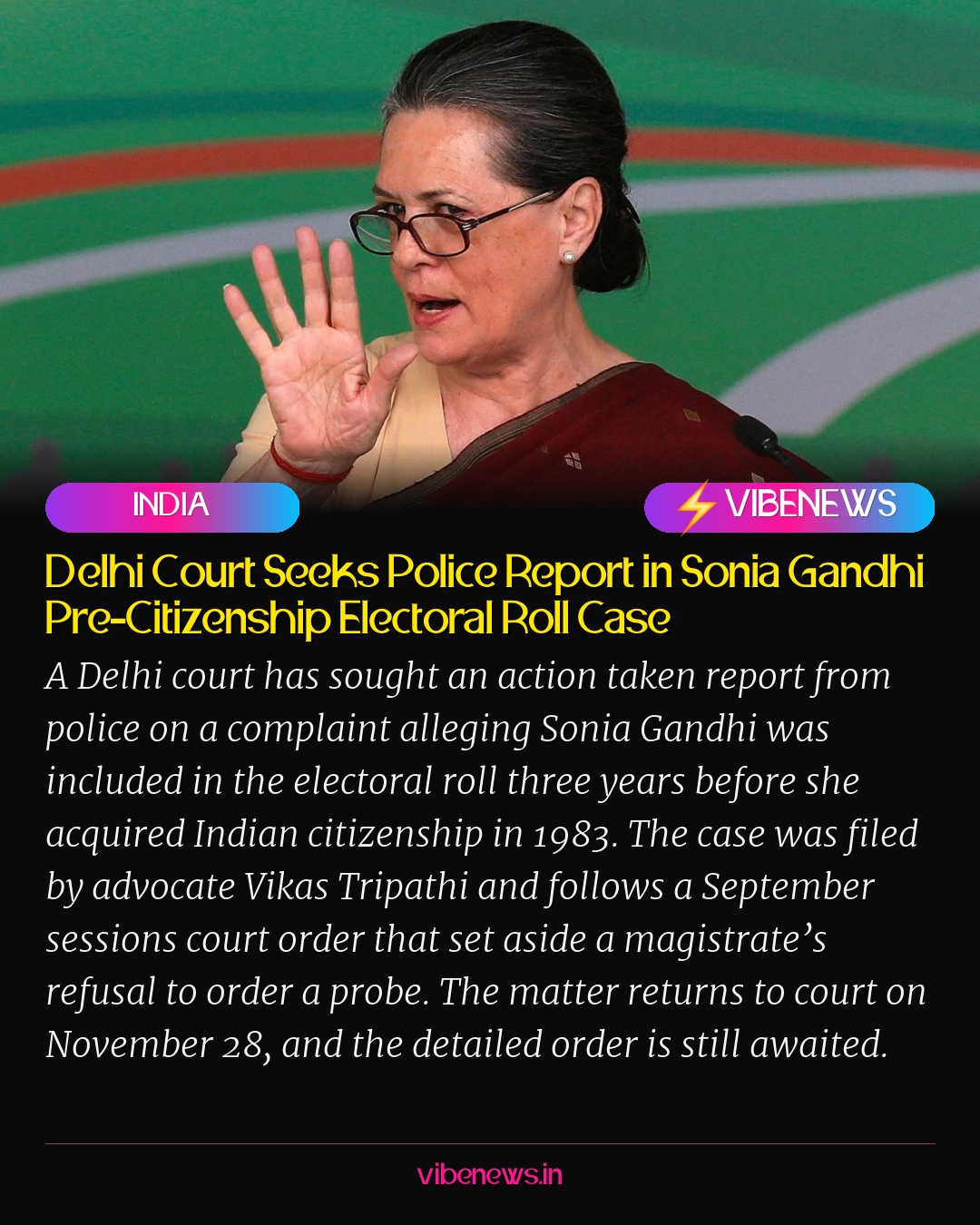
A Delhi court on Wednesday sought an action taken report from the police on a complaint alleging that senior Congress leader Sonia Gandhi was included in the electoral roll three years before she acquired Indian citizenship in 1983. The matter has been posted for further proceedings on November 28.
Additional Chief Judicial Magistrate Vinod Joshi passed the direction. He asked the police to file the action taken report and listed the case again for the end of the month. A detailed order is awaited, so the precise wording of the court’s reasoning is not yet available.
The complaint and the people behind it. The complaint was filed by advocate Vikas Tripathi, who serves as vice-president of the Central Delhi Court Bar Association at the Rouse Avenue court. Tripathi’s allegation rests on timing. It claims that Gandhi’s name appeared on the electoral roll before she had become an Indian citizen. The core allegation, as the complaint is described in the reporting, reads:
Sonia Gandhi was included in the electoral roll three years before acquiring Indian citizenship in 1983.
A September ruling that reopened the file. The case did not begin with Wednesday’s order. In September, a sessions court set aside a magistrate’s order that had refused to direct a probe into the allegations against Gandhi. That ruling came on a revision plea, a route that lets a higher court review a lower court’s decision. By setting the magistrate’s order aside, the sessions court effectively sent the complaint back into the process, and Wednesday’s direction is the first visible step that followed in the magistrate’s court.
What an action taken report actually does. An action taken report, usually shortened to ATR, is the document in which police tell a magistrate what steps they have taken on a complaint. It does not decide whether an allegation is true. Courts generally read it before choosing whether to order a formal inquiry, call for further material or allow the proceedings to move ahead. In this case, the magistrate has asked for the ATR and set the next hearing date, which suggests the court wants the police position on record before it decides its next move. The reporting does not say what the police have done so far, or whether any inquiry has already been opened.
Why the citizenship date carries weight. The complaint turns on a sequence of two events: an entry on an electoral roll, and later the acquisition of citizenship. Electoral rolls in India are meant to include only citizens, so a gap between the two dates is what gives the complaint its legal edge. That is the logic the complainant is putting before the court. Whether the dates and documents support that logic is a question the court has not answered, and it is not one that today’s order resolves.
What the reporting does not tell us. The available account does not include a response from Gandhi or from the Congress party. It also does not describe the documents or evidence the complainant relies on, and it does not say whether the police have examined the electoral roll record or the citizenship file. Those gaps matter. An allegation in a complaint is not a finding, and the court has made no ruling on the merits of the claim. It has only asked for the police’s account and kept the matter alive.
Why this case is drawing attention. Gandhi is among the most prominent figures in the Congress party, and a case touching on her citizenship or voter record will draw interest well beyond the courtroom. The story also has a procedural twist that makes it worth following. The case has already moved through a magistrate’s court, a sessions court and now back to the magistrate, each step deciding whether the complaint deserves further examination. Each stage has been about process rather than guilt, and that is likely to remain the case until the court takes a substantive view.
What happens next. The matter returns to court on November 28. By then, the police’s action taken report should be on the record, and the detailed order may explain why the magistrate chose to seek it. Depending on what the report says, the court could move toward a formal inquiry, ask for more material or consider whether the complaint can proceed. Until that happens, the allegation remains exactly what it is in this filing: a complaint, awaiting the response of the police and the court.
The bottom line for readers. A Delhi court has asked the police to explain what they have done on a complaint that questions the timing of Sonia Gandhi’s entry on the electoral roll and her Indian citizenship in 1983. The court has not ruled on the claim, the police have yet to file their report, and the next hearing on November 28 will show whether the case moves into a deeper inquiry.
TL;DR
- Delhi court sought an action taken report from police on a complaint against Sonia Gandhi.
- The complaint alleges she was included in the electoral roll three years before getting Indian citizenship in 1983.
- Advocate Vikas Tripathi, vice-president of the Central Delhi Court Bar Association, filed the complaint.
- In September, a sessions court set aside a magistrate’s order that had refused to order a probe.
- The matter is listed for further proceedings on November 28, and the detailed order is awaited.