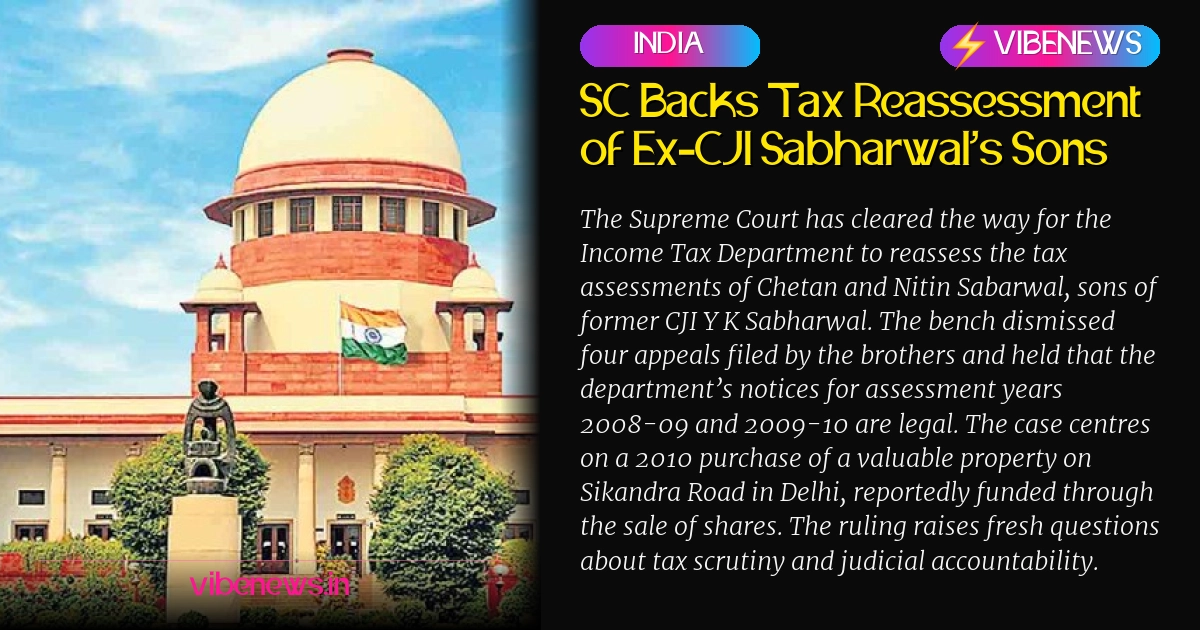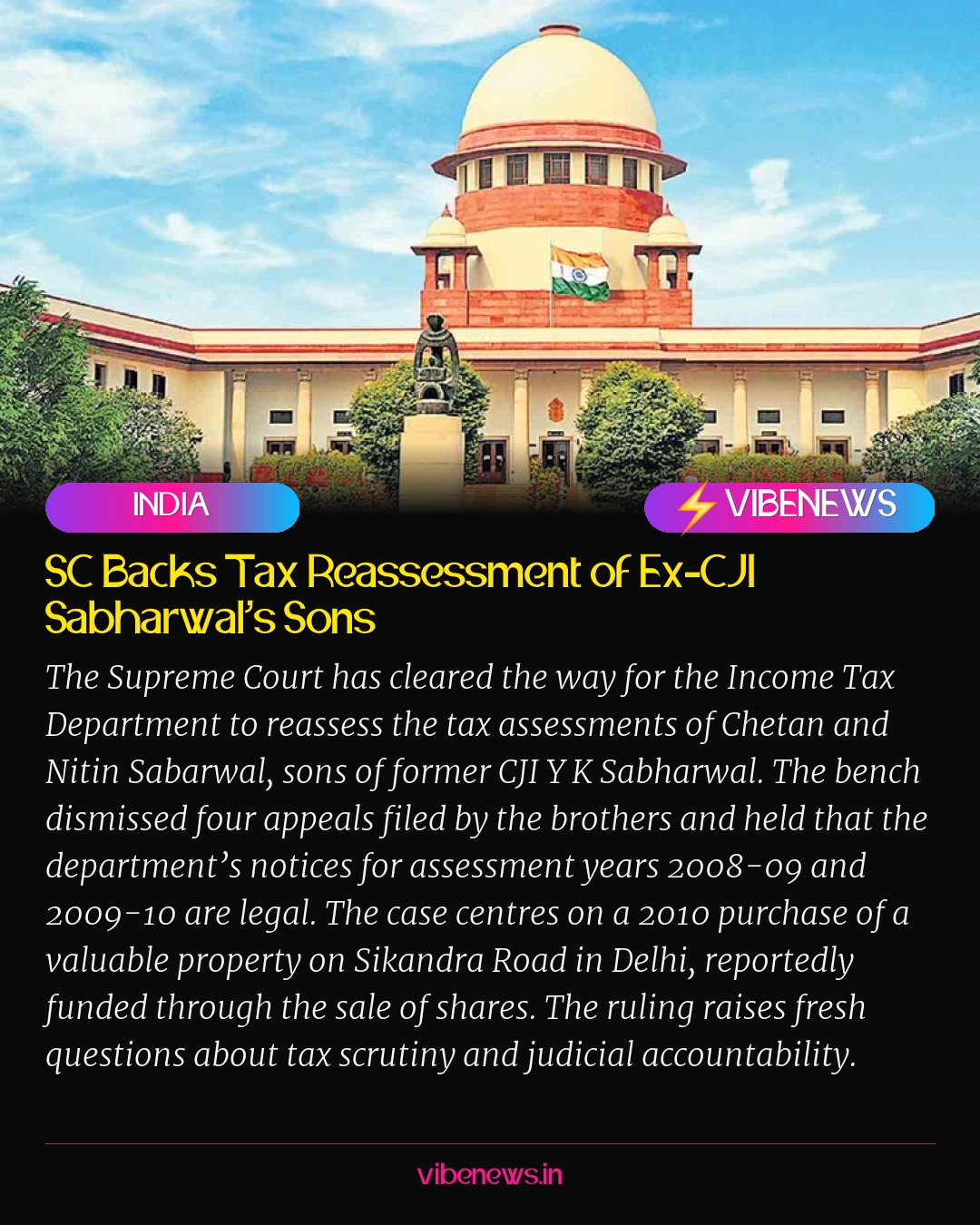
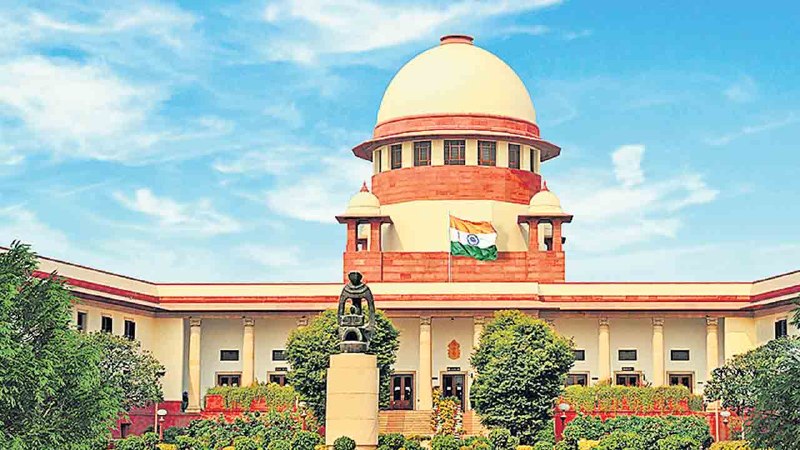
The Supreme Court has cleared the way for the Income Tax Department to reassess the income tax assessments of Chetan Sabarwal and Nitin Sabarwal, the sons of former Chief Justice of India Y K Sabharwal. The apex court upheld the department’s reassessment notices, rejecting appeals filed by the two brothers.
The dispute centres on a property purchase. According to the report, the brothers bought a valuable property on Sikandra Road in Delhi in 2010, using money generated from the sale of shares. The Income Tax Department examined that transaction and issued reassessment notices. The brothers challenged those notices, and the matter eventually reached the Supreme Court.
What the bench decided
A bench comprising Justice Pardiwala and Justice K Vinod Chandran heard the matter and dismissed four appeals filed by Chetan Sabarwal and Nitin Sabarwal. The judgment brings the litigation over the reassessment notices to a decisive point at the highest court in the country.
The income tax notices issued for the assessment years 2008-09 and 2009-10 are legal.
That finding is the core of the ruling. By holding the notices valid, the court has allowed the tax department to proceed with reviewing the brothers’ assessments for those two years. The ruling does not reflect any finding of wrongdoing beyond the reassessment process itself, and the report does not indicate what the department will do next.
Why reassessment matters
Reassessment is a legal mechanism that allows tax authorities to revisit an earlier assessment of a taxpayer’s income. When the department believes income was not properly assessed in a given year, it can issue a notice to reopen that assessment. Taxpayers can contest such notices, which is exactly what the Sabarwal brothers did, taking their challenge all the way to the top court.
The Supreme Court’s decision means the question of whether the notices were lawful is now settled. The remaining stage will focus on the substance of the assessments for the years 2008-09 and 2009-10. The report does not disclose the amounts involved or the specific income figures under review, so those details remain outside what is known from the available account.
A case that reaches beyond one family
The family connection is what makes the case stand out. Y K Sabharwal served as Chief Justice of India, the highest judicial office in the country. When a sitting or former judge’s family faces tax scrutiny, the matter draws attention well beyond the individuals involved. Readers want to know whether the same rules apply to everyone, and how the courts treat challenges to tax notices when the taxpayers have close ties to the judiciary.
The bench’s decision answers part of that question. The Supreme Court did not block the department’s notices. It declined to interfere with them and dismissed the appeals. The outcome signals that procedural challenges to reassessment notices face a high bar, at least in this case.
For tax lawyers and compliance officers, the ruling is a reminder that old transactions can return to the table years later. A property purchase made in 2010, funded through a share sale, became the trigger for reassessment proceedings covering years earlier still. That timeline matters for anyone who keeps records of asset purchases and the source of the funds used to make them.
The accountability question
Judicial accountability is a recurring theme whenever a senior legal figure’s relatives become the subject of official scrutiny. Critics and supporters alike tend to watch how institutions handle such cases. In this instance, the tax process has moved forward through the courts, and the Supreme Court has ruled on the legality of the notices. Whatever follows will be judged on the same standard of transparency that applies to any other taxpayer.
The report confirms the core facts: the Supreme Court dismissed four appeals, the bench of Justice Pardiwala and Justice K Vinod Chandran upheld the notices, and the assessment years in question are 2008-09 and 2009-10. The Delhi property, purchased in 2010 through share sale proceeds, sits at the centre of the matter.
The story is still developing in one important sense. The court has settled the validity of the notices, but the tax department’s reassessment of the brothers’ income for those years has yet to produce a final outcome in the material available. Readers should expect further developments as the department completes the process.
TL;DR
- The Supreme Court has upheld income tax reassessment notices against Chetan and Nitin Sabarwal, sons of former CJI Y K Sabharwal.
- The bench of Justice Pardiwala and Justice K Vinod Chandran dismissed four appeals filed by the brothers.
- The notices cover assessment years 2008-09 and 2009-10 and were declared legal by the court.
- The case stems from a 2010 purchase of a valuable property on Sikandra Road in Delhi.
- The property was reportedly bought using money from the sale of shares.
- The ruling clears the Income Tax Department to proceed with reassessing the two years.