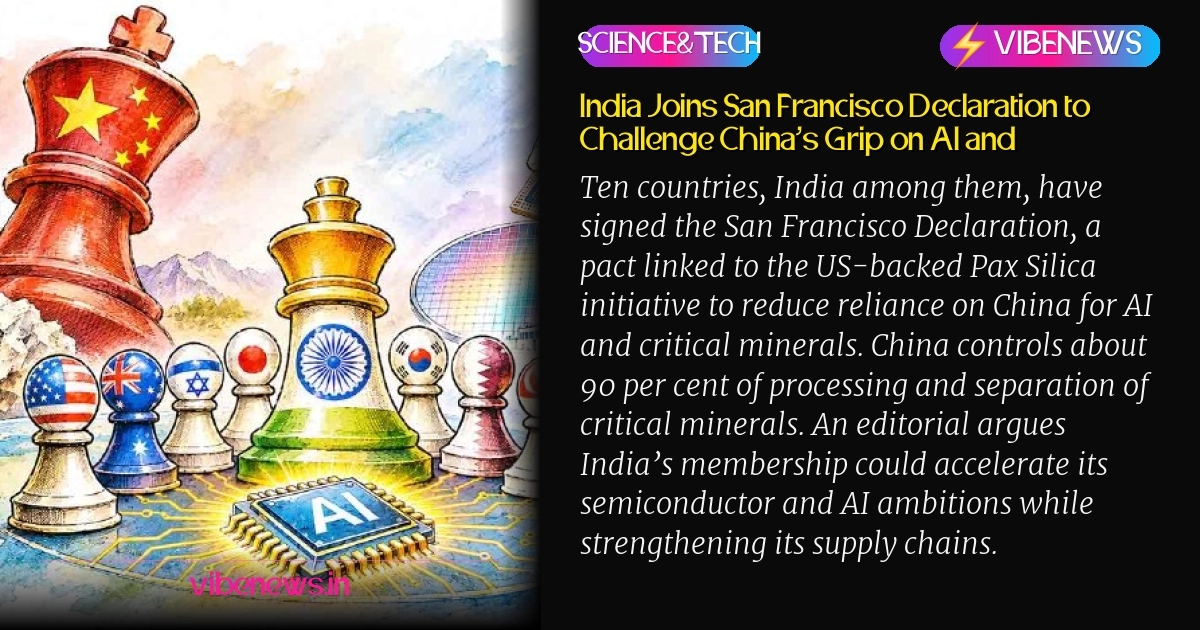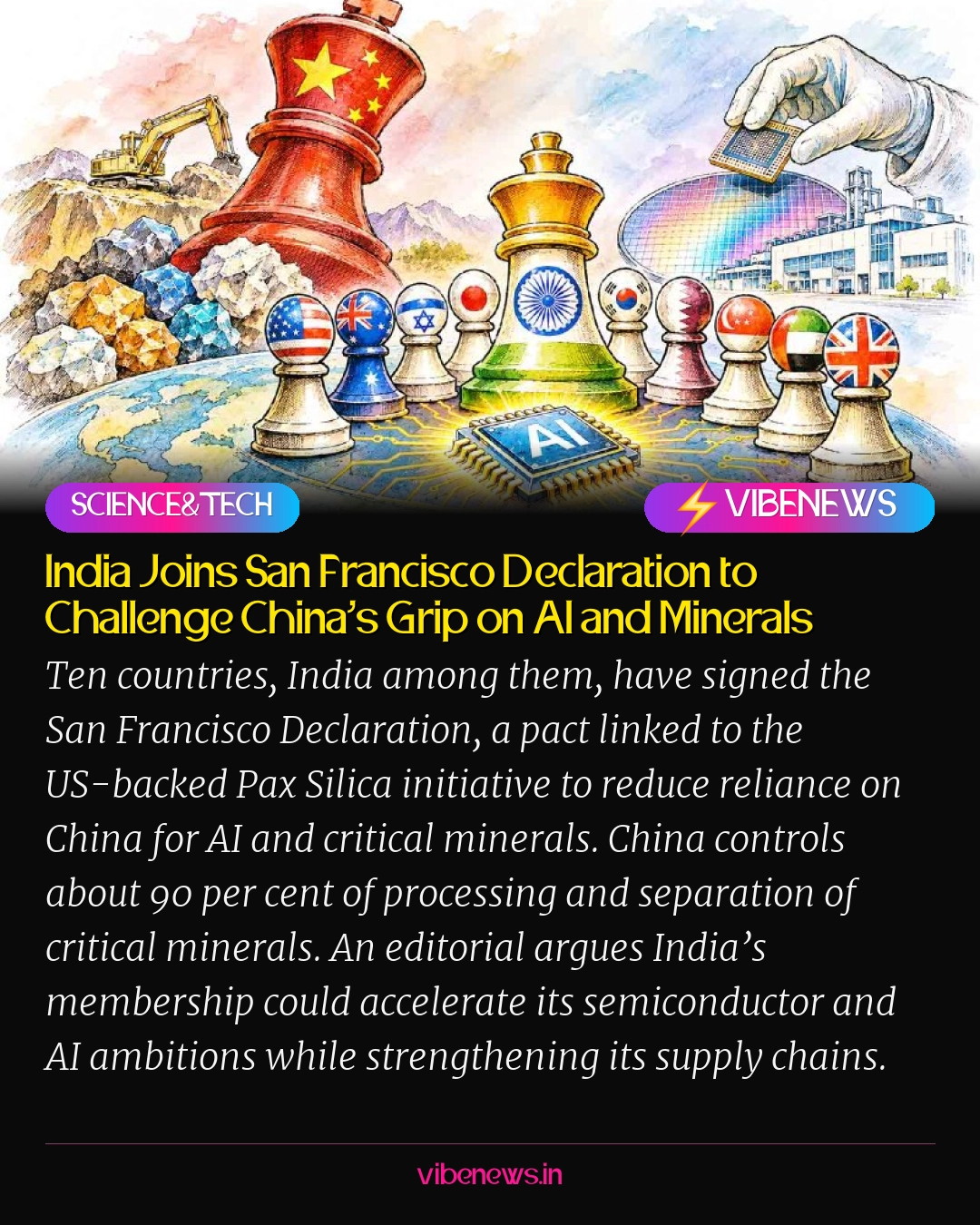
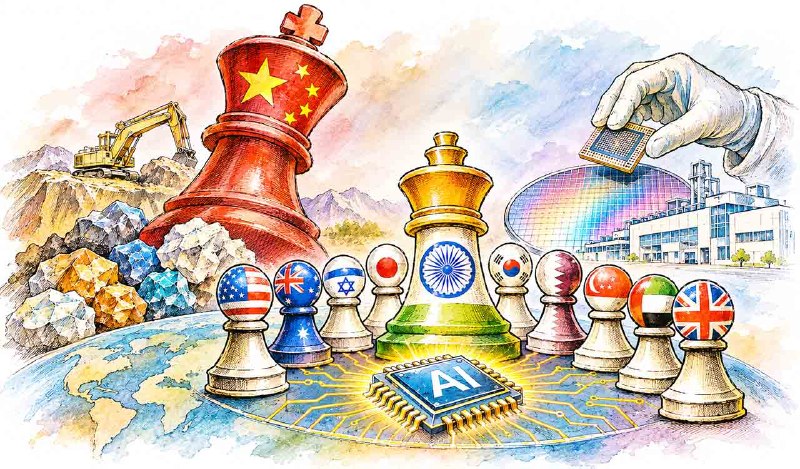
Ten countries, including India, have signed a multilateral agreement designed to stop any single nation from controlling the artificial intelligence ecosystem. The pact, called the San Francisco Declaration, is linked to a wider US-sponsored effort known as Pax Silica, and it targets the same problem: China’s outsized hold over the supply chains for critical minerals and AI.
The other signatories are the United States, Australia, Israel, Japan, South Korea, Qatar, Singapore, the UAE and the United Kingdom. The agreement’s formal title is the San Francisco Declaration on the Secure Foundations of Enduring Prosperity. Its central premise is simple. AI development spans many countries and industries, so no single country should be able to secure it alone, and partners need to coordinate their moves.
What the Declaration Sets Out
The declaration has four stated goals. It aims to reduce reliance on concentrated markets, counter economic and supply chain pressure from China, address non-market overcapacity, and keep hostile actors from acquiring sensitive technologies that could give them military or intelligence advantages.
The signatories have also agreed to share a list of high-priority technologies and critical infrastructure. The purpose is to guard against theft, illicit transfers and undue foreign control. That commitment matters because it moves the arrangement beyond statements of intent and into the work of identifying what needs protecting.
The editorial behind this story puts the core idea in one line that captures the logic of the pact:
no country can secure the AI ecosystem alone
There is also a growing consensus that economies should work together to de-risk critical technologies. The idea is to tie AI governance to resilient supply chains and long-term economic security partnerships, rather than treating them as separate issues.
Beijing’s Grip on Minerals
The numbers explain why Washington and its partners are moving now. According to the editorial, China accounts for around 60 per cent of global critical mineral mining, 90 per cent of processing and separation, and 94 per cent of permanent magnet manufacturing. Those are the stages where the real leverage sits, and they feed directly into electronics, batteries and defence hardware.
China’s control of exports adds another layer. Beijing has extended the temporary suspension of export controls on rare earth elements, lithium-ion batteries and graphite anode materials until January 10, 2027. Yet the editorial notes that China has also tightened its controls on rare earth exports, now requiring government clearance before minerals can be shipped abroad. In other words, the pause is temporary, and the approval process gives Beijing a lever it can pull.
The editorial says that dominance gives China considerable leverage in trade talks. It also argues the world has already seen supply chains used as weapons, which is why resilience has become a strategic priority rather than a business preference.
India’s Place in the Board
For India, the editorial argues that membership brings two things at once: opportunity and obligation. The inclusion signals that New Delhi is seen as an important participant in the global AI ecosystem, not simply a market that consumes technology built elsewhere. The editorial says this raises India’s standing among major technology and strategic powers in the Indo-Pacific.
The practical upside, the editorial suggests, is that joining Pax Silica could open doors for India to speed up its semiconductor and AI goals. The Pax Silica declaration covers cooperation across the full chain, from raw materials to semiconductors and AI infrastructure. India could benefit from stronger partnerships, diversified supply chains, investment and access to advanced technologies. Working with trusted partners could also reduce excessive dependence on any single country.
The editorial makes a central point about breaking what it calls China’s semiconductor chokehold. Building alternatives, it says, is essential to strengthening economic security. Whether India can build those alternatives quickly is a separate question, and the piece does not claim it can.
What Remains Unclear
The source material leaves several questions open. It does not say how the shared list of high-priority technologies will be compiled or enforced. It does not give a timeline for India’s semiconductor or AI milestones, and it does not describe any formal response from Beijing to the declaration.
The January 10, 2027 date is the nearest hard marker in the story. It is when China’s current suspension of export controls on rare earths, lithium-ion batteries and graphite anode materials runs out. Whether that deadline becomes a point of pressure, a bargaining chip or simply a date that passes quietly will shape how the San Francisco Declaration is tested in practice.
TL;DR
- Ten countries, including India, have signed the San Francisco Declaration on AI and supply chain security.
- The pact is linked to the US-sponsored Pax Silica initiative and aims to reduce reliance on China.
- China accounts for about 60% of mining, 90% of processing and separation, and 94% of permanent magnet manufacturing.
- China has extended its suspension of rare earth and battery material export controls until January 10, 2027.
- The editorial argues India’s membership raises its standing and could accelerate its semiconductor ambitions.
- Signatories will share lists of high-priority technologies to guard against theft and undue foreign control.