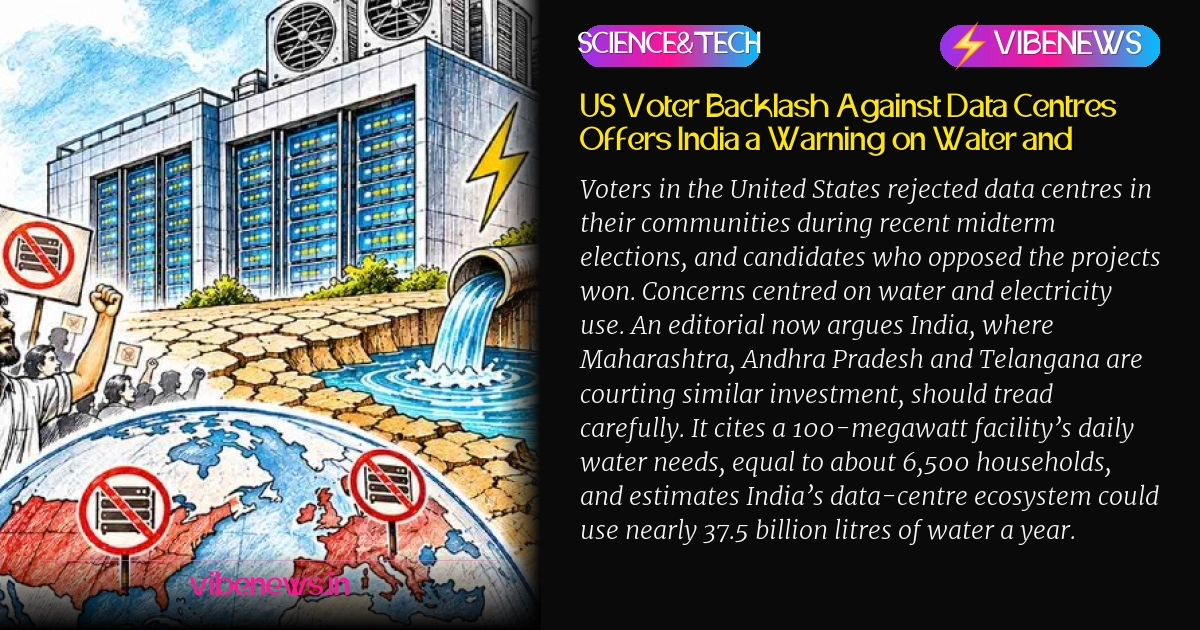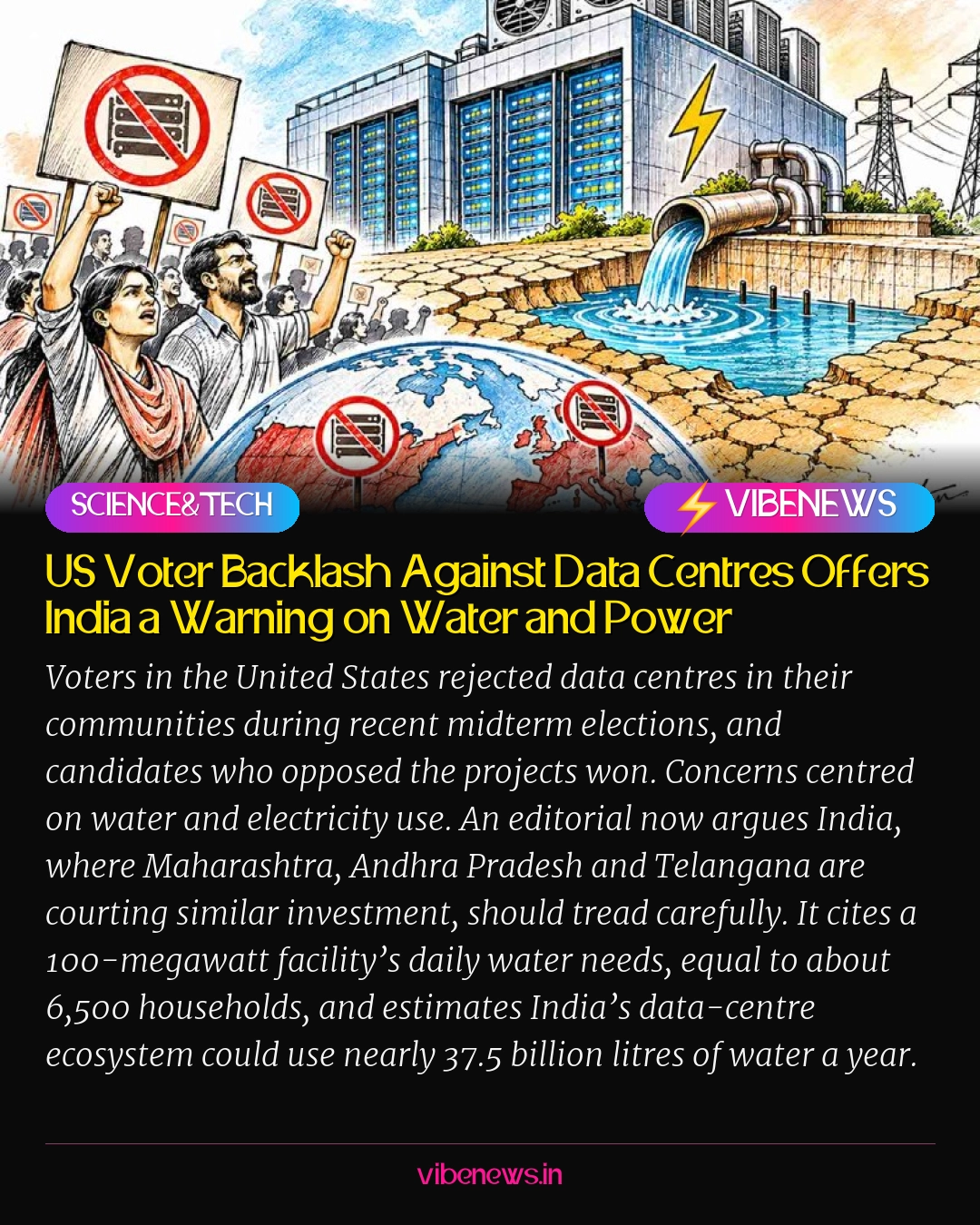
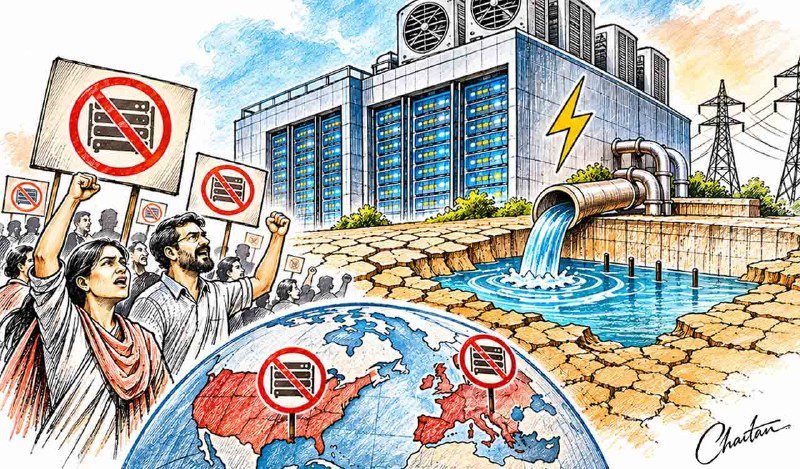
Voters in the United States pushed back hard against data centres in their local communities during the recent midterm elections, and candidates who campaigned against those projects won. The rejection was driven largely by environmental concerns, and it is now being read as a warning for India, where several states are racing to attract the same kind of investment.
The pattern is not confined to America. Several European countries have also seen growing opposition to data-centre projects. The core complaint is consistent across regions: these facilities are massive consumers of water and electricity, and residents living near them fear the strain on local resources.
In Texas, farmers have grown anxious about dwindling water supplies, and that anxiety has turned into a significant political issue. Similar resistance across several American states shows that residents increasingly want a say in decisions that directly shape their daily lives. People are no longer willing to watch from the sidelines while a project reshapes their water and power supply.
The boom itself is driven by the artificial intelligence race, and the economic upside is real. The editorial does not dispute that. Its argument is that the opposition emerging in developed economies carries a plain lesson. Technological progress should not come at the expense of communities or the environment.
Technological progress should not come at the expense of communities or the environment.
India now faces a paradox. The push to rapidly expand data-centre capacity for AI and cloud computing is colliding with the need to protect the environment. Ambitious investment drives, including major data-centre proposals, could strengthen digital infrastructure and create jobs. But those gains come with a cost that has to be managed rather than ignored.
For Andhra Pradesh and Telangana, that tension is not abstract. Both states are named alongside Maharashtra as sitting at a critical crossroads. Their investment pitches promise digital infrastructure and employment, yet the same states will have to answer for how much water and power these facilities draw. The editorial’s message to them is to pursue the technology industry without letting local resources and ecosystems become the price of admission.
The scale of the water question is what makes the argument hard to dismiss. According to the editorial, the daily water requirement of a 100-megawatt data centre is equal to the needs of roughly 6,500 households. Extending that logic to the whole country, India’s growing data-centre ecosystem could consume nearly 37.5 billion litres of water annually. That is equivalent to the yearly needs of around 7 to 8 lakh people, based on urban consumption norms prescribed by the Central Public Health and Environmental Engineering Organisation.
Those numbers land in places already short on water. As major technology companies race to expand data-centre capacity to support AI, their resource consumption is climbing. The editorial points out that this growth is worsening the challenges faced by communities that are already grappling with water scarcity. A new facility does not arrive in an empty region. It arrives in a place where people are already competing for every litre.
The editorial places much of the responsibility on companies. It says firms must prioritise responsible resource-management practices and should invest in energy-efficient technologies, renewable power, sustainable cooling systems and, wherever feasible, zero-water technologies. Those are not optional extras in the editorial’s framing. They are the baseline for projects that expect to win approval in communities that have learned to ask hard questions.
The editorial also places responsibility on governments and approval processes. Residents, it says, must be given clear information about resource consumption, environmental impacts and economic benefits before projects receive approval. Communities should be treated as stakeholders in development rather than passive observers. That is a higher bar than many local projects have faced so far, and the editorial suggests it is the bar India needs to set now, before the expansion gathers speed.
The editorial’s closing argument is about how success gets measured. Data centres can power India’s digital future, it says, but the scorecard should not stop at investment figures and computing capacity. It should also count the jobs created, the resources conserved and the communities empowered. Progress, in the editorial’s words, must benefit everyone, not just technology giants.
TL;DR
- US voters rejected data centres in their communities over environmental concerns during the recent midterm elections, and anti-project candidates won.
- Similar opposition is growing in several European countries, with concerns focused on water and electricity use.
- A 100-megawatt data centre’s daily water requirement equals the needs of about 6,500 households.
- India’s data-centre ecosystem could consume nearly 37.5 billion litres of water a year, based on urban consumption norms.
- Maharashtra, Andhra Pradesh and Telangana are at a crossroads between investment and protecting local resources.