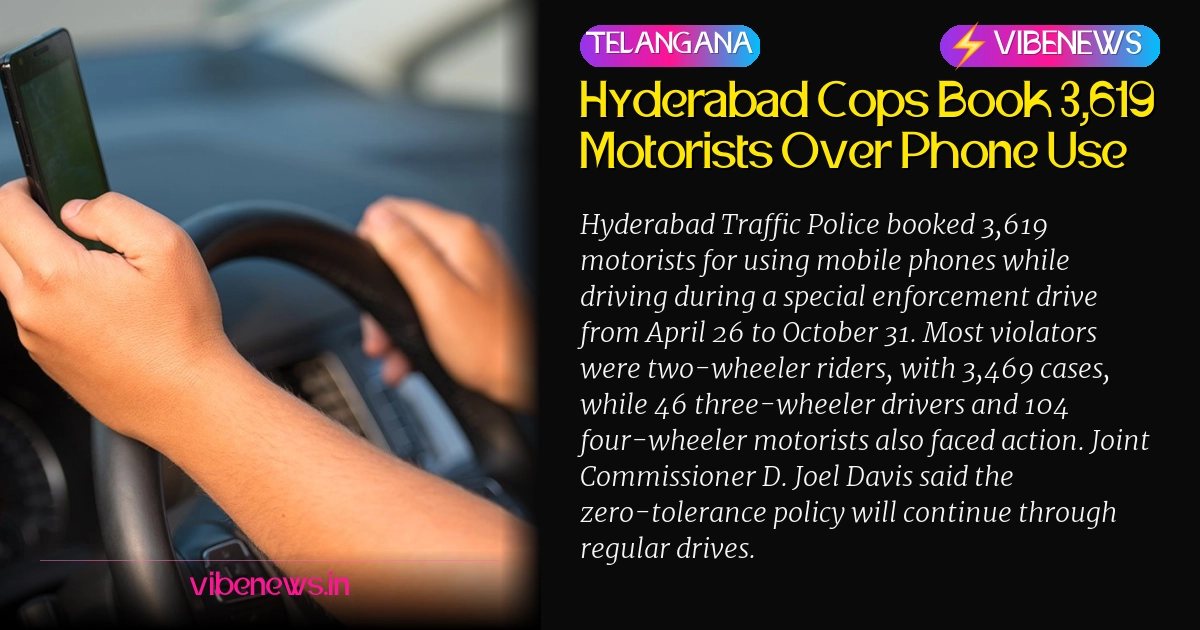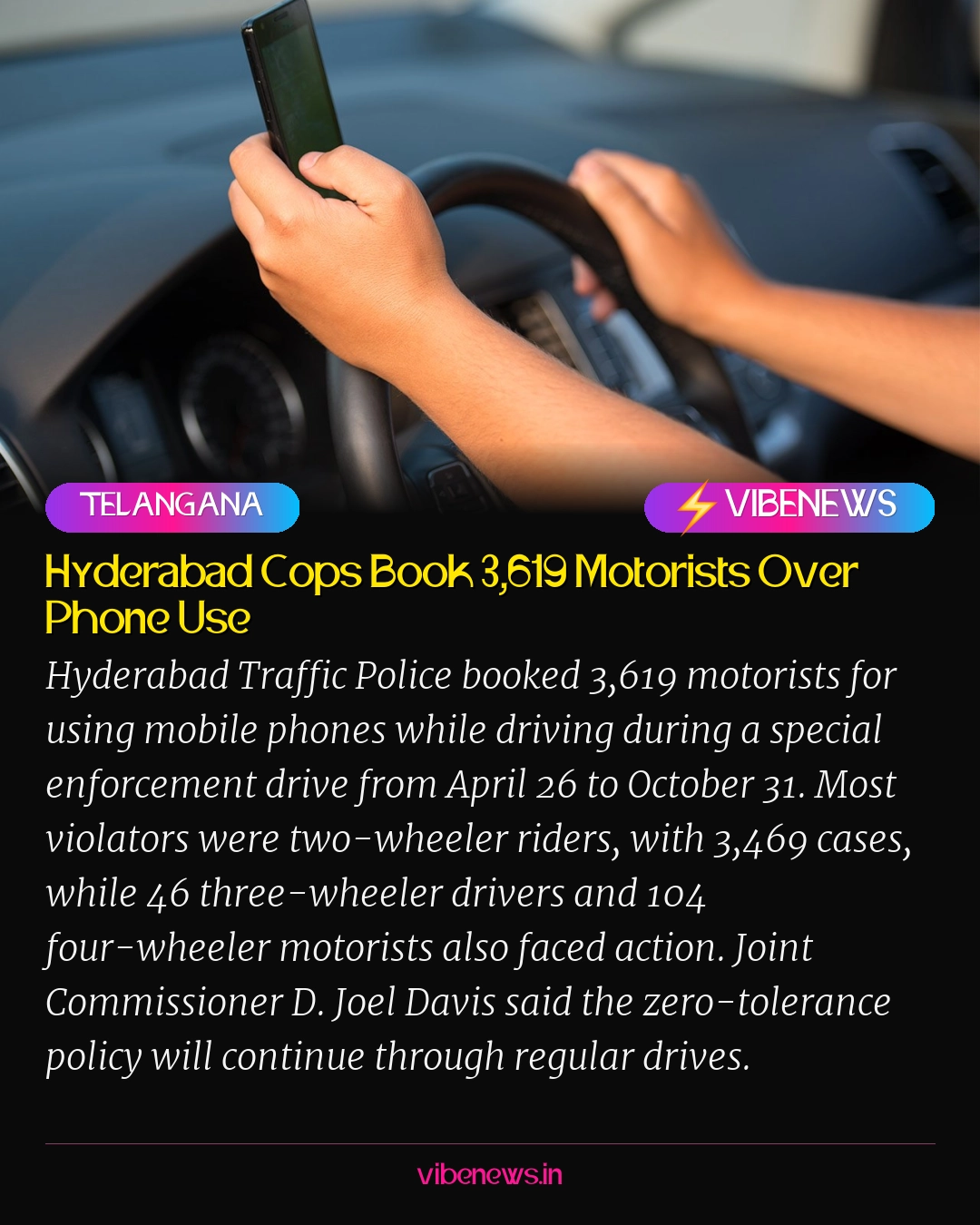
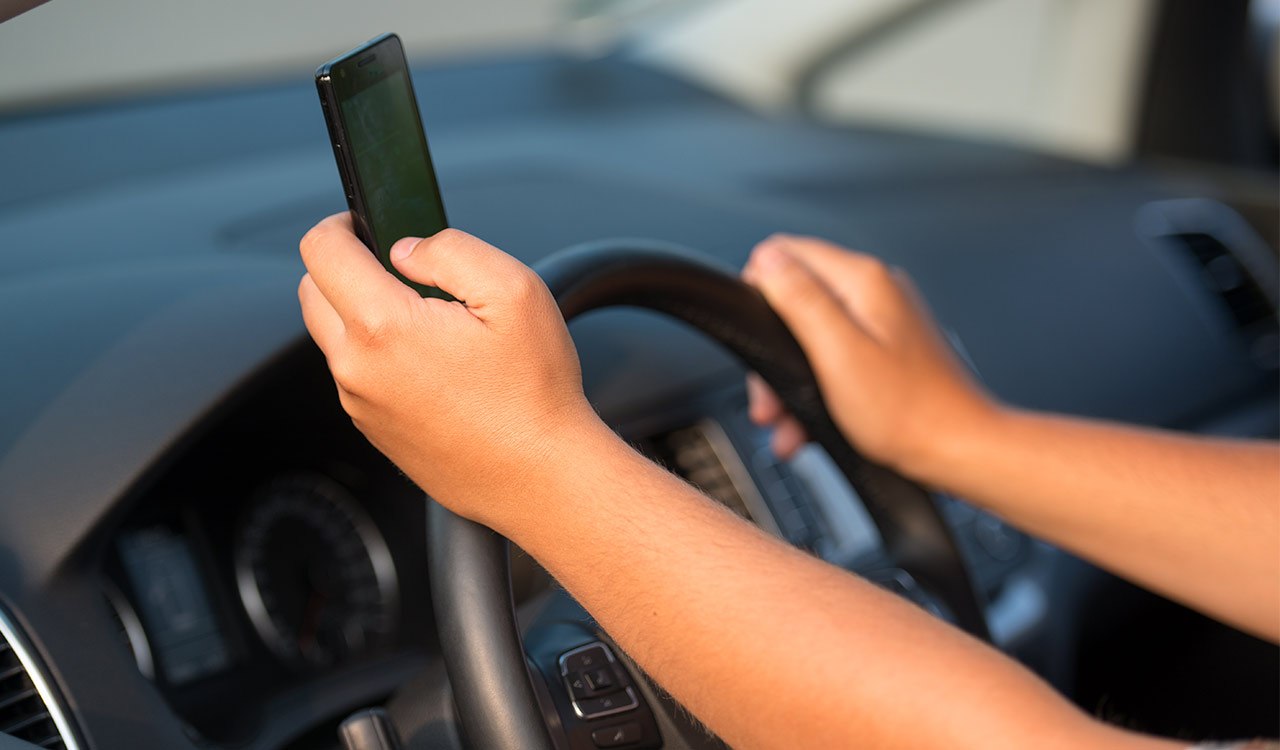
The Hyderabad Traffic Police have booked 3,619 motorists for using mobile phones while driving, after a special enforcement drive that ran from April 26 to October 31. Every one of those violators will be produced before a court along with charge sheets and penalised as per law, officials said.
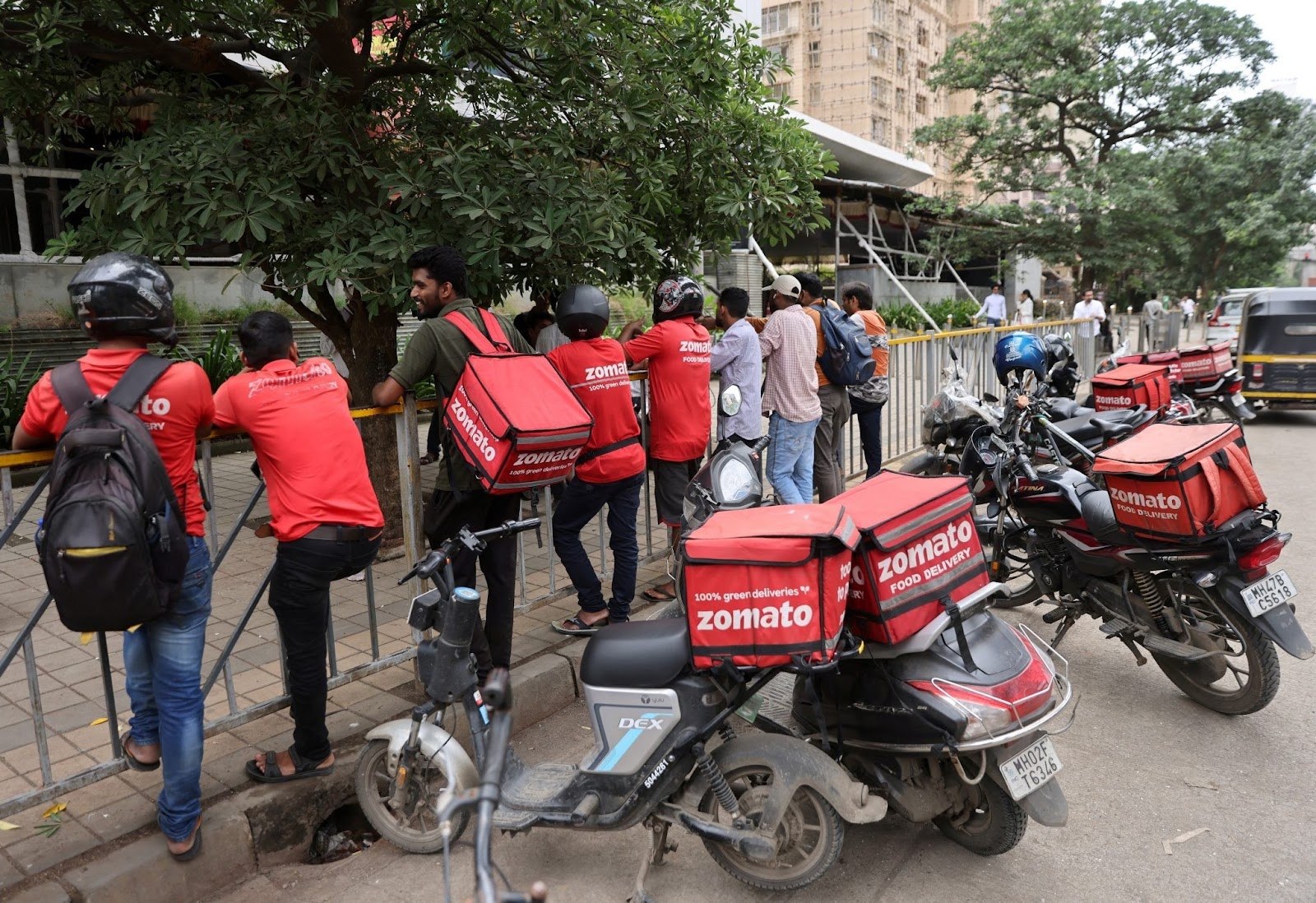
The numbers are not subtle. In a city where two-wheelers crowd every signal, the bulk of the cases came from people on bikes and scooters. Of the 3,619 motorists booked, 3,469 were two-wheeler riders. Another 46 were three-wheeler drivers and 104 were four-wheeler motorists.
Who got caught
The overwhelming majority of the cases involved two-wheeler riders. That single detail says a lot about how the drive played out on the ground. A rider holding a phone to an ear or thumbing a screen at a red light has very little margin for error, and the police statement makes clear that this was the category they focused on most.
Three-wheeler drivers and four-wheeler motorists made up a much smaller share of the total, with 46 and 104 cases respectively. The breakdown shows that the drive was not limited to one type of vehicle, even if two-wheelers dominated the tally.
Why police are pushing this hard
The department did not dress up its reasoning. Traffic police said using mobile phones while driving causes distraction, slows reaction time and increases the risk of road accidents. Those three effects compound each other. A driver who looks away for a few seconds at a screen loses track of the road, reacts later to a sudden brake light or a pedestrian stepping off a curb, and gives a crash less room to be avoided.
That logic sits at the heart of the crackdown. Phones are not a minor distraction in the eyes of the force. They are treated as a direct threat to every person on the road, from the rider beside you to the child walking to school.
Joint Commissioner of Police (Traffic) D. Joel Davis said the traffic police follow a zero-tolerance policy towards mobile phone usage while driving.
Davis also said the department will continue special enforcement drives regularly. That is a signal, not a one-off. The force is telling motorists that the April to October drive is not a closed chapter, and that more checks are coming.
What happens next for violators
According to the police statement, every violator will be produced before the court along with charge sheets. That moves the matter beyond a roadside ticket and into the formal legal process. Officials said the violators will be penalised as per law.
The report does not spell out the specific penalty amounts for each category of violator, and it does not describe how the court process will unfold for individual cases. Anyone booked will want to understand exactly what the law requires in their own situation, and that detail is not in the official account.
Hyderabad’s stake
This is a Telangana story, and it lands squarely in the state capital. Hyderabad’s roads carry heavy two-wheeler traffic, and the city’s traffic police are the ones writing the challans and filing the charge sheets. A figure of 3,619 bookings in a little over six months gives a clear picture of how often the rule was being broken on city streets during that stretch.
For residents, the message is simple. The enforcement is active, the penalties are formal, and the police have made clear they intend to keep going. Anyone who keeps a phone in hand while riding or driving in the city is now in the crosshairs of a drive that has already produced thousands of cases.
The commuter’s dilemma
For the daily commuter, the news is unsettling. Many people reach for a phone out of habit, whether to check a map, answer a call from work or glance at a message. The drive shows that those habits carry real consequences. A motorist who assumed a quick glance was harmless now faces a court appearance.
The panic is understandable. When a crackdown of this size is announced, the first reaction for many people is to wonder whether they have been caught without knowing it, or whether the next check will be at their own junction. That uncertainty is exactly what enforcement drives are designed to create, and the police have made no secret of wanting it.
What the numbers leave out
The official statement is precise about the bookings but silent on several points that readers will want answered. It does not say how many accidents were linked to phone use during the drive period. It does not compare the figures with earlier years. It does not provide the number of violators who were stopped at checkpoints versus those caught through other means.
Those gaps matter. A count of 3,619 cases tells you how much enforcement happened. It does not, on its own, tell you how much danger was prevented. The police argument rests on the claim that phone use increases the risk of accidents, and the logic is widely understood. But the statement offers no local crash data to show how that risk played out on Hyderabad’s roads during these months.
The bottom line for motorists
The Hyderabad Traffic Police have made their position unmistakable. Phone use while driving is treated as a zero-tolerance offence, the violators are headed to court, and the drives will keep coming. For anyone who has been treating the phone as a small exception on the road, the message from this enforcement push is that the exception no longer exists.
Joint Commissioner D. Joel Davis asked motorists to strictly follow traffic rules and avoid using mobile phones while driving to ensure the safety of all road users. That request is now backed by thousands of cases and a promise that the next drive is already on the way.
TL;DR
- Hyderabad Traffic Police booked 3,619 motorists for phone use while driving between April 26 and October 31.
- Of those booked, 3,469 were two-wheeler riders, 46 were three-wheeler drivers and 104 were four-wheeler motorists.
- All violators will be produced before court with charge sheets and penalised as per law, officials said.
- Traffic police say phone use causes distraction, slows reaction time and increases the risk of road accidents.
- Joint Commissioner D. Joel Davis said the zero-tolerance policy will continue through regular special drives.