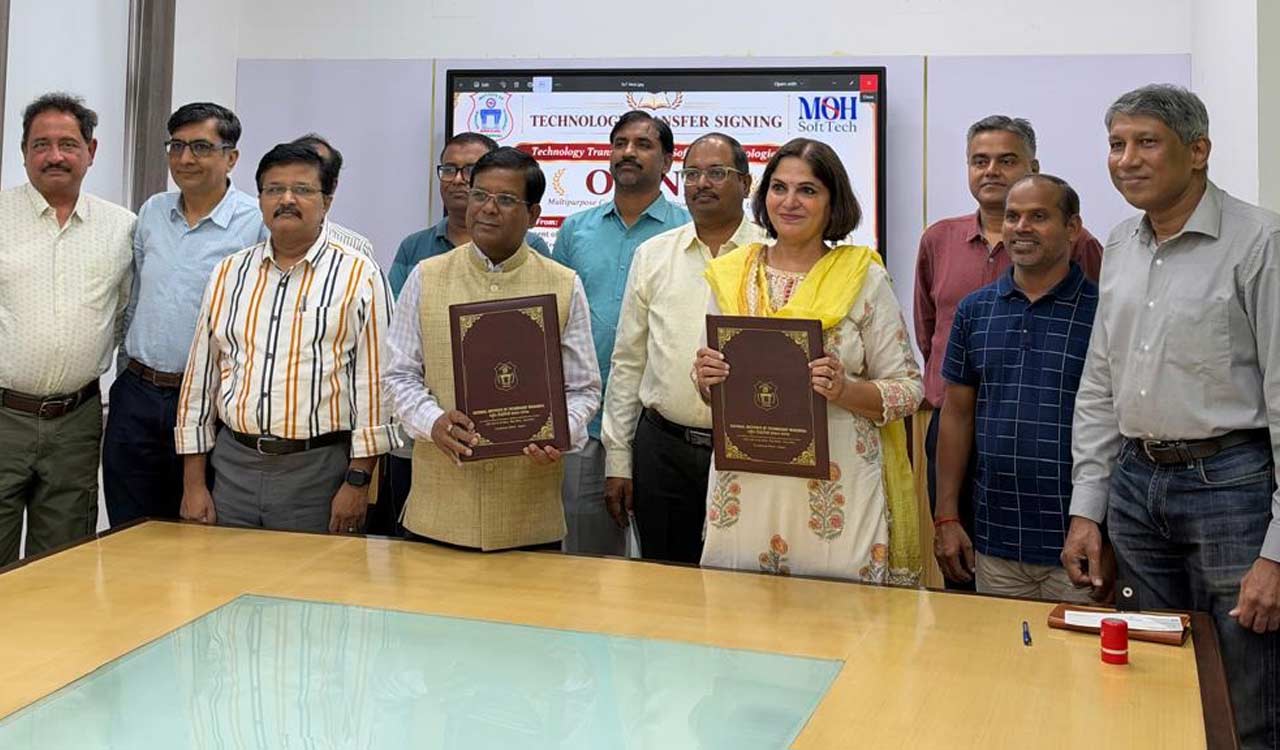
NIT Warangal has signed a technology transfer agreement with MOHSoft Tech Private Limited to commercialise an indigenous ozone-based disinfection technology developed by researchers from its department of physics. The institute announced the deal in a release on Thursday, and the stated goal is clear: move the technology out of the lab and into large-scale manufacturing and deployment.
The central claim is a striking one. The system harnesses the natural oxidising properties of ozone to eliminate up to 99.9 per cent of viruses, bacteria and other pathogens. The release is careful to add a qualifier, though. That figure holds under specified operating conditions, not in every setting.
What sets ozone apart from conventional disinfectants
Most disinfectants leave a chemical footprint that someone has to manage afterward. The NIT Warangal release points to a different outcome. Unlike conventional chemical disinfectants, ozone decomposes into oxygen after use.
That single difference is why the technology is being framed as more than a lab curiosity. A disinfection method that breaks down into oxygen speaks to the sustainability goal the inventors themselves describe. They say the work was aimed at producing an effective, sustainable and indigenous disinfection solution, and the ozone chemistry is central to that pitch.
From a physics lab to a production line
The commercial path is now mapped out. According to the release, commercial production of the first batch of industrial ozone disinfection systems is expected to begin early next year. Pilot deployments are expected to follow.
The sequence matters. Industrial output comes first, then real-world pilots that test the system outside the institute. The release does not say where those pilots will take place, so that detail remains open.
MOHSoft Tech’s Chief Strategy Officer and co-founder Shyam Mamidi, who is an alumnus of NITW, provided the production timeline. His connection to the institute is a reminder that the partnership is rooted in the campus community as well as in industry.
The people behind the research
The technology was developed by Prof. D. Harnath and Prof. R. Rakesh, who described it as the outcome of their research to harness the unique properties of ozone. The inventors framed their goal as building a disinfection solution that is effective, sustainable and indigenous. That combination of local origin and practical purpose is what the partnership is meant to carry forward.
NIT Warangal Director Prof. Bidyadhar Subudhi put the institutional goal in plain terms. Translating research outcomes into technologies that address real-world challenges, he said, is an important part of the institute’s vision.
Translating research outcomes into technologies that address real-world challenges was an important part of institutes’ vision.
Subudhi added that the collaboration would take an indigenously developed technology beyond the laboratory and open opportunities for its wider adoption across sectors. That phrase suggests the target is not one niche market. The company and institute have framed the work as applicable across diverse uses.
MOHSoft Tech CEO and co-founder Subha Chaganty said the company was pleased to partner with NITW. The idea, as she put it, is that combining the institute’s research expertise with the company’s engineering and industry capabilities would produce efficient disinfection solutions for diverse applications.
Why this matters for Telangana
This is a Telangana story in the most direct sense. NIT Warangal is based in Warangal, and the technology was developed by researchers from its physics department. A homegrown disinfection system moving toward commercial production from a state institute is a development that stays close to home for the region’s students, researchers and industry partners.
The institute’s own alumni are part of the story too. Mamidi’s involvement shows how a campus can feed into companies that take research to market. For a state that is watching its academic institutions turn ideas into products, this partnership offers a concrete example to point to.
What the release does not say yet
The announcement leaves several questions open. The release does not disclose the commercial terms of the technology transfer agreement. It does not give a price for the systems, a production capacity for the first batch, or the locations for pilot deployments.
It also does not spell out the specified operating conditions behind the 99.9 per cent figure. That is the detail buyers and regulators will want most, and it is the one most likely to shape how the technology is adopted. Until those specifics are published, the headline number should be read with its conditions attached.
What is clear is the timeline and the intent. An indigenous ozone-based disinfection system, developed at a national institute in Telangana, is moving toward factories and field trials. The next checkpoint is early next year, when the first industrial batch is expected to roll out.
TL;DR
- NIT Warangal signed a technology transfer agreement with MOHSoft Tech to commercialise its ozone-based disinfection technology.
- The system can eliminate up to 99.9 per cent of viruses, bacteria and other pathogens under specified conditions.
- Unlike conventional chemical disinfectants, ozone decomposes into oxygen after use.
- Industrial production of the first batch of ozone disinfection systems is expected early next year.
- Pilot deployments are expected to follow the initial commercial production.
- The technology was developed by physics researchers Prof. D. Harnath and Prof. R. Rakesh.