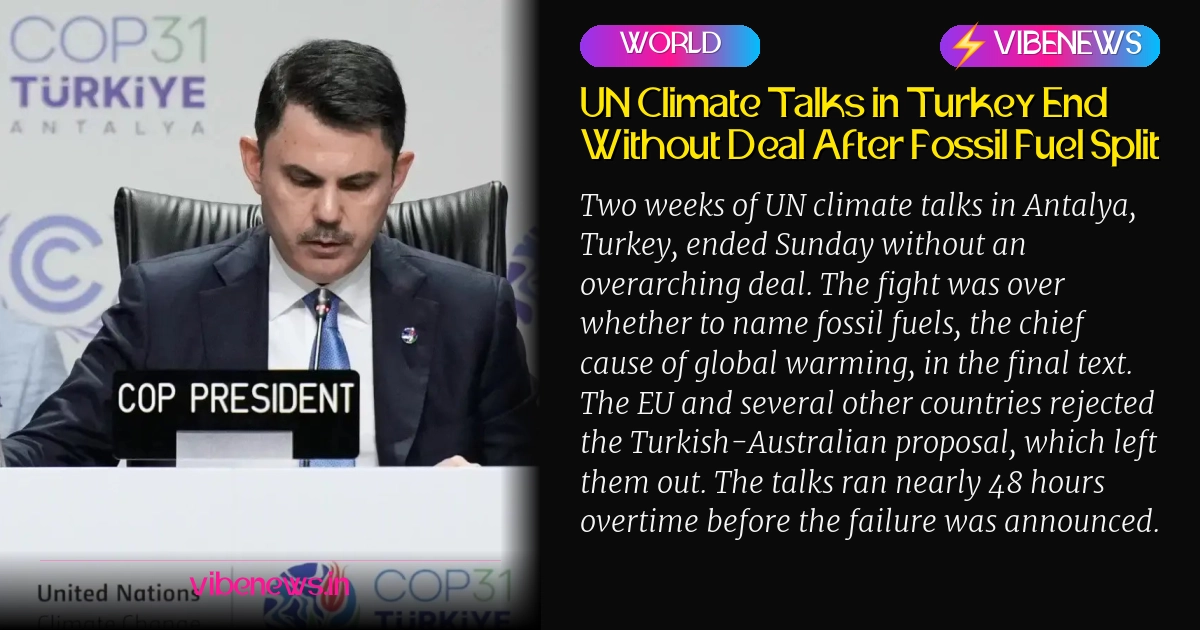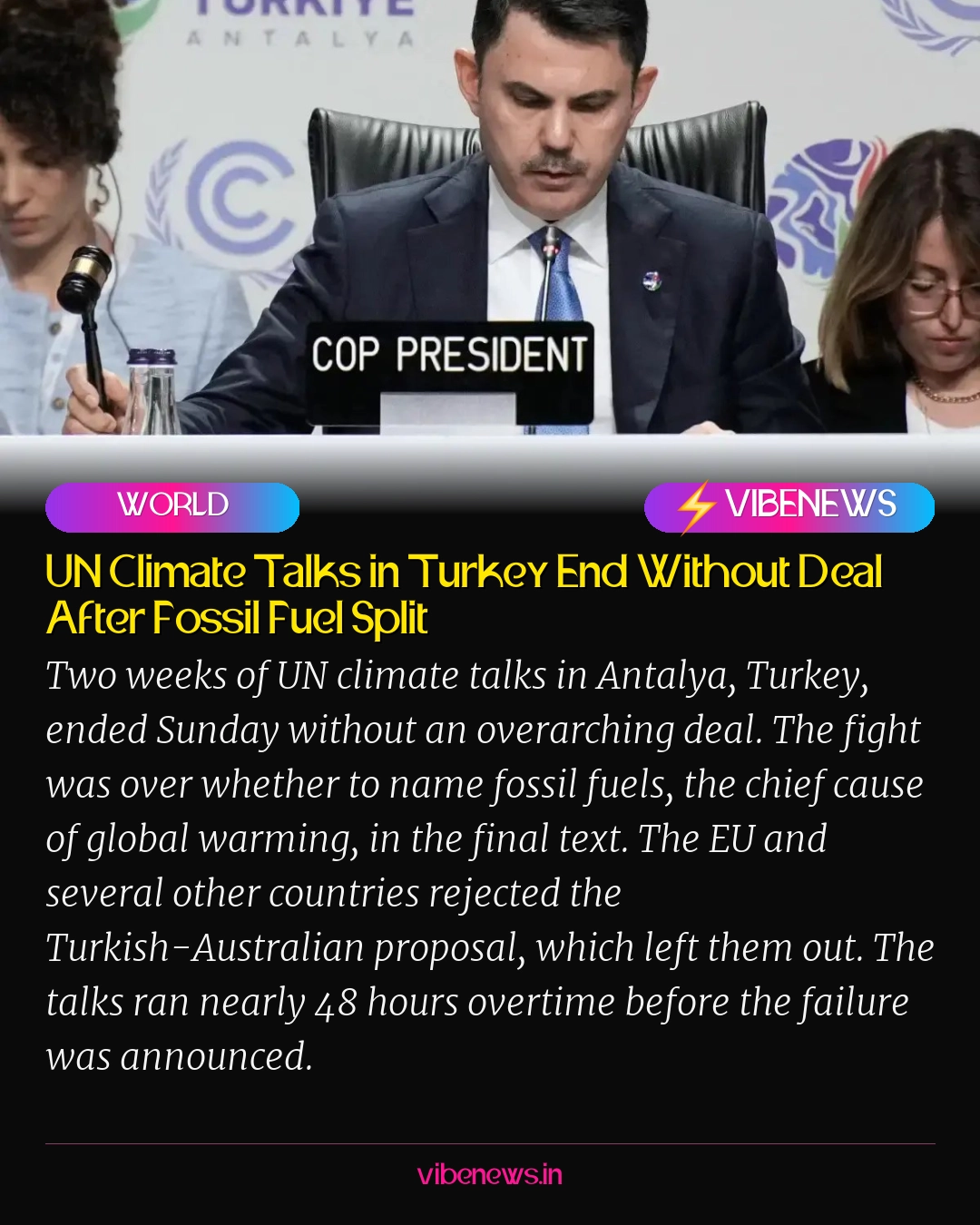
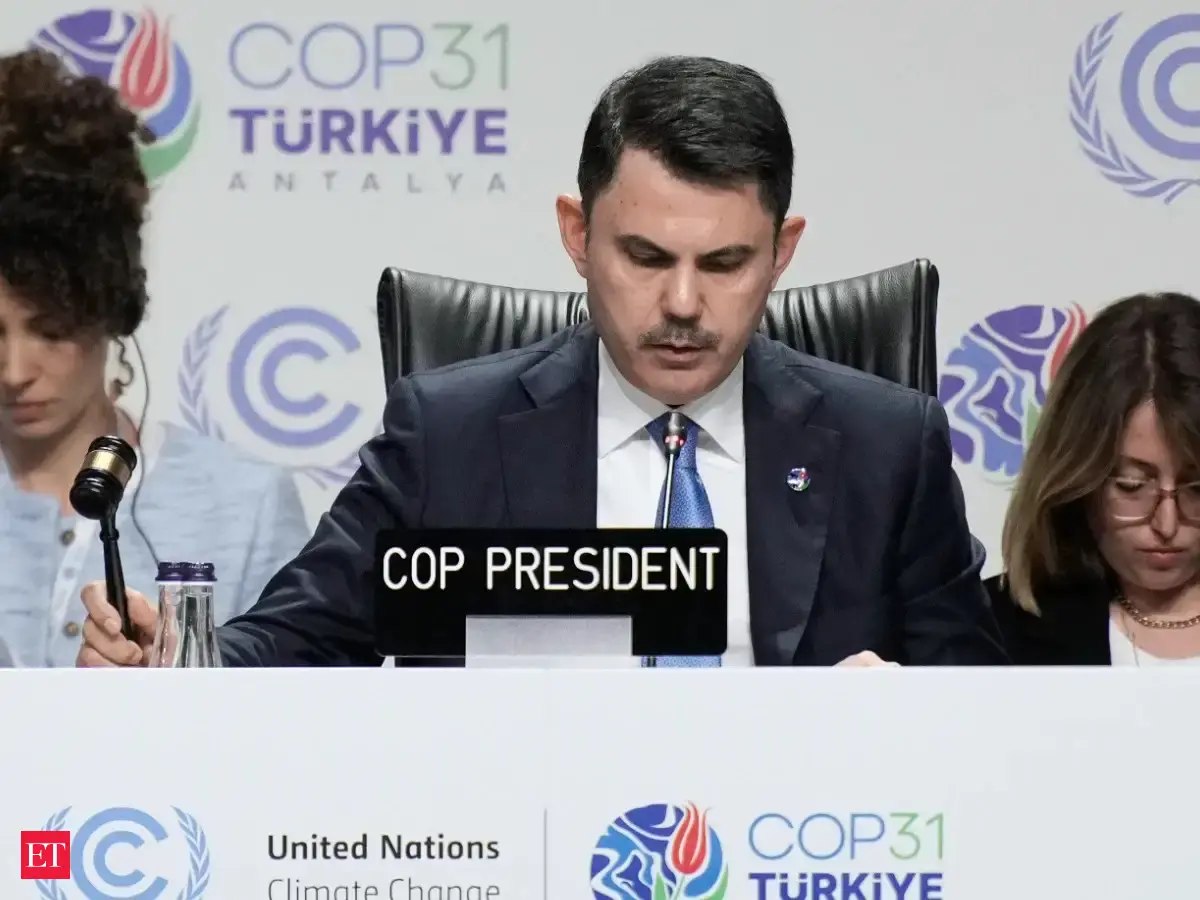
Chaotic UN climate talks in Antalya, Turkey, ended Sunday without an overarching agreement, after negotiators failed to settle whether the final document should explicitly mention fossil fuels. The talks, called COP31, ran nearly 48 hours past their scheduled end.
Expectations were already low going into the two-week negotiations. Discussions over fossil fuels and money proved irreconcilable, and the meeting continued without a main agreement, known as a cover decision. Smaller issues did move forward after that failure, according to the reporting.
Why the Deal Collapsed
Any pact at these talks needs near-unanimous consensus. Several countries and the 27-nation European Union said they could not accept the final proposal from the joint Turkish-Australian leadership, because it did not mention fossil fuels. A much larger group of nations accepted the decision anyway, often reluctantly, because they believed consensus mattered more. Russia and Saudi Arabia pushed to keep fossil fuels out of the document.
The draft also raised a second problem. It included explicit language and a goal for carbon capture and storage for industrial polluters. Many nations and activists said that approach would work against efforts to cut overall emissions.
“It’s unconscionable that we would have a climate act that makes no reference to fossil fuels,” said Irish Climate Minister Darragh O’Brien, speaking on behalf of the EU.
Criticism and the Collapse in the Plenary
Rachel Cleetus of the Union of Concerned Scientists blamed richer nations, petrostates and the Turkish and Australian COP presidents for the outcome. “The failure of this COP to deliver ambitious, fair, science-based outcomes falls squarely on the shoulders of richer nations, petrostates, and the disgracefully incompetent duo of the Turkish and Australian COP presidents,” she said.
When the proposed deal fell apart in the plenary session, Turkish Environment Minister Murat Kurum, who is president of COP31, was absent. Elchin Allahverdiyev of Azerbaijan announced the failure instead.
Where the Dubai Agreement Stands
The fossil fuel debate matters because of what came before. For most of the first 25 years of UN climate talks, outcomes did not explicitly mention fossil fuels. That changed three years ago, when a groundbreaking agreement in the oil-rich United Arab Emirates called for “transitioning away from fossil fuels.” No explicit mention has appeared since then. The Turkish-Australian proposal recalled the Dubai deal entirely, but that was not enough for many nations and environmental groups.
Australia’s Chris Bowen, who serves as president of negotiations in the unusual joint leadership, said he was disappointed. “Unfortunately, we were unable to reach agreement on a cover decision. And that’s disappointing, very disappointing,” he said. Bowen also said the explicit call in the Dubai agreement to wean away from coal, oil and natural gas is still in force. “Transition away from fossil fuels in the real world is happening. It’s happening. It’s happening at speed and it’s irreversible.”
Key Facts
The COP31 talks in Antalya, Turkey, ended Sunday without a cover decision.The talks ran nearly 48 hours overtime after a two-week negotiation.The EU and several other countries could not accept the Turkish-Australian proposal, which did not mention fossil fuels.Russia and Saudi Arabia pushed to keep fossil fuels out of the document.The Dubai agreement from three years ago still calls for transitioning away from fossil fuels, according to Chris Bowen.TL;DR
- UN COP31 climate talks in Antalya, Turkey, ended Sunday without an overarching deal.
- The main sticking point was whether the final text should explicitly name fossil fuels.
- Several countries and the EU rejected the Turkish-Australian proposal, which did not mention fossil fuels.
- Russia and Saudi Arabia pushed to keep fossil fuels out of the document.
- The talks ran nearly 48 hours overtime before officials announced the failure.
- Australia’s Chris Bowen said the Dubai agreement’s call to move away from fossil fuels remains in force.