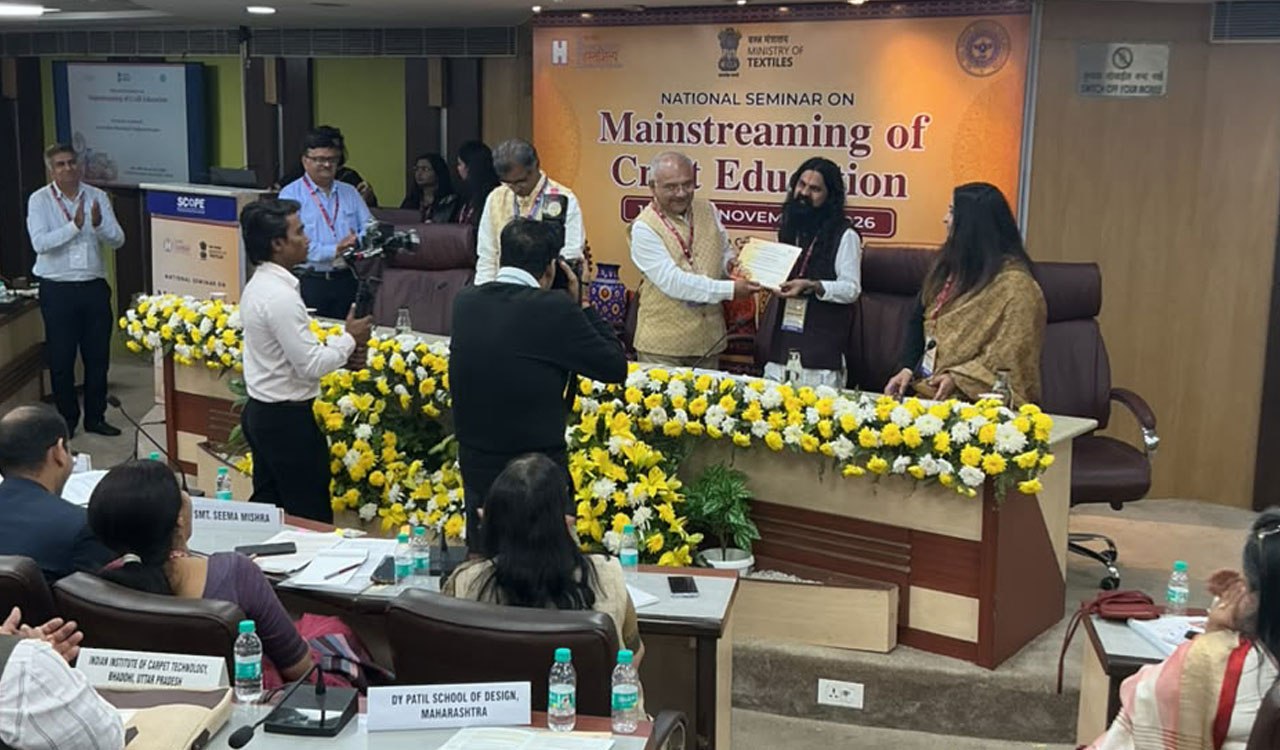
The principal of the Sri Lakshmi Narasimha Institute of Traditional Sculpture and Architecture (SLNITSA) in Yadagirigutta, Mothilal Sthapathi, used a national seminar in New Delhi on Thursday to argue that India’s traditional craft knowledge belongs inside formal higher education.
The seminar, titled “Mainstreaming of Craft Education in Higher Education,” was organised by the Ministry of Textiles and the Development Commissioner (Handicrafts). Sthapathi made his presentation there, and he was specific about what he wants. He called for dedicated undergraduate, postgraduate and research programmes in traditional sculpture and temple architecture, stone carving, heritage conservation, traditional painting, woodcraft, metal crafts, handloom and textile design.
Each of those fields, as he laid it out, would need its own structure. A degree in stone carving or metal crafts would require a syllabus, a research component and industry-oriented training, the same way any other professional discipline does. The point is not to add a few craft workshops to an existing college timetable. It is to give these subjects the same academic standing as engineering or architecture courses.
The more pointed part of his argument concerns the knowledge itself. Sthapathi said that traditional systems of learning should not be treated as relics. Texts such as Shilpa Shastra, Vastu Shastra and Agama Shastra, along with the Guru–Shishya Parampara, the traditional teacher-student lineage through which craft skills have long been passed on, should be fused with contemporary design, digital technology, sustainability and entrepreneurship.
“Traditional knowledge systems such as Shilpa Shastra, Vastu Shastra and Agama Shastra, along with the Guru–Shishya Parampara, should be integrated with contemporary design, digital technology, sustainability and entrepreneurship,” Mothilal stressed.
Recognition is the second pillar of his pitch. He urged universities to formally credit master craftspeople, Sthapathis and experienced artisans. The tools he named were Recognition of Prior Learning (RPL), academic credit systems, equivalence pathways and appropriate recognition for faculty. RPL is a process that assesses skills and knowledge gained outside a classroom so that they can count toward a qualification. For a traditional sculptor who has spent decades at the chisel, that could mean experience is measured on its own terms rather than ignored because there is no certificate attached.
He also reframed the role of artisans. Traditional craftspeople, he observed, were not merely skilled workers. They were knowledge holders, innovators and custodians of India’s living cultural heritage. That framing carries the rest of the argument. If artisans are the keepers of a body of knowledge, then the institutions that teach that knowledge have to make room for them as teachers and as credentialed experts, not only as subjects of study.
A Telangana model on a national stage
Sthapathi did not keep the argument abstract. He presented Telangana as a working example of institutionalising traditional knowledge and pointed to the work of SLNITSA in Yadagirigutta. The institute offers a three-year BA programme in Traditional Sculpture and Architecture, specialising in temple architecture. The course is affiliated with Jawaharlal Nehru Architecture and Fine Arts University (JNAFAU), which means it sits within a recognised university framework rather than outside the state’s formal system.
That is the detail that gives his presentation weight. Many discussions about heritage crafts stall at the level of cultural pride, with plenty of praise and little structure. A degree programme with a named university affiliation is a different kind of proof. It shows the model can be written into academic rules, examined, certified and repeated. Whether other states or institutions follow that template is a question the seminar did not settle, but the Telangana case gave the proposal something concrete to point to.
A separate school-level debate on the same page
The Telangana Today report carried a related but distinct item on education policy in the state. The Telangana Gazetted Headmasters’ Association welcomed the proposed integration of intermediate and school education. It also sought vocational courses from Classes IX to XII. The association raised three further demands: post upgrades, protection of service rights and a clear policy for institutions.
The two stories do not share a stated link. The headmasters’ demands concern school-level restructuring and teacher service conditions, while Sthapathi’s argument concerns degree-level programmes in craft disciplines. Still, both point to the same question that education planners face: how to make learning outside the traditional academic track carry real value, whether that learning happens in a school workshop or a temple-architecture studio.
What is still unknown
The report does not say whether any of the programmes Sthapathi described have been approved or scheduled. It does not give funding figures, timelines or enrolment plans. It also does not record any response from the ministry or from university officials to the specific proposals. A seminar presentation is a starting point, and the reporting makes clear that what happens next depends on bodies beyond the principal’s office.
For students and families weighing their options, the practical questions are narrower and more important. Can a craft-based qualification lead to recognised academic standing? Will the experience of master artisans be counted as credit? Can someone trained through the Guru–Shishya tradition move into formal teaching posts? The seminar raised all three. The answers are not in the source material yet, but the argument is now on the record, presented by an institution that already runs a degree in the field.
TL;DR
- SLNITSA principal Mothilal Sthapathi urged India to build traditional craft knowledge into formal higher education.
- He made the case at a national seminar in New Delhi organised by the Ministry of Textiles and the Development Commissioner (Handicrafts).
- He proposed UG, PG and research programmes in sculpture, temple architecture, woodcraft, handloom and textile design.
- He called for Recognition of Prior Learning and academic credit for master artisans and Sthapathis.
- SLNITSA in Yadagirigutta runs a three-year BA in Traditional Sculpture and Architecture, affiliated with JNAFAU.
- The Telangana Gazetted Headmasters’ Association separately sought vocational courses from Classes IX to XII.