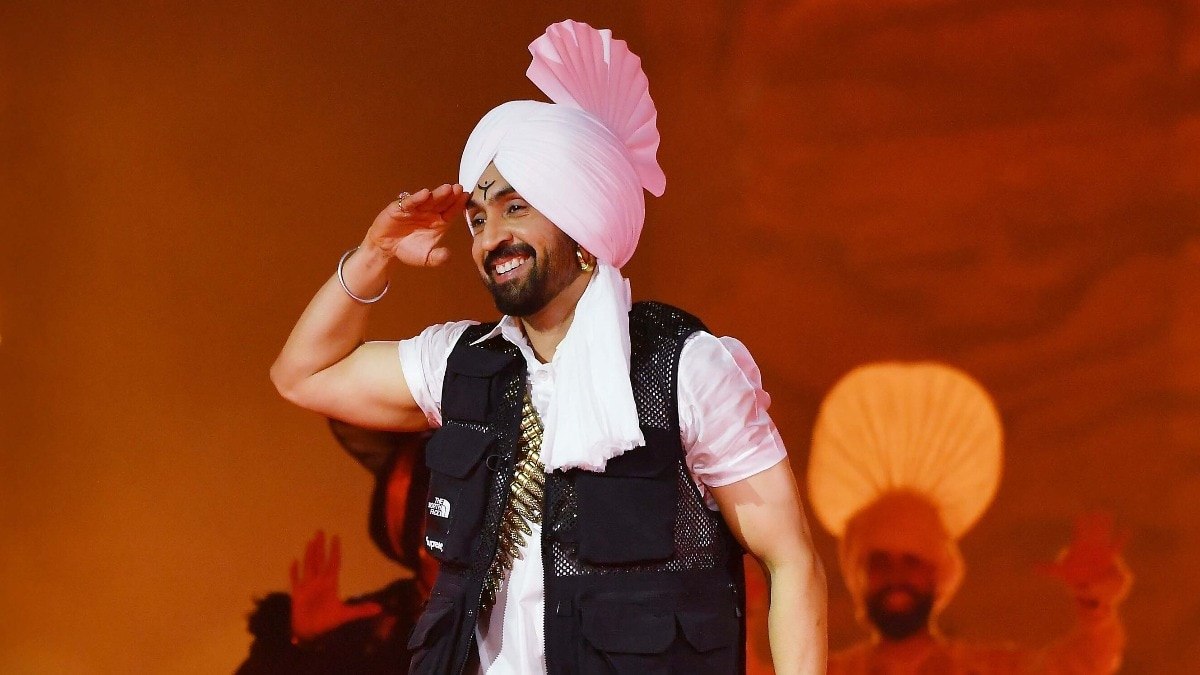
Delhi Police’s Special Cell has arrested three people, including a woman, for writing pro-Khalistan slogans at two Delhi Metro stations, even as Punjabi singer Diljit Dosanjh’s concert at Jawaharlal Nehru Stadium drew lakhs of fans. Police say the operation was an attempt to tarnish the show, and investigators have traced the money trail back to the banned Khalistani outfit Sikhs for Justice (SFJ).
The concert itself went off well. But behind the crowds and the music, a separate plan was unfolding on the city’s transit network, and it has now been exposed.
The graffiti that appeared overnight
The first slogan surfaced at Jahangirpuri Metro Station on October 29. It was found on the floor near Gate Number 1. The second turned up a day later, on October 30, at Shastri Nagar Metro Station. There, the writing was on the wall of the staircase near Gate Number 2.
Both messages were written in English and carried the same line: ‘Diljit Singh kaum de gaddar khoon da badla SFJ Khalistan’. Roughly translated, it calls the singer a traitor to the community, promises that blood will be avenged, and openly backs SFJ and the Khalistan movement.
’Diljit Singh kaum de gaddar khoon da badla SFJ Khalistan.’ Roughly translated: Diljit Singh, traitor of the community, blood will be avenged, SFJ Khalistan.
Police said the slogans were not random vandalism. They were designed to spread a political message at a high-profile event, using some of the busiest public spaces in the capital.
How the investigators caught the accused
The case was handed over to the Northern Range of the Special Cell. Officers went through CCTV footage from both stations and combined it with technical investigation to identify the people involved.
The first arrest was of Sumeet alias Raftaar, 30, a resident of Samalkha in Panipat, Haryana. Questioning him led police to Punjab, where they carried out an operation and arrested Sumit Kumar alias Kaka, 22, of Dera Baba Nanak in Gurdaspur, and Gurpreet, 22, of Mahilpur in Hoshiarpur.
Police say Sumit Kumar alias Kaka was the central figure in the plan. During questioning, investigators learned that he had made contact with people in Ludhiana and Gurdaspur who hold pro-Khalistan views.
Money, encrypted apps and a template for hate
According to police, Kaka was then asked to download an encrypted messaging app, and all further instructions came through it. A member linked to SFJ allegedly sent him designs and templates for the Khalistan slogans. In return, he was promised a large payment.
Kaka then brought in two acquaintances, Sumeet alias Raftaar and Gurpreet. Both agreed to take part. The accused had been reached through WhatsApp, and the encrypted app was used to discuss payment for writing graffiti in Delhi.
The three men reached Delhi on October 28, according to police. They then split up and worked across different stations. Raftaar wrote the graffiti at Jahangirpuri Metro Station and recorded a video of the work, which he sent to his handlers. Kaka and Gurpreet wrote the slogans at Shastri Nagar. Police say all of it happened in the overnight hours between October 28 and 29.
Police also said the accused admitted to writing graffiti at both Metro stations during interrogation.
A background of drugs, dropouts and a chance meeting online
The investigation has also revealed how the three came together. Raftaar had earlier worked as a freelance content creator on the Bigo Live platform. The Government of India banned Bigo Live in 2019. He later moved to Tango Live, and it was on that platform that he met Kaka.
Police say Raftaar, who studied up to Class 12, had enrolled at an ITI in Ajitwal in Moga, Punjab, but never completed the course. Kaka also studied till Class 12. After school, police say, he drifted into drug use and anti-social activities.
Gurpreet’s path was different on paper but ended in the same place. She studied till Class 12, then worked at a salon in Zirakpur and at several hotels and hospitality businesses in Punjab and Haryana. She had known Kaka for about four years through a common friend.
Police say Kaka initially told Gurpreet that they were travelling to Delhi for shopping. Only after they arrived was she told about the plan to write slogans at a Metro station. Both of them then wrote the graffiti at Shastri Nagar.
A third incident, and a wider hunt
Interrogation also revealed that Kaka had written pro-Khalistan graffiti on October 30 near the GTK Bypass, under the Samaypur Badli police station area. Investigators are running a separate probe into that incident.
Two FIRs have been registered in Delhi for the Metro station graffiti. The accused face charges under Section 3 of the Delhi Prevention of Defacement of Public Property Act, 2007, and Section 62(2) of the Metro Railways (Operation and Maintenance) Act, 2002.
The Special Cell is now focused on the people who sat behind the operation. Officers want to know who sent the designs, who offered the money, and who gave instructions through the encrypted app. Investigators are also examining other contacts of the accused.
Police say the probe is continuing and that the entire SFJ-linked network, including its handlers, is being traced.
Why this case matters
The case sits at the intersection of a mass public event and a banned separatist group’s alleged attempt to inject its message into it. Metro stations are crowded, and the slogans were placed where thousands of commuters pass every day. A high-profile concert with lakhs of fans in the crowd made the target even more visible.
For now, the story is about three young men who police say were paid to write hate-filled slogans, and about the people they say were pulling the strings from behind a screen. The Special Cell’s next steps will determine whether the network behind the graffiti can be fully identified.
TL;DR
- Three people, including a woman, arrested by Delhi Police for pro-Khalistan graffiti at two Metro stations.
- Graffiti appeared at Jahangirpuri and Shastri Nagar Metro stations on October 29 and 30.
- Police say the accused were lured with money by people linked to the banned group SFJ.
- The Special Cell traced the suspects through CCTV footage and technical investigation.
- Accused allegedly received designs and instructions through an encrypted messaging app.
- Investigators are now hunting the handlers and the wider network behind the alleged plot.