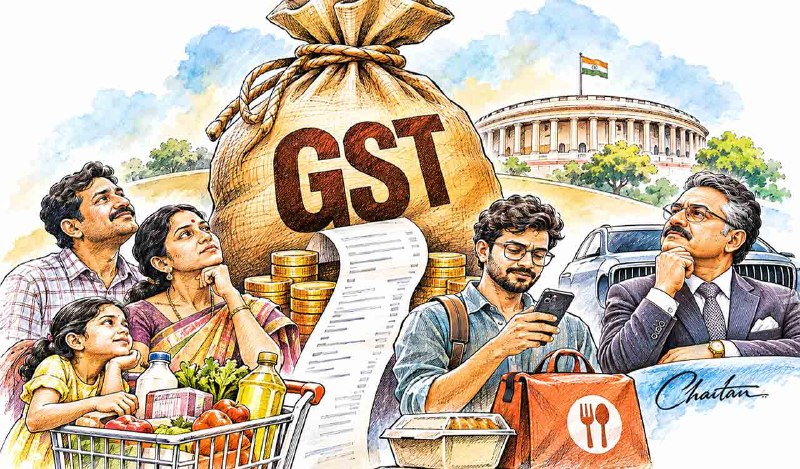
The same GST bill can land very differently depending on who pays it. Two households buying a Rs 10,000 appliance at 18 per cent GST each pay Rs 1,800 in tax, according to an opinion piece by Dr CS Pitresh Kaushik and Dr Sushanta Kumar Mahapatra. One household earns Rs 30,000 a month and the other Rs 3 lakh.
On paper, the tax is identical. In practice, the authors argue, it is not. For the first family, Rs 1,800 could mean delaying another essential purchase. For the second, it barely registers in the monthly budget.
Why the rate alone misleads
The writers say the headline rate does not show who carries the heavier load. Income, consumption and the share of household resources going to taxable goods all matter. Indirect taxes are often called regressive because poorer households spend a larger share of their income and have less room to save.
The authors stop short of calling GST regressive in India. Exemptions and lower rates on essentials, alongside higher rates on luxury or demerit goods, change how the burden spreads.
What the study found
A September 2025 study in the Economic and Political Weekly, drawing on India’s 2022-23 Household Consumption Expenditure Survey, found GST progressive across rural and urban India on the distributional measures it examined. The writers say that result does not mean every household or every price rise hits equally, since it depends on what families buy and whether businesses pass tax changes to customers.
Who ends up paying
Businesses collect and deposit GST, but consumers may bear some or all of it through higher prices. Suppliers sometimes absorb part of it through thinner margins. When rates fall, buyers do not automatically get the full cut. The size of any price drop depends on competition, costs and pricing decisions.
What the authors want changed
The piece calls for three priorities. Policymakers should regularly study GST’s distributional impact using household consumption data rather than headline collections. Tax cuts should reach buyers through clearer pricing, easy complaint mechanisms and monitoring. Success should be judged on more than revenue growth, with attention to compliance costs and pressure on households with little cushion.
The writers conclude that a fair system cannot make every household’s burden identical, but it can keep the burden reasonable, rules predictable and reform gains reaching consumers.
Key Facts
A Rs 10,000 appliance at 18 per cent GST costs Rs 1,800 in tax.The two example households earn Rs 30,000 and Rs 3 lakh a month.A September 2025 Economic and Political Weekly study used India’s 2022-23 Household Consumption Expenditure Survey.That study found GST progressive across rural and urban India on the measures it examined.Dr CS Pitresh Kaushik teaches at School of Management Studies, Swami Rama Himalayan University, Dehradun. Dr Sushanta Kumar Mahapatra teaches Economics at the ICFAI School of Social Sciences, IFHE, Hyderabad.
TL;DR
- A Rs 10,000 appliance at 18% GST costs Rs 1,800 for both a Rs 30,000-income and a Rs 3 lakh-income household.
- The tax weighs far more on the poorer family’s budget than on the richer one’s.
- A September 2025 Economic and Political Weekly study found GST progressive across rural and urban India.
- The authors say tax cuts must reach consumers through clearer pricing and effective monitoring.
- Distributional impact should be studied regularly using household consumption data, not just collections.