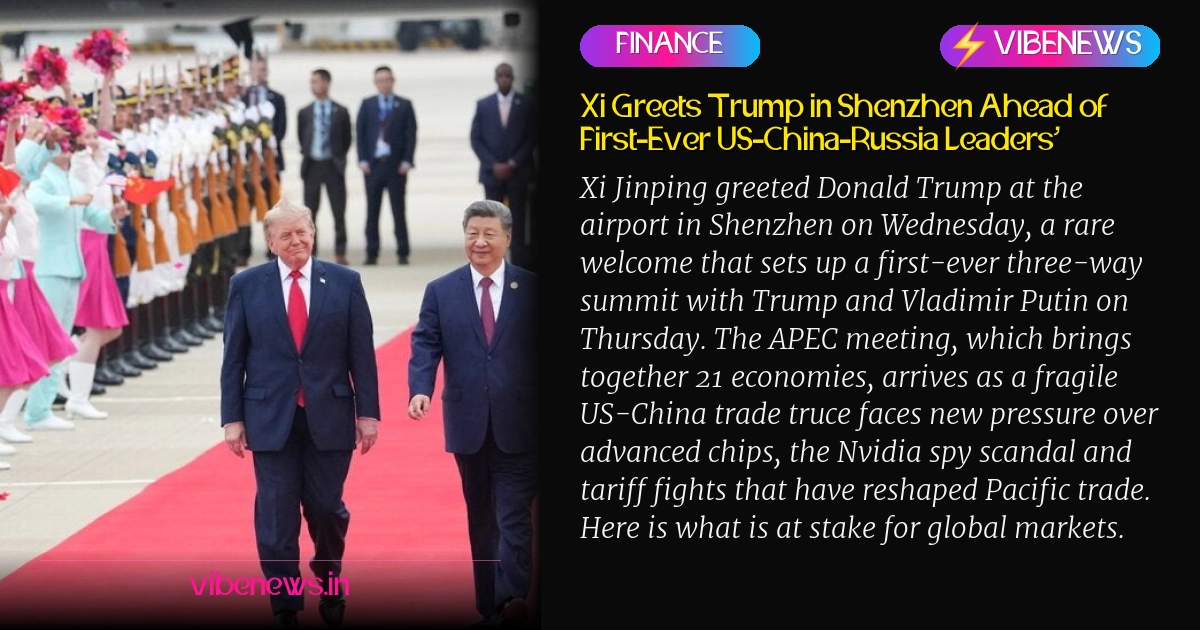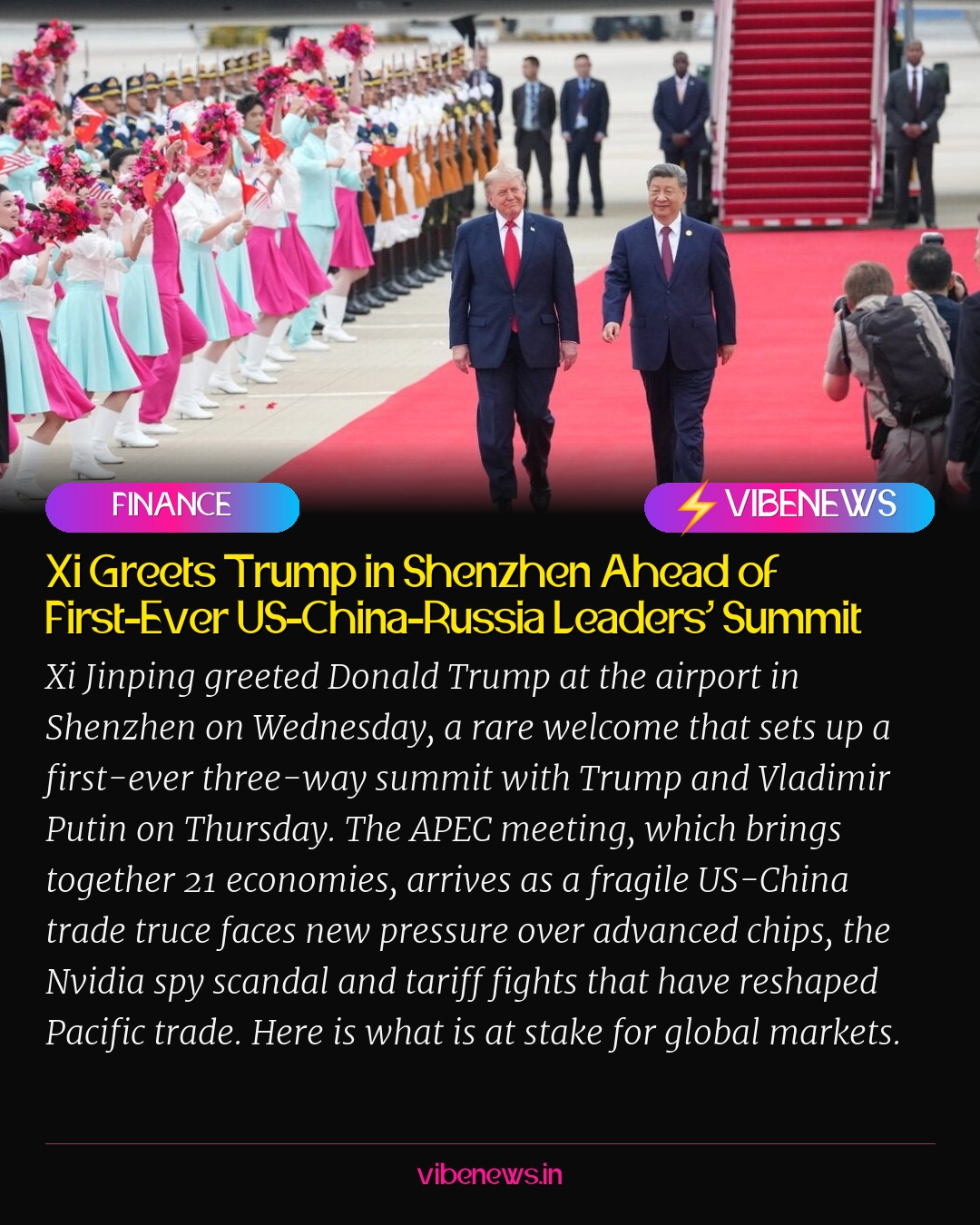
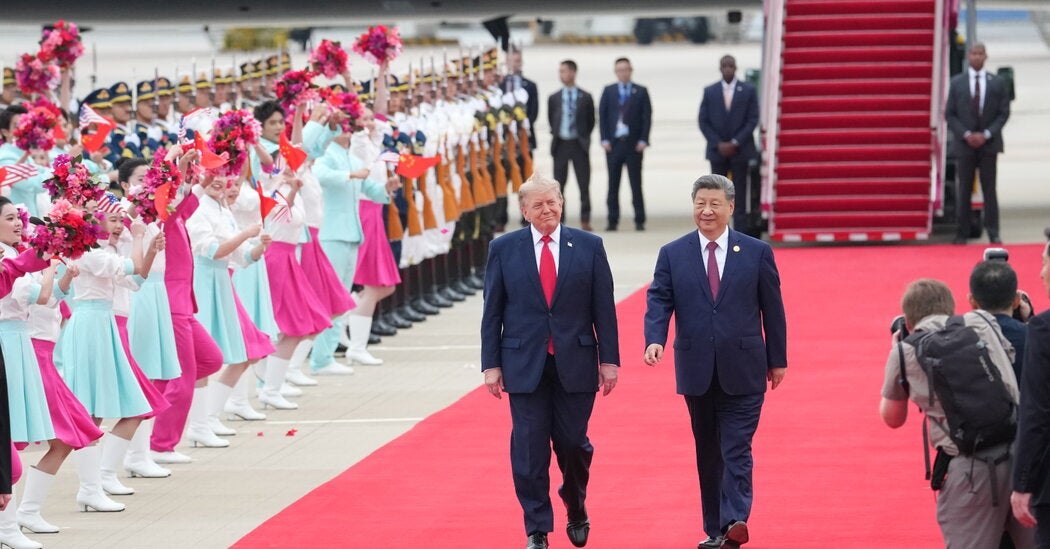
President Xi Jinping personally greeted President Trump when he arrived in Shenzhen on Wednesday, a welcome that breaks with protocol. Foreign leaders are usually received by senior Chinese officials, not by Xi himself. The gesture sets the tone for a trip that will end with the first-ever three-way meeting between the leaders of the United States, China and Russia, expected on Thursday.
Trump left Manila on Wednesday afternoon for Shenzhen, a center of China’s artificial intelligence and robotics industries. He had already joined a meeting of the Association of Southeast Asian Nations in the Philippines. Shenzhen is the host city for the Asia-Pacific Economic Cooperation forum, a group of 21 member economies. The APEC agenda focuses on digital trade, artificial intelligence and cross-border e-commerce.
Why the Airport Greeting Matters
The welcome is not random. Xi did not come to the airport when Trump visited Beijing in May. Trump returned the favor in September, traveling to Joint Base Andrews outside Washington to meet Xi. That was a rare move for any American president and the first time Trump had done it for a foreign visitor.
This year, Trump and Xi have met three times in person. Trump has shifted from regularly attacking China’s trade practices to pursuing friendlier ties between the world’s two largest economies. That shift is the backdrop for everything happening in Shenzhen this week.
A Summit Built on Awkward Silences
Trump has said he does not intend to raise Chinese interference in American affairs during this visit. The omission is striking. Jensen Huang, the chief executive of Nvidia, was forced to resign after revelations about an extramarital affair with a businesswoman whom U.S. intelligence determined was spying for China. Trump has said he will not discuss that matter with Xi.
The pattern is familiar. Even after Trump gave a prime-time address in July accusing China of hacking or buying U.S. voting files, he did not raise the issue publicly when he hosted Xi in September. He is not expected to raise it this week either. Critics of that approach argue it leaves security concerns unspoken while the two sides negotiate on trade.
The Trade Truce Is Under Strain
The most immediate economic risk is a new American proposal. This week, the Trump administration proposed a rule that would restrict China’s access to advanced chips through data centers located outside its borders. Beijing responded fast. China’s ministry of commerce said the rule goes against the terms the two countries agreed to in a fragile truce, which expires in two months.
A ministry spokesman put it bluntly. "If the US persists, China will take countermeasures." That warning should be read as a signal about how much room either side has left. China experts say the rule is the latest in a series of escalatory moves from both sides, and it will make it harder for Xi and Trump to reach a meaningful agreement that cools the conflict between the world’s biggest economies.
"If the US persists, China will take countermeasures."
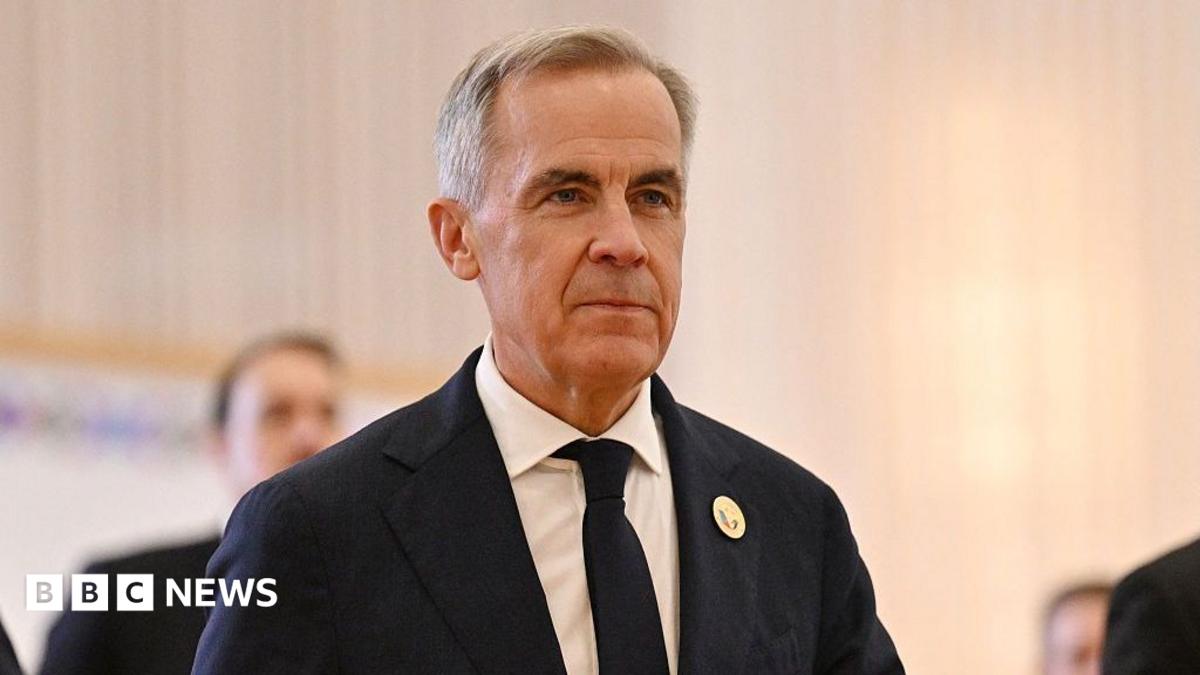
Trade is not the only pressure point. Trump’s protectionist tariff policies have overturned the free-trade consensus that once defined APEC. Prime Minister Mark Carney of Canada said he would meet Trump in Shenzhen on Wednesday to discuss the trade dispute between their two countries. Carney has been pushing to reduce Canada’s reliance on the United States after Trump started a trade war and suggested Canada should become the 51st American state.
Breakdowns at Home Add Pressure
While Trump is abroad, his administration is dealing with computer failures across the technology, airline and banking sectors. Secretary of State Marco Rubio, who is traveling with the president, said on Wednesday there was no evidence the failures were connected. He suggested the rush to patch systems before they can be hacked by new artificial intelligence capabilities may be contributing to the problems. The answer has not satisfied everyone, and the timing is awkward for a president trying to project control on a foreign stage.
What It Means for Markets in the US, UK and Australia
The reporting does not detail how markets in the United States, Britain or Australia are reacting to the summit, and nothing in the source material quantifies the economic fallout for those countries. What the reporting does show is where the risk sits. Chip access, tariffs and AI security are the issues driving the talks, and they touch the companies at the center of global supply chains. Shenzhen is home to Huawei and ZTE, which Washington has labeled national security risks, as well as BYD and the drone maker DJI. Apple’s main assembler, Foxconn, runs a sprawling campus there, and Walmart manages its China business from the city.
For investors in those three countries, the key question is whether the chip rule holds. If Beijing follows through on its threat, the damage would spread beyond the two superpowers. Any new restrictions or retaliation would ripple through technology supply chains that companies in all three countries rely on. A deal that de-escalates the trade fight would do the opposite. The problem is that nobody at the summit has yet shown a clear path to that deal.
A Summit Wrapped in Security
Shenzhen looks calm on the surface. The city has halved subway fares this week to clear roads for summit buses, and schools have closed. Many residents have left town, and local authorities have told companies to let employees still in the city work from home. Police have been posted in apartments facing the conference center, and drones have been banned. A resident named Wang said people were unhappy about the disruption but could not say so openly. "The government wouldn’t welcome our dissatisfaction," she said.
Putin’s Shadow Over the Talks
Putin arrived in Shenzhen with a show of force. Russian strategic nuclear bombers landed in Vietnam close to the time he reached China, according to satellite footage. It was the first publicly documented arrival of such warplanes in Vietnam since the Soviet era. Putin met Xi earlier on Wednesday in talks that lasted more than two hours, according to Russian state news agency Tass. Xi and Putin are expected to press for alignment before the trilateral meeting, and nuclear arms control is likely to be on the table. Trump has said he is eager to discuss it, but Xi is reluctant. China’s arsenal remains much smaller than those of the United States and Russia, and Beijing does not want limits on it.
Trump has also said he will talk about Ukraine, where Putin’s aides are holding talks with American and Ukrainian officials. Putin is also demanding that NATO pull back troops to where they were before the alliance expanded toward Russia. Smaller powers, including Ukraine, could find themselves on the outside of any deal struck by the big three.
Trump’s Other Stops
The trip has produced a few surprises along the way. In Manila, Philippine President Ferdinand Marcos Jr. had Jollibee fried chicken delivered to Trump as a late-night snack. Trump said the two countries had unexpectedly signed a new trade deal. Marcos’s office later said it would cover energy and food security, without giving more detail. Trump said it would benefit American farmers.
Trump may also meet North Korean leader Kim Jong-un while in China, though it is not clear whether Kim will attend the APEC summit. Russian state news agencies reported that Putin could meet Kim if he travels to China, citing the Kremlin spokesman.
The coming hours will test whether the warm airport welcome translates into anything concrete. Thursday’s three-way meeting is the moment to watch. If Beijing’s chip warning turns into action before the truce expires, the summit will be remembered less for the handshakes and more for what was left unsaid.
Watch Video: https://vp.nyt.com/video/2026/11/18/183819_1_17vid-trump-jollibee-art-5292_wg_720p.mp4
TL;DR
- Xi Jinping personally greeted Trump at the Shenzhen airport on Wednesday, an unusually high-level welcome.
- A first-ever three-way summit with Trump, Xi and Vladimir Putin is expected Thursday in Shenzhen.
- China warned it will take countermeasures if the US proceeds with a proposed rule restricting its access to advanced chips.
- US-China trade truce expires in two months, and the new chip rule threatens to make a deal harder to reach.
- Trump’s trip is also overshadowed by the Nvidia spy scandal and computer failures across tech, airline and banking sectors.