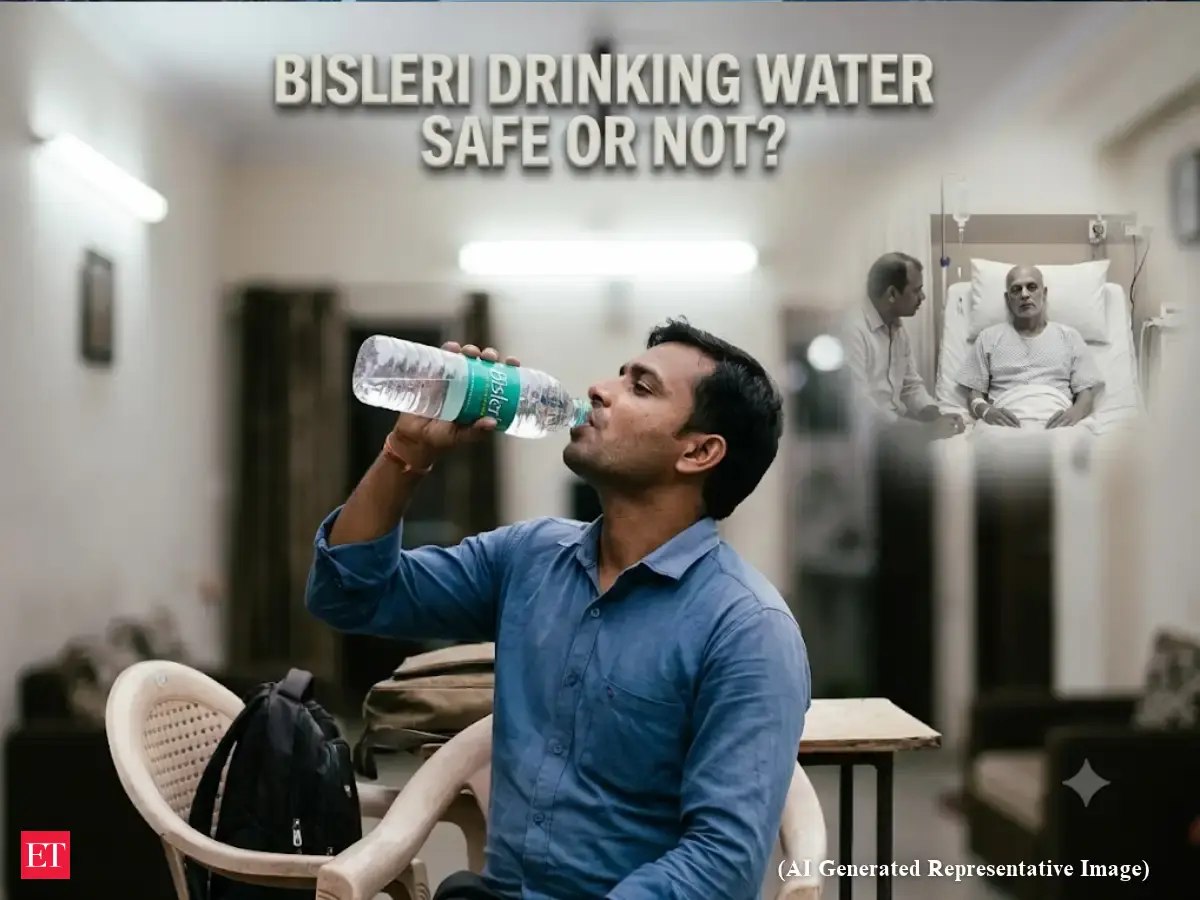
The Food Safety and Standards Authority of India (FSSAI) has sanctioned prosecution against Bisleri International after a packaged drinking water sample from its Goa facility was declared unsafe. The sample failed laboratory tests for bromate and polynuclear aromatic hydrocarbons (PAHs), which paves the way for legal proceedings over alleged food safety violations.
Bisleri disputes the findings. The company says subsequent independent tests found bromate levels within the prescribed limit.
What the Goa Test Found
According to Bisleri, FSSAI collected six samples from its Goa facility on September 30, 2025. Five met the applicable standards. The sixth recorded bromate at 12 micrograms per litre, against a prescribed limit of 10 micrograms per litre.
Bisleri appealed the initial finding on November 22, 2025. A referral laboratory then declared the sample unsafe after detecting PAHs, FSSAI said.
The company says it sent its own results to FSSAI’s Western Regional Office in a letter dated February 2, 2026. It says it received no further communication, believed the matter was closed, and did not receive a notice by email or in hard copy. FSSAI has nonetheless sanctioned prosecution. That permits legal action but does not amount to a conviction.
Bisleri says drinking water safety is a priority, that it conducts more than 90 quality tests across its 10-step manufacturing process, and that it will cooperate with the regulator. These are the company’s claims. The prosecution follows FSSAI’s laboratory findings.
Why Bromate Forms in Drinking Water
Bromate is a chemical that can form during water treatment. One of its main sources is ozonation, a disinfection process that uses ozone to destroy microorganisms. When ozone reacts with naturally occurring bromide ions in source water, bromate can form as a by-product.
The amount depends on bromide concentration, ozone dosage, pH and overall water quality. Bromate can also form in certain hypochlorite solutions used for disinfection. Its presence does not necessarily mean someone deliberately added it, which is why manufacturers must control the process and test the finished product.
The Health Risk Behind the Limit
The World Health Organization (WHO) has set a provisional guideline value of 0.01 milligrams per litre, equal to 10 micrograms per litre. The 12 micrograms per litre recorded in the initial Bisleri sample was 2 micrograms above that limit, or 20% higher. The limit is designed to control exposure over time.
The main concern is cancer. The International Agency for Research on Cancer has classified potassium bromate as possibly carcinogenic to humans, based on animal studies. WHO’s assessment refers to animal experiments in which long-term exposure was associated with tumours, including in the kidneys and thyroid. Laboratory research has also found evidence of genetic damage.
The principal health concern associated with bromate is cancer risk following prolonged exposure.
Evidence of cancer-causing effects in humans is inadequate, and the classification does not mean everyone exposed to bromate will develop cancer. Very high exposure can cause nausea, vomiting, diarrhoea and abdominal pain. Kidney and nervous system effects, as well as hearing loss, have been reported in high-exposure cases. Those effects should not be confused with the concentration found in the Bisleri sample.
Tighter Scrutiny of Packaged Water
The case comes as regulators tighten oversight of packaged drinking water. FSSAI removed the mandatory Bureau of Indian Standards certification requirement for packaged drinking water and mineral water in October 2024. From January 1, 2026, it introduced a mandatory testing scheme. Manufacturers must run prescribed tests, maintain batch-wise records and take corrective action when samples fail safety requirements.
Key Facts
FSSAI sanctioned prosecution against Bisleri International over a Goa facility water sample.The sample recorded bromate at 12 micrograms per litre, against a limit of 10 micrograms per litre.WHO’s provisional guideline value for bromate is 0.01 milligrams per litre.Bisleri says its independent tests found bromate within the permissible limit.FSSAI’s mandatory testing scheme for packaged drinking water began January 1, 2026.Is Bisleri water unsafe to drink?
The sources do not say whether other Bisleri products are affected. FSSAI’s laboratory declared the Goa sample unsafe, and five of the six samples met applicable standards. Bisleri says its own independent tests found bromate within the limit.
Has Bisleri been found guilty?
No. According to the reports, FSSAI’s sanction permits legal proceedings to be initiated but does not amount to a conviction.
Can bromate in water cause cancer?
Animal studies linked long-term bromate exposure to tumours. Evidence of cancer effects in humans is inadequate, and the classification does not mean everyone exposed will develop cancer.
TL;DR
- FSSAI has sanctioned prosecution against Bisleri International over a packaged water sample from its Goa facility.
- The sample recorded bromate at 12 micrograms per litre, against a prescribed limit of 10.
- Bisleri disputes the findings, saying independent tests found bromate within the permissible limit.
- Five of six samples collected on September 30, 2025 met applicable standards, according to Bisleri.
- Prosecution permits legal proceedings but does not amount to a conviction.
- Bromate exposure over time is linked to cancer risk in animal studies.