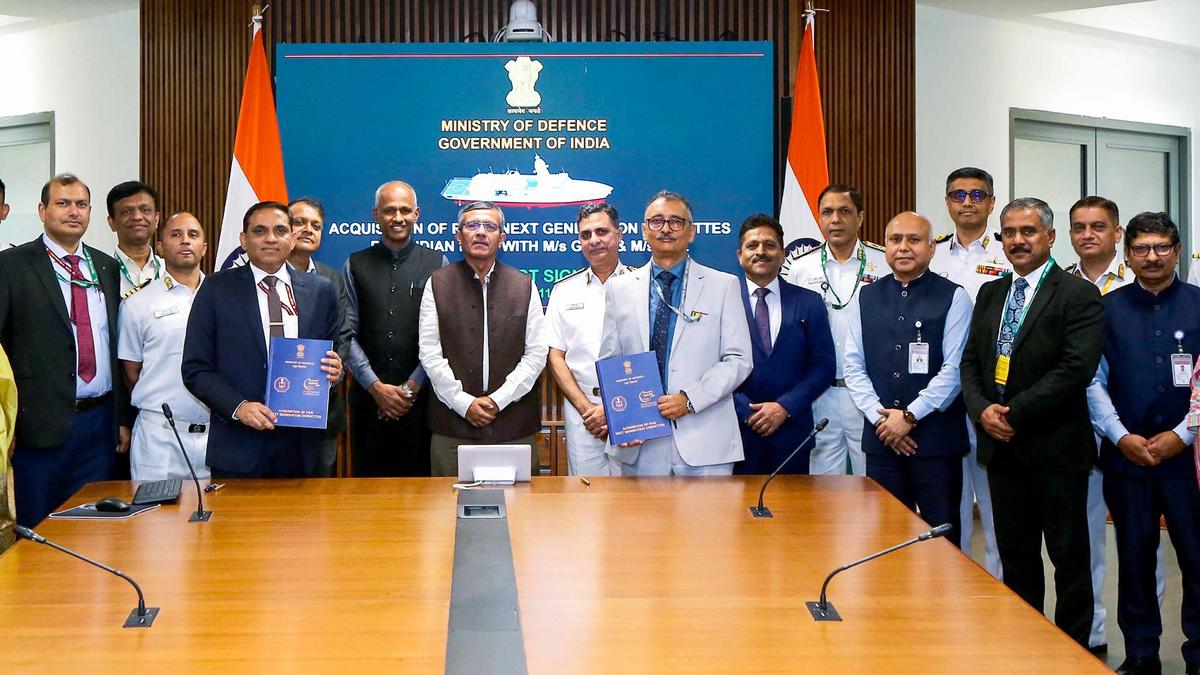
India’s Ministry of Defence has sealed contracts worth ₹53,866 crore to buy eight warships for the Indian Navy, handing the work to two state-run shipbuilders. The Ministry announced the deal on Monday, November 2, 2026.
The contracts were signed with Garden Reach Shipbuilders & Engineers Limited (GRSE) and Goa Shipyard Limited (GSL) for the acquisition of eight Next Generation Corvettes, known as NGCs. The split is clear. GRSE will build five. GSL will build the remaining three.
The sheer size of the order makes it a major procurement. At 538.66 billion rupees, it is a multi-billion-dollar commitment that will shape how India builds and fields its naval fleet for years. But the Ministry is pointing at something else entirely.
The design is the real story
Most navies buy warships from a shipyard that designs and builds them. This deal breaks that pattern in a specific way. The Ministry says the Indian Navy itself designed the ships, and state-run builders will construct them.
The Ministry put it plainly in its statement:
"The project marks a significant milestone in India’s indigenous warship design and construction capabilities, as it is the first project in which the ships will be indigenously designed by the Indian Navy and constructed by Defence Public Sector Undertakings (DPSUs) selected through a competitive process."
That sentence contains two separate shifts. The first is who holds the blueprint. When the navy designs the ship, it sets the requirements, owns the design logic, and reduces its reliance on outside designers. The second is how the builders are chosen. The shipyards were selected through a competitive process, which means the work went to yards that were judged against one another rather than handed over by default.
Two state yards, one national push
GRSE and GSL are both Defence Public Sector Undertakings, the category of government-owned defence manufacturers the Ministry references. Splitting the order between them spreads the production load across two yards rather than concentrating it in one. The Ministry’s statement assigns five corvettes to GRSE and three to GSL, and that division is the most concrete operational detail the announcement provides.
For a country trying to reduce dependence on imported warships, the structure matters as much as the headcount. Building domestically in state yards keeps the work, the skills, and the supply chains inside India’s own defence base. Every vessel that comes out of these yards adds to the country’s ability to design, build, and maintain its own fleet.
Why global navies are watching
Naval power is ultimately about presence. A navy that can design its own ships and build them at home can expand its fleet on its own timetable and set its own standards. That independence carries weight in the Indo-Pacific, where maritime routes carry a large share of global trade and where regional navies are competing for influence.
For Western readers, the message is about strategy as much as shipbuilding. A large, domestically designed warship program signals that India intends to be a maritime power that does not depend on outside suppliers for its core fleet. Allies deciding who to partner with, and rivals measuring the balance at sea, will both take note of an order of this scale.
The contracts also reflect a broader question for any government running an expensive military program. Does the money stay at home, build capacity, and create a defence industry that can grow? Or does it flow out to foreign yards? This deal answers that question in the first direction, at least on paper.
What the announcement does not say
The Ministry’s statement is short. It confirms the contract value, the number of ships, the builders, and the design arrangement. It does not provide delivery schedules, specific ship capabilities, or the timeline for when the first corvette will enter service. Those details will matter, and they are not in the public statement released Monday.
What is clear is the direction. The Indian Navy is taking more control over its warship design, and two state-run yards are being trusted with building a large batch of new vessels. The next stage will show whether the design, the construction, and the schedule hold together.
For now, the headline number is the first thing people will see. The more important shift is the one buried in the design language: India is trying to build a navy that it designs, builds, and owns from start to finish.
TL;DR
- India’s Defence Ministry sealed contracts worth ₹53,866 crore on Monday, November 2, 2026, to procure eight warships.
- GRSE will build five Next Generation Corvettes and Goa Shipyard Limited will build the remaining three.
- The Ministry calls it the first project where the Indian Navy designs the ships and DPSUs build them.
- The DPSUs were selected through a competitive process, the Ministry said.
- The statement does not give delivery timelines or detailed ship capabilities.