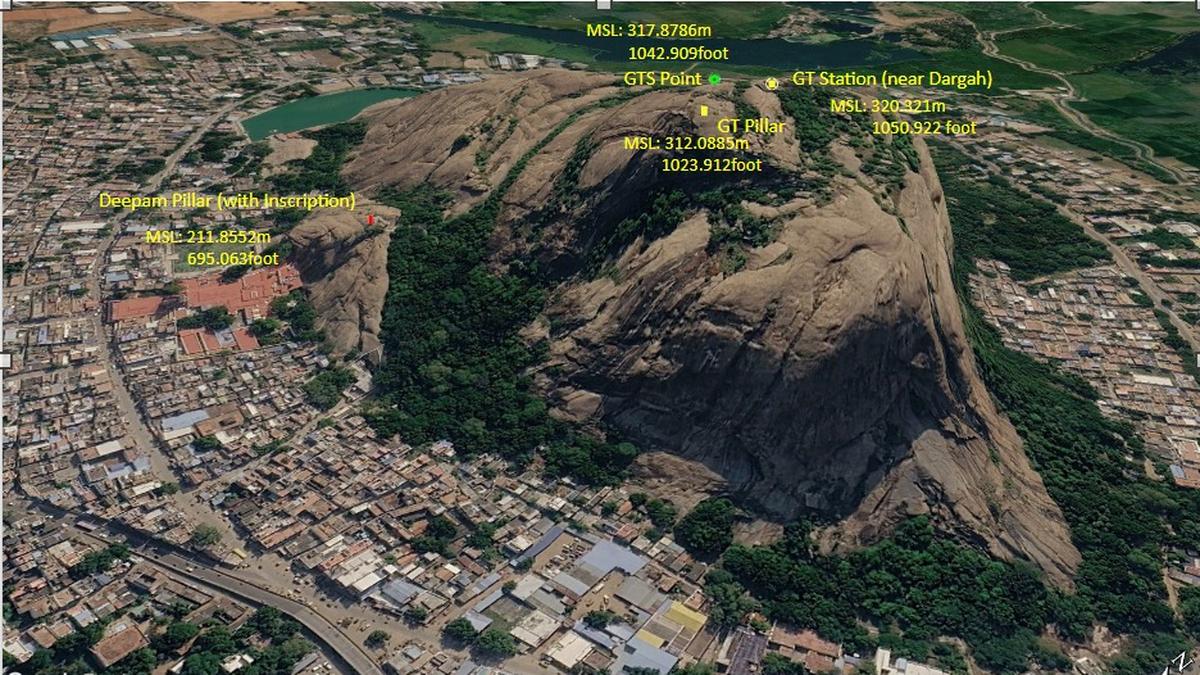
A 2026 report compiled by the Survey and Settlement and Archaeology departments of the Tamil Nadu government says the pillar near the Sikandar Badusha Dargah on Thiruparankundram hill is a Great Trigonometrical Survey (GTS) pillar erected by the British. The report, which has drawn attention amid a bitter dispute over lighting the Karthigai Deepam on the hill, also places the original Deepathoon, or lamp pillar, below the dargah.
The timing matters. The dispute over the Karthigai Deepam has taken centre stage since the Supreme Court permitted the lamp to be lit at the newly identified deepathoon as a limited, one-time arrangement. The government report now offers an official survey-based account of what stands at the top of the hill.
What the survey found
According to the report, triangulation bearings taken in the present survey from Sikandarmalai hill station to nearby stations, including Nagamalai, Sadragiri, Gopalswami, Kutiparai, the Madurai Meenakshi Amman temple, Ponurikimalai and Perumalmalai, are consistent with values given in the colonial-period GTS report. "These values suggest that the pillar installed at Sikandarmalai and the associated station marks engraved in situ on the rocky surface having circle with a dot is a survey pillar," the report says.
The five-volume report runs over 1,800 pages. In its first phase, more than 800 stations were identified, and 484 of them, including 210 primary and 274 secondary stations, were physically documented. Thiruparankundram was a secondary station, marked by a stone pillar and a stone mark.
How the report came about
The work followed an order issued by the Revenue and Disaster Management Department of Tamil Nadu in December 2025 to systematically identify and document all GTS stations. The Revenue Department granted permission to publish the report in August 2026. The Department of Survey and Settlement sits under the Revenue and Disaster Management Department.
The order said many original station points had become untraceable because of time, rapid and often unplanned urbanisation, terrain change from natural calamities, industrialisation and human vandalism. The Director of Survey and Settlement proposed a field exercise to identify, map, document and preserve all GTS stations in the state, and to use their coordinates for future surveys.
Key Facts
The report was compiled by the Survey and Settlement and Archaeology departments of the Tamil Nadu government in 2026.It identifies the pillar near the Sikandar Badusha Dargah as a GTS pillar erected by the British.The original Deepathoon lamp pillar is identified as lying below the dargah.More than 800 stations were identified in the first phase, with 484 physically documented.The Revenue Department granted permission to publish the report in August 2026.TL;DR
- Tamil Nadu report says the pillar atop Thiruparankundram hill is a British-era Great Trigonometrical Survey pillar.
- The original Deepathoon lamp pillar is identified as lying below the Sikandar Badusha Dargah.
- The 2026 report was compiled by the Survey and Settlement and Archaeology departments.
- The findings come as the Supreme Court allowed a one-time Karthigai Deepam lighting at the new deepathoon.
- More than 800 stations were identified in the survey’s first phase, with 484 physically documented.
- The Revenue Department granted permission to publish the report in August 2026.
Frequently asked questions
What does the Tamil Nadu report say about the pillar on Thiruparankundram hill?
The 2026 report, compiled by the Survey and Settlement and Archaeology departments, says the pillar near the Sikandar Badusha Dargah is a Great Trigonometrical Survey pillar erected by the British.
Where does the report place the original lamp pillar?
The report identifies the original Deepathoon, or lamp pillar, as lying below the Sikandar Badusha Dargah.
Why is the report significant now?
It arrives amid a dispute over lighting the Karthigai Deepam, after the Supreme Court permitted a limited, one-time lamp lighting at the newly identified deepathoon.