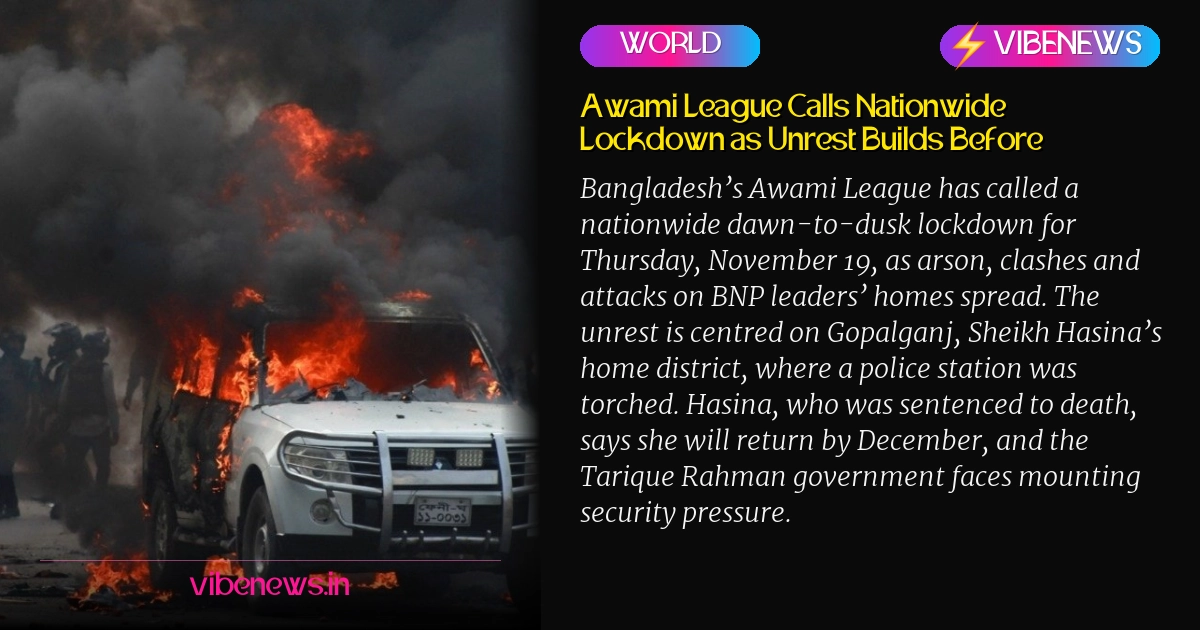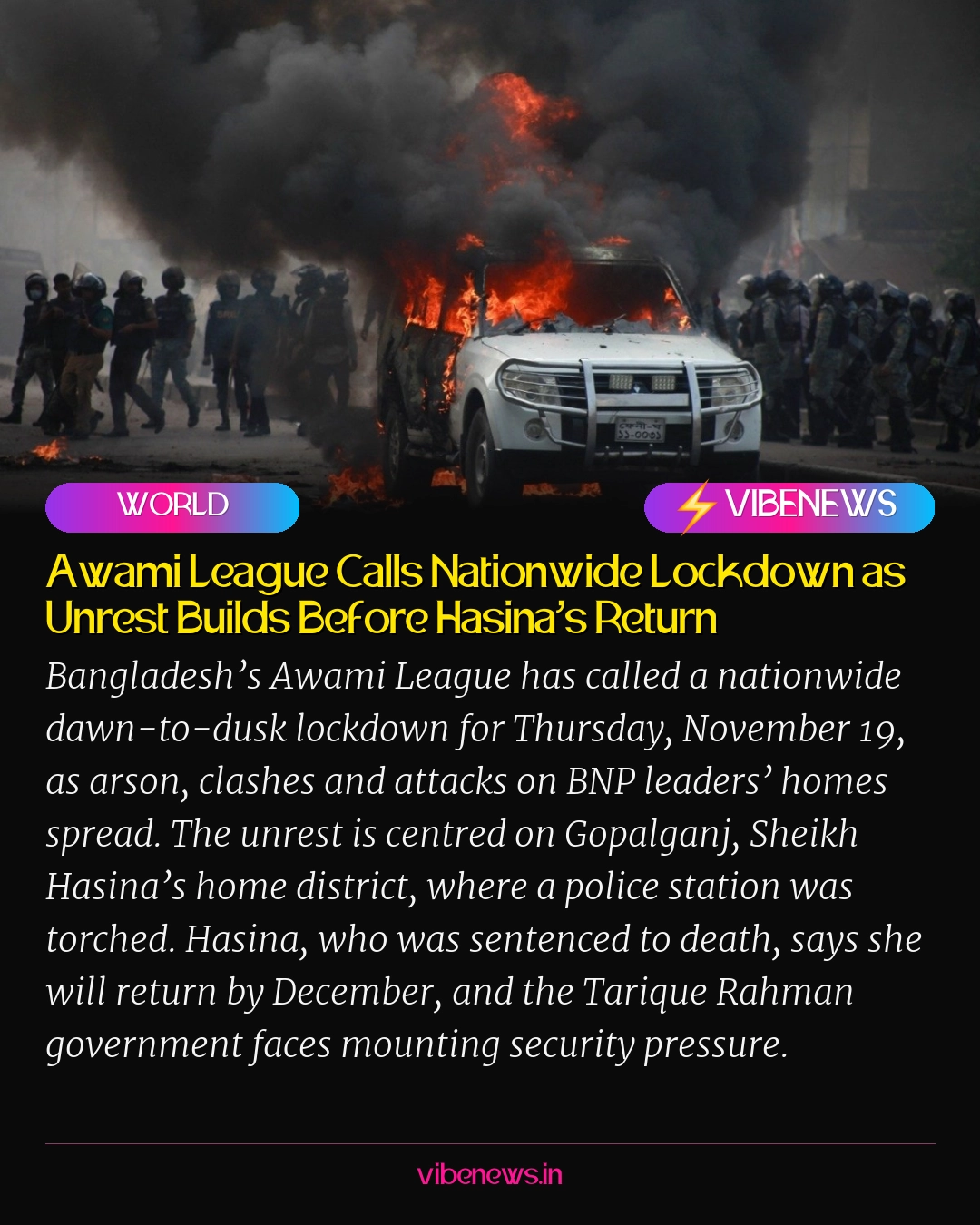
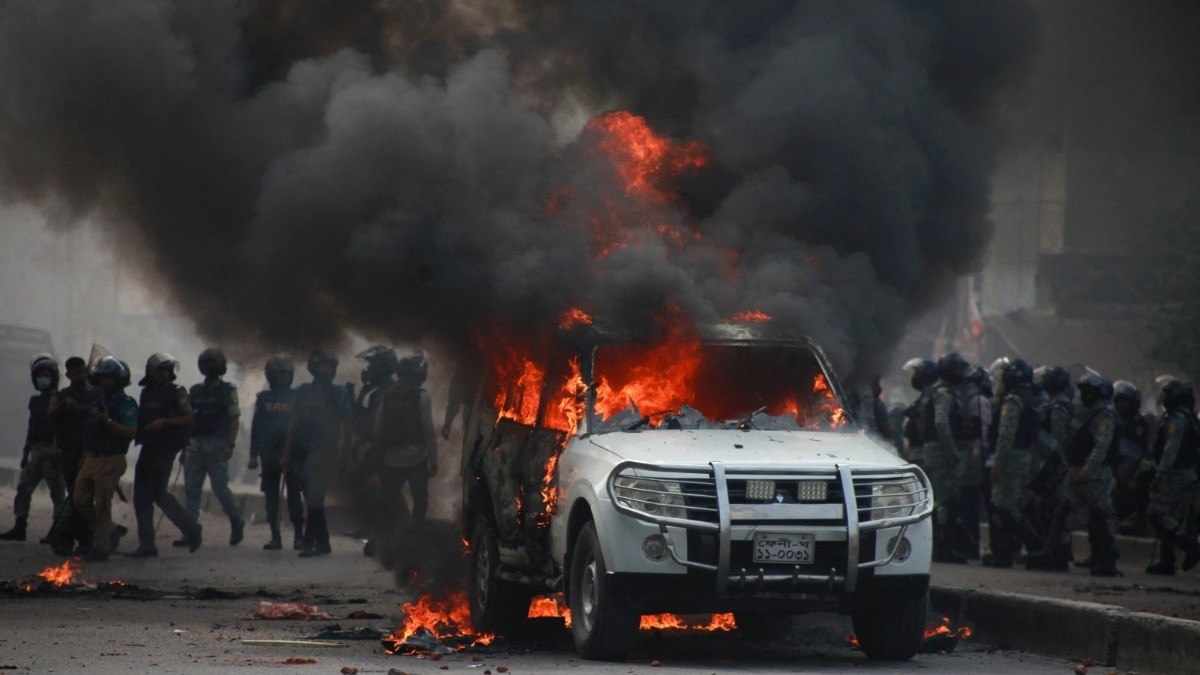
Bangladesh’s Awami League has called a nationwide dawn-to-dusk lockdown for Thursday, November 19, as the party steps up its campaign to bring back Sheikh Hasina from India. The shutdown is the centrepiece of a five-day protest programme, and it arrives at a moment of deepening instability for the government led by Prime Minister and BNP chief Tarique Rahman.
Two years after student protests forced Hasina out in August 2024, her party is trying to show it still has the muscle to shut the country down. The Awami League, founded by Sheikh Mujibur Rahman, ruled Bangladesh from 2009 to 2024 under Hasina’s leadership. The interim administration led by Muhammad Yunus that followed banned the party’s political activities and outlawed several affiliated organisations, including the Jubo League and Chhatra League. The party has been forced underground, but its cadre is now visibly back on the streets.
What the lockdown demands
The party’s statement, published on its official Telegram channel, lays out eight demands. They include lifting the ban on the Awami League, abolishing the International Crimes Tribunal, withdrawing what the party calls fabricated verdicts and false cases, releasing political prisoners, controlling the prices of essential commodities and reopening closed industrial units. The tribunal handed Hasina a death sentence, and the party has treated that verdict as the central grievance.
The mobilisation began on November 14 with leaflets, wall writings and public outreach. Rallies and marches followed on November 15. On November 16, party units were told to submit memorandums to deputy commissioners, foreign embassies and international organisations. November 17 was observed as a ‘Black Day’ to protest the death sentence, which the party says was handed down a year ago.
The Thursday shutdown calls for transport services, shops, factories, government and private offices, banks, courts and schools to close. Ambulances, hospitals, pharmacies, fire services and news media are exempt, and Awami League members have been told to keep emergency services running.
Gopalganj becomes the flashpoint
Nowhere is the party’s revival more visible than in Gopalganj, the district where Hasina was born and where the village of Tungipara is located. The escalation there began on Sunday, when hundreds of Awami League and affiliated-organisation activists took to the streets of Gopalganj town in an open show of strength.
Armed with sticks, clubs and sharp weapons, the cadre broke through police barricades. They vandalised a police armoured personnel carrier and a police box, smashed the July Memorial near Sheikh Kamal Stadium and set it on fire. They also reopened the district Awami League office, which had been locked since Hasina’s ouster in August 2024.
Local reports said at least seven houses belonging to BNP leaders and activists were attacked that evening. One of them was the residence of Tungipara municipal BNP president Imdadul Haque Mollah, which was looted and set on fire. A police sub-inspector was hacked and injured.
Monday brought more of the same. Activists marched through Tungipara and broke into the local party office, which had been shut for more than two years. Reports said more than 100 people gathered near the upazila parishad building, broke the lock, held a meeting and then marched to the mausoleum of Sheikh Mujibur Rahman. In Kotalipara, another procession vandalised and set fire to a commemorative arch belonging to a local BNP leader.
The police station attack
The situation turned sharply on Tuesday evening. Police arrested several Awami League and Chhatra League activists in Tungipara. Party supporters then gathered outside Tungipara Police Station after announcements were made through mosque loudspeakers, demanding the release of those detained.
According to local reports, the crowd stormed the station, vandalised its premises and set fire to the building and vehicles. Several detainees were reportedly freed and firearms were looted. The violence spread to the residence of BNP lawmaker SM Zilani, who represents Gopalganj-3, and that house was also set ablaze. Reports said nine police vehicles and 15 motorcycles were burned at the station. Videos of the attack circulated on Facebook, and some of the attackers were heard chanting ‘Joy Bangla’.
By Wednesday, the station was effectively deserted. There were no personnel on duty, its rooms, computers and furniture were badly damaged, and officers were seen removing their belongings. An officer confirmed that several weapons had been looted, though some have since been recovered.
On the same day, Awami League and Chhatra League activists openly carried machetes and axes along the Gopalganj-Tungipara road. Reporters found activists blocking roads at six locations using felled trees and bamboo poles. Some of them told a local newspaper, on condition of anonymity, that they were on the streets to implement the November 19 lockdown.
Some activists told reporters, on condition of anonymity, that they were on the streets to implement the November 19 lockdown.
A wider wave of blasts and arson
Gopalganj is not the only pressure point. Across the country, crude-bomb explosions, petrol-bomb attacks and arson have targeted public transport, political offices, government establishments and financial institutions. Authorities allege that Awami League members were involved in many of these incidents.
Local reports said at least 19 buses were torched and crude bombs exploded at 29 locations between November 7 and 9. In Netrokona, a compartment of the Haor Express was set on fire. In Dhaka, crude bombs went off near the Faculty of Business Studies and the Faculty of Arts at Dhaka University.
Reuters reported on November 18 that police had recorded dozens of crude-bomb explosions and vehicle arson incidents across at least 28 districts in the previous 10 days. On November 16, two crude bombs exploded near Hazrat Shahjalal International Airport in Dhaka. At least 37 Grameen Bank offices and branches have also been targeted since November 10, according to the bank.
The garment sector has added another layer. Workers demanding higher wages in Gazipur, Savar and Ashulia have blocked highways, clashed with police and attacked vehicles. A police vehicle was set ablaze in Gazipur on Wednesday. The workers’ agitation is separate from the Awami League campaign, but the two have unfolded at the same time and add to the strain on the streets.
A government under pressure
The BNP government is now firefighting one crisis after another. Dhaka has deployed more security forces across the country, especially in Gopalganj. It has also placed thousands of police officers and bureaucrats under scrutiny over alleged links to the Awami League.
Tarique Rahman has told his party’s lawmakers to return to their constituencies and confront the banned party’s activities politically, according to reports. That instruction suggests the government sees the fight as a political one, not just a security one, but the streets are moving faster than the politics.
The timing matters. Hasina said in August that she would return to Bangladesh by December, one way or the other, and she has repeated that position in several interviews since then. Her lawyers have also approached Dhaka for a new passport. Whether she follows through is still unclear, but the Awami League is clearly preparing the ground for it. With December approaching, the political and security pressure on the government is likely to intensify in the coming weeks.
TL;DR
- The Awami League has called a nationwide dawn-to-dusk lockdown in Bangladesh for Thursday, November 19.
- The shutdown is part of a five-day protest demanding the return of Sheikh Hasina from India and an eight-point charter.
- Gopalganj, Hasina’s home district, has seen a police station torched, BNP homes attacked and weapons looted.
- Local reports say crude-bomb blasts and arson have hit at least 28 districts in the past 10 days.
- Garment workers in Gazipur, Savar and Ashulia are also protesting over wages, adding to the unrest.
- PM Tarique Rahman’s government faces mounting security pressure as Hasina’s planned December return approaches.