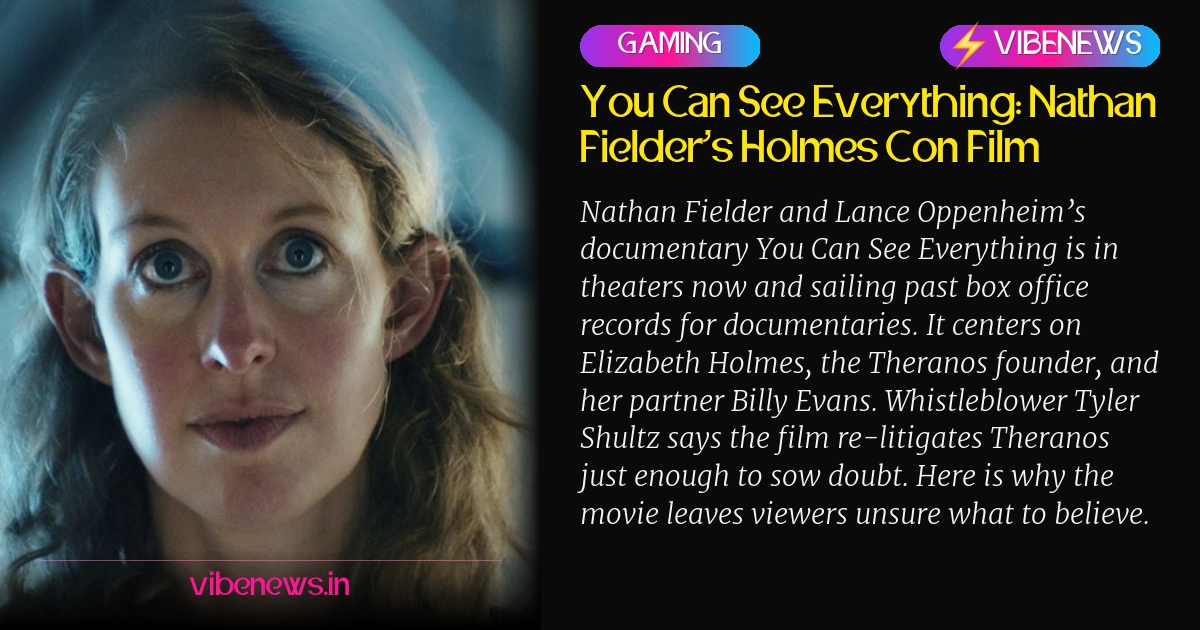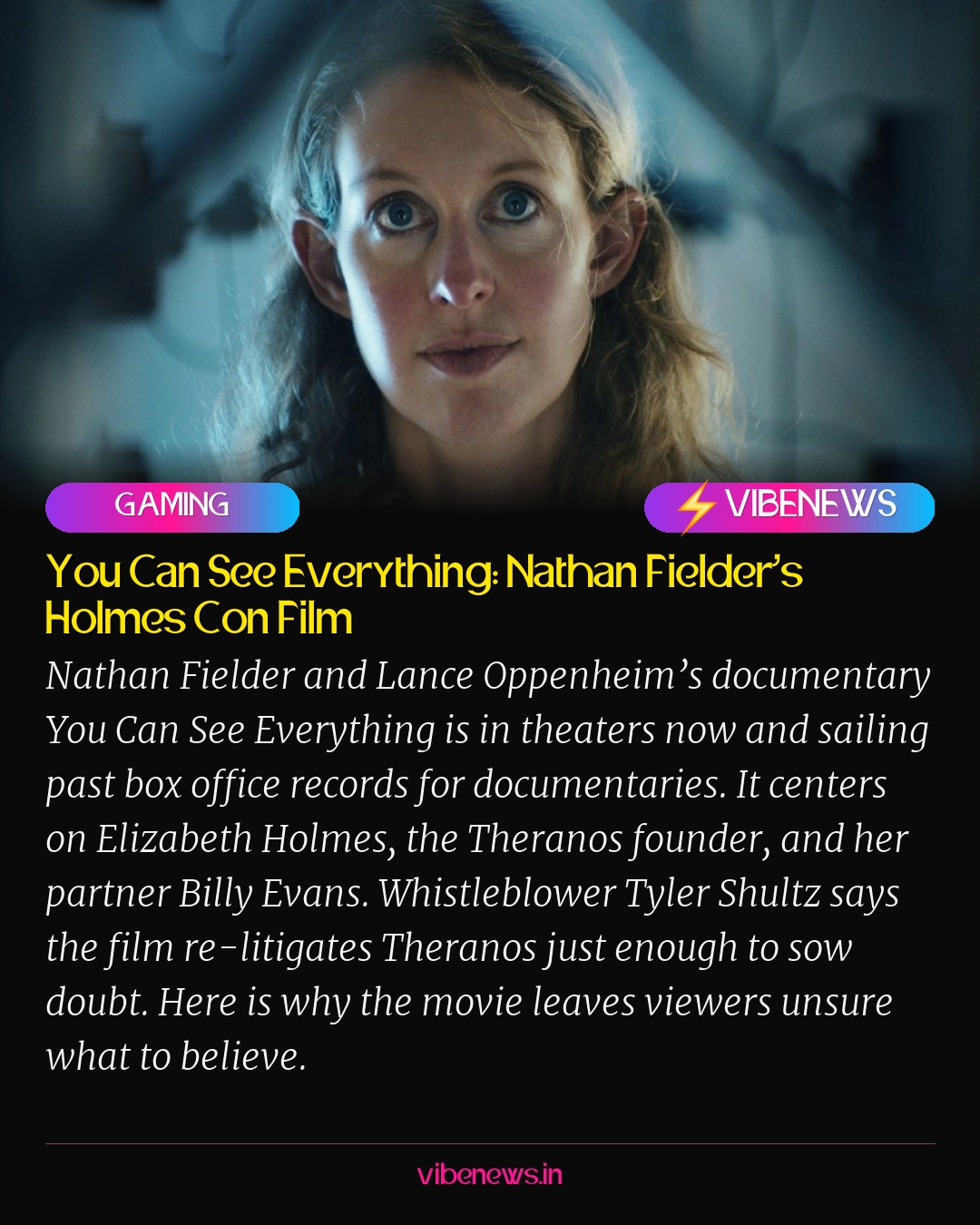
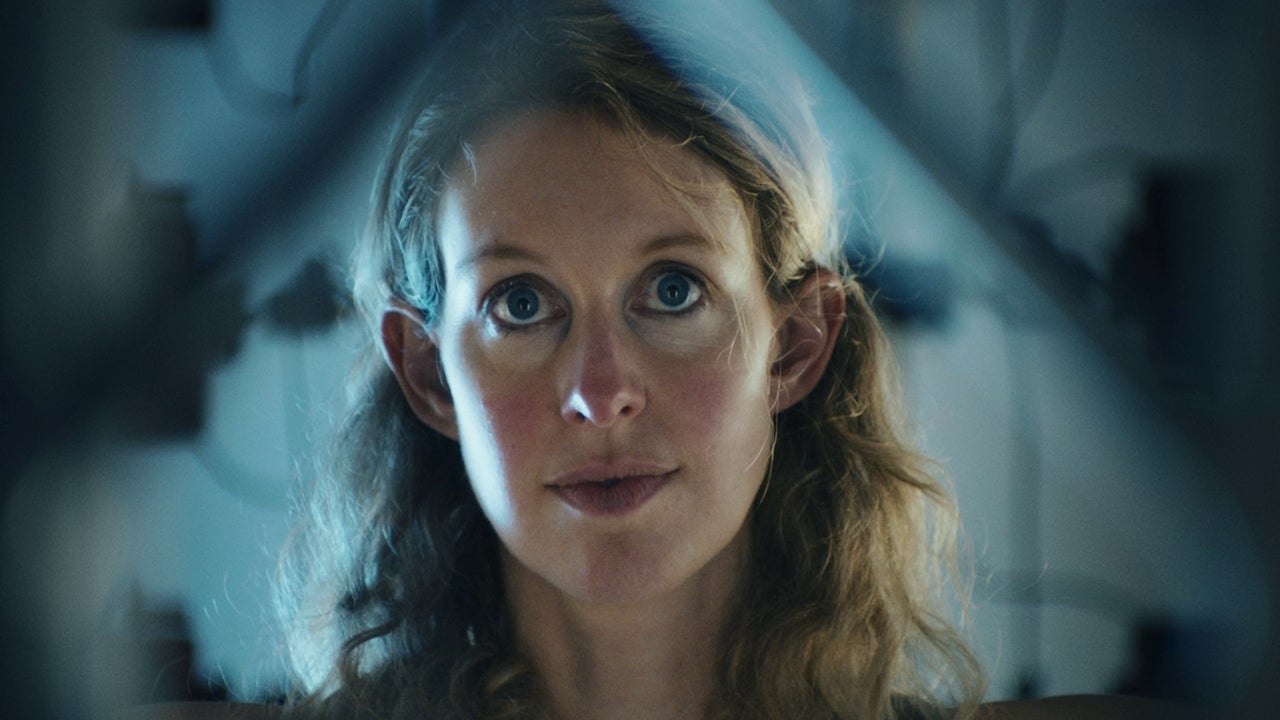
Nathan Fielder and Lance Oppenheim’s documentary You Can See Everything is in theaters now, and it is sailing past box office records for documentaries. The film is impressive, often surprising and effective filmmaking. But its staying power comes from something else: it works as a social experiment about whether any of us truly know, care about, or communicate what is real outside our own interests.
The directors have not delivered a definitive verdict on whether Elizabeth Holmes is a liar. Legal authorities and whistleblowers say she is. Her company Theranos was revealed to be, in essence, selling a blood-testing machine that did not actually work. What the film asks is whether Holmes knows she is lying, or whether she can no longer tell the difference between what she wishes were true and what is.
The Who’s on First Moment
The first jaw-dropping scene comes when Fielder shows Holmes and Evans the famous Abbott and Costello sketch “Who’s on First?” Holmes finds it funny, yet insists she never understood that the first baseman’s name was “Who,” which is the entire crux of the joke. As Fielder presses, she becomes visibly upset by her own confusion, and Evans sends her to bed like a child.
Again and again, the film suggests her discernment is inhibited and that she does not use language the way the rest of us do. Evans claims her brain simply works differently. The experiment grows out of a clip in which Holmes says the Theranos machine “can” run the tests without clarifying that it could not yet. Holmes and Evans bring the machine out of storage to show what she meant. The machine itself could work, but the testing had not caught up with its capabilities. The implication is that what looked like a lie was a failure to grasp linguistic nuance.
Could it be that she did terrible things, but her neurological conditions have been misunderstood? The film keeps that question open.
The Whistleblower Pushes Back
Theranos whistleblower Tyler Shultz wants to shut that speculation down. In an interview, he said he almost jumped out of his seat during the sequence featuring the Theranos device. According to him, it was not the machine used on patients, but a future version that was never completed. In his view, the film re-litigates Theranos just enough to plant doubt in the audience’s mind.
Shultz also makes a broader point. This is not a documentary. It is a very well-made film and a cleverly told story that holds up a funhouse mirror to truth, and to all of us.
For years, pundits and armchair psychiatrists have speculated that Holmes has Narcissistic Personality Disorder and sociopathic or psychopathic tendencies. She has no public diagnosis. Yet the film gives her moments that appear neurodivergent and reframe her whole story. Her partner Billy Evans is, on screen at least, wildly controlling, and the relationship often feels abusive. The film also raises the question of whether Holmes was manipulated by her earlier romantic and business partner, Ramesh “Sunny” Balwani, whom she met when she was 18 and he was 37. Is that pattern now playing out with Evans?
Showmen, Not Documentarians
The question of who is manipulating whom starts with the film itself. Holmes and Evans pitched a “documentary” to tell their version of the story. The directors used the same loose label to tell theirs. Nobody had to meet a real, standardized legal bar to capture the truth.
Courts often rely on an imagined “reasonable viewer” who recognizes dramatization. When Olivia de Havilland sued FX over the series Feud, the court did not seem to believe an audience would read a docudrama as fact. The same defense has worked for a news network. When a cable news network was sued over Tucker Carlson’s show, its lawyers argued no reasonable viewer would take his statements as factually accurate. The judge agreed, writing that given Carlson’s reputation, his viewers arrive with an appropriate amount of skepticism, and dismissed the case.
Real audiences do not appear to make those distinctions. A Washington University study found that when a film contradicted an accurate text, students recalled the film’s misinformation as much as half the time. A general warning that films can be inaccurate did not change the outcome. Only a specific warning about that particular error had an effect. A UK survey cited in press coverage found the share of viewers who believe The Crown is an accurate account of history rose from 19% to 27% between 2022 and 2023. We are not very good at separating fact from fiction, even in the best circumstances.
That matters because of who made this film. Fielder and Oppenheim are not Ken Burns or Errol Morris. They are showmen whose work has long blurred the line between performance and reality. Oppenheim just released Primetime, a film about how To Catch a Predator host Chris Hansen was willing to use and manipulate subjects to get his story. Hansen calls that film a complete work of fiction that exploited his name and image for commercial gain. Now Oppenheim has co-directed a film about a known liar that may be playing with the idea of truth itself.
Fielder has faced his own questions. Critics have asked whether the way participants were portrayed in Nathan for You and The Rehearsal skirted ethical lines. The filmmakers are very good at what they do, and that does not make them unethical. One reading is that they are deliberately using their own reputations to ask hard questions. Another is that they framed pieces of Holmes in or out, depending on what served the narrative.
The Amanda Seyfried Twist
One of the film’s sharpest turns arrives just as the story seems finished. Holmes has gone to prison. The editing room feels like it is hitting a wall, since what the filmmakers have is interesting but not quite enough to break through. So they flip the premise. They have Holmes watch a fictional version of herself, and then do the reverse with Amanda Seyfried. Watching Seyfried and Holmes watch each other brings a bit of voyeuristic glee, and the film knows it.
Fielder showed Holmes The Dropout, the Hulu series in which Seyfried played her. He also showed his film to Seyfried. Those sequences recall a story a filmmaker once told about a brutal car crash scene he shot, based on a traumatic incident a friend had shared without permission. At the premiere, he invited her to sit beside him without warning her, then stared at her to see her reaction. The impulse here feels related: I want to see what it looks like when you are faced with shame, pain, or heartbreak. Then I want to show the world what that looks like.
Seyfried, by all accounts, is a genuinely good person. She cares enough about Holmes to tell Fielder she hated seeing her in a toxic relationship with Evans. She also has a stake in a particular reading of Holmes, having won an Emmy for her portrayal in The Dropout. Yet when she watches Holmes and Fielder’s time together, she immediately slips into the fantasy of playing her again.
In one of the film’s most inventive scenes, Seyfried reenacts a prison visit between Fielder and Holmes, since he could not film inside. Holmes claims guards and others treat her terribly because they believe the version of her that The Dropout presents. Fielder second-guesses his memory of her wording, and Seyfried wonders aloud whether he is being fully accurate or protecting his subject. Neither can be sure their version of events is real. The exchange shows how readily audiences accept the version of a person a series presents, until they see another.
The Many Faces of Liz
Large chunks of the film explore how Holmes’ image has been used. Balwani used it, and so did Holmes herself. The Dropout did, and now Fielder and Oppenheim do. Most grotesquely, Evans does too. He reportedly wants to make an AI version of her available to the public, letting anyone put words in her mouth. He posts from her social media account, apparently without her knowledge, including offensive comments that she, not he, will be judged for.
The film spends its opening stretch making jokes at her expense, and most of the audience laughs along. A thread in the documentary follows Evans wanting to benefit financially from the project. The couple ultimately relinquished their stake. Still, the movie is making a great deal of money itself, and The Dropout earned acclaim and awards before it.
Set against all of this is real violation. Holmes was in two relationships that read as abusive. She testified that Balwani abused her, which he denies. The film presents Evans in an abusive light. Crucially, according to her father, a sexual assault changed her forever. The film mentions this quickly and never follows up. Maybe that assault is part of why she built characters she felt safe hiding behind. Whether any真实 “Liz” sits beneath those characters is unknowable. The film seems to say Holmes is many things, and among them she is an object others have used for years, and here we are doing it again.
The film puts the viewer in the position of being had by Holmes, and, perhaps, by the filmmakers themselves.
Who Gets Believed
The film does not claim Holmes is the only liar in tech. A man involved in Holmes and Evans’ new venture, which some have dubbed Theranos 2.0, says in one scene that all CEOs lie. That raises an uncomfortable question about how different Holmes is from many tech leaders. Elon Musk settled with the SEC over a “funding secured” tweet that a judge ruled was untrue and reckless, and he was never criminally charged. Nikola founder Trevor Milton was convicted of lying to investors and later pardoned. When does a lie matter, and when does it not?
Holmes’ case has one clear distinction. Theranos deployed its machines, and real people received inaccurate medical results. The company voided two years of results from its Edison devices, and misdiagnoses caused patients real distress. Yet the film spends almost no time on what actually happened with Theranos. Holmes’ patients are largely unseen. Holmes was acquitted on the patient-fraud charges and convicted only of defrauding investors. The film may have left that piece out because it was inconvenient to the story. The danger is that it presents a far more sympathetic “Liz” than The Dropout did, and neither version is fully true.
The Blaine Analogy
Fielder brings up illusionist David Blaine, who appears to shove an ice pick through his hand. In reality, Fielder says, it is not an illusion. Blaine is literally driving the pick through his hand. Shultz sees the analogy this way: Holmes is in an abusive relationship, so viewers feel empathy for her, but she is doing the real thing, enduring actual pain, for the sake of the magic trick. From that angle, she is a victim, but one who is so by design. Shultz says the woman he saw on screen is unrecognizable from the Elizabeth Holmes he knew, who commanded any room.
So what is the truth? The filmmakers likely know Holmes is a liar and that she knows it too. But owning that alone does not make a movie. Evans knew he was not inviting traditional documentarians into his world. Did he and Holmes think they could play the players? Did it work? Or is the film playing the audience? Maybe it is all of the above. You Can See Everything is manipulative, and it captures something essentially human. Those two things are not necessarily in conflict.
“You can see everything” is a promise Holmes makes to Fielder early in the documentary. It also points to what the filmmakers are doing. In the end, we do not see or know anything definitively. Clinical psychologist Dr. Ramani Durvasula points out that viewers are left unmoored, possibly gaslit, feeling like victims of narcissistic abuse often do.
That is the film’s ultimate magic trick. It weaponizes empathy. If you do not feel a little taken in, the film suggests, you may sit toward the sociopathic end of the spectrum it presents. If you do feel taken in, you are likely a sucker, ripe for the taking.
TL;DR
- Nathan Fielder and Lance Oppenheim’s documentary You Can See Everything is in theaters now and pulling in box office records for documentaries.
- The film asks whether Elizabeth Holmes knows she is lying, or whether she can no longer tell what she wishes were true from what is.
- Whistleblower Tyler Shultz says the film re-litigates Theranos just enough to sow doubt in viewers.
- The directors show Holmes a clip of herself saying the Theranos machine “can” run tests, then bring the device out to test her claim.
- Research suggests viewers struggle to separate film fiction from fact, even when warned about inaccuracies.
- The film’s final twist has Amanda Seyfried reenact a prison visit, questioning whether Fielder is being fully accurate.