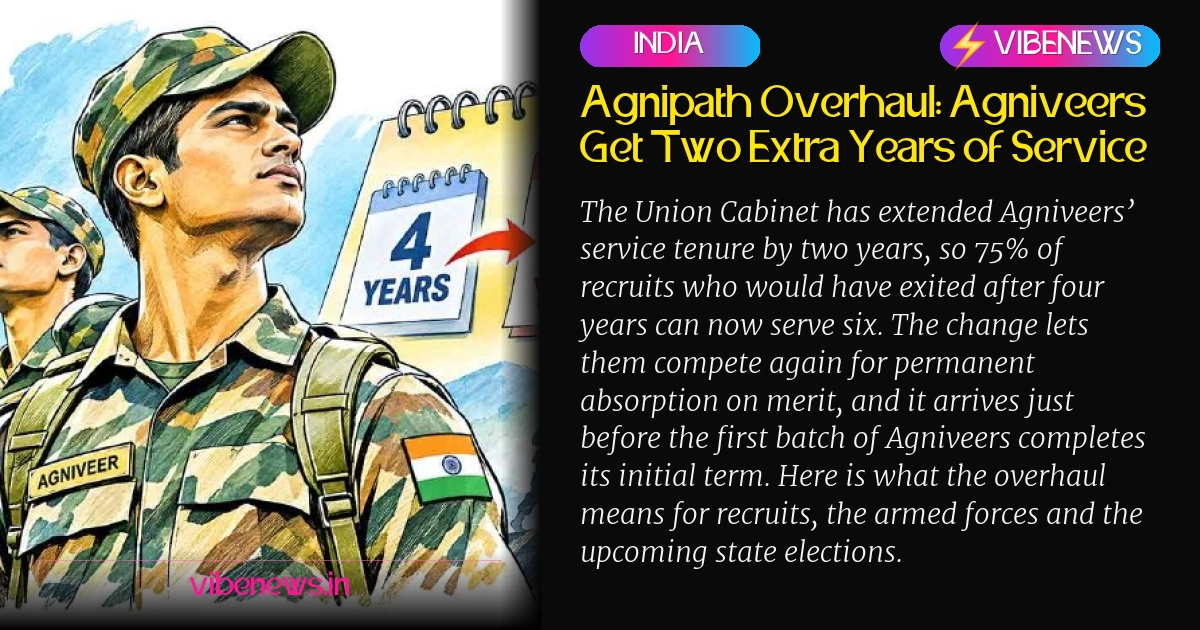
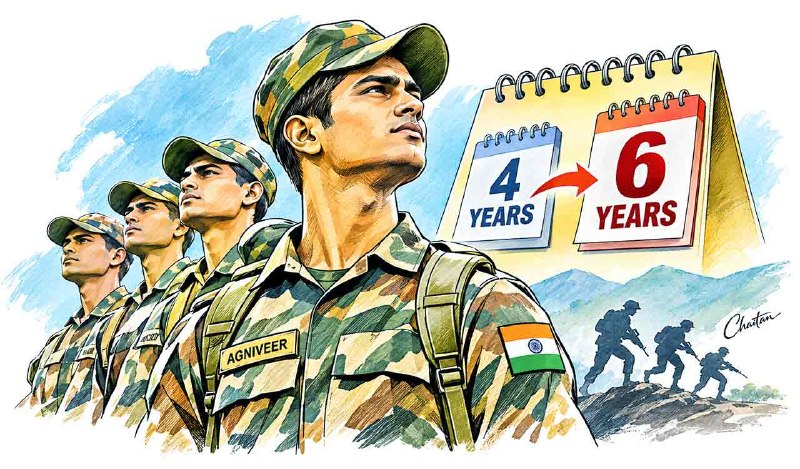
The Union Cabinet has approved a two-year extension to the service tenure of Agniveers, a move that reshapes the Agnipath scheme just as its first batch reaches the end of the original four-year term.
What changed for recruits
Under the original design, recruits were hired for four years. Only a fraction of each batch could stay on. The rest had to leave once their contracts ended. The revised framework changes that math. Around 75% of Agniveers who would have otherwise exited after their initial four years will now be offered an additional two years of service. That creates a pathway toward permanent absorption that did not exist before.
The remaining 25% will continue to be eligible for induction into the regular cadre under the existing selection process. So the core structure of the scheme stays in place, but the exit point moves from year four to year six for most recruits.
The shift raises the potential service period from four years to six. For a recruit who starts out expecting a short contract, that extra stretch is the difference between a sudden discharge and a second chance to compete for a long-term career in uniform.
Why the timing matters
The announcement comes just before the first batch of Agniveers completes its four-year tenure. That timing is hard to ignore. Recruits who were weeks or months away from a hard exit now have a clear answer about what comes next.
A major point of contention among candidates was the uncertainty surrounding their abrupt termination after four years, with no assurance of permanent absorption. The extension effectively postpones that discharge. It does not guarantee a permanent job, but it keeps the door open.
By extending the tenure by two years, the government effectively postpones this sudden discharge, providing recruits with a renewed opportunity to compete for long-term military service.
The pay and the promise
Under the scheme, recruits are hired for a four-year term and receive a monthly salary starting at Rs 30,000, rising to Rs 40,000 by the fourth year. The extension means that the salary structure now applies across a longer stretch for those who stay on.
Only 25% of the total annual recruits are allowed to continue for another 15 years under permanent commission. That figure has been the centre of the debate since the scheme began. The new change does not alter that permanent commission share. What it does is give a larger group of recruits a route to be evaluated again after six years.
On completing six years, recruits will once again be eligible for evaluation for regular absorption into military service, based on merit and established selection criteria. The government is framing this as a viable channel for every recruit to compete for long-term placement in the armed forces.
Why the scheme drew fire
The Agnipath scheme was rolled out with the stated objective of boosting youth recruitment in the armed forces. It also had a major aim to bring down the average age of military personnel and cut ballooning salary and pension bills. Those goals drew support from some quarters but intense criticism from the opposition.
Critics widely felt that the scheme severely undermines the operational capabilities of the armed forces. The concern was that short contracts and frequent turnover would weaken the professional core of the services. The revised framework is an attempt to answer that criticism by keeping more trained personnel in service for longer.
When the scheme was introduced in 2022, it triggered massive protests by youth in several regions over the lack of guaranteed job security. Those protests are central to understanding why this overhaul happened now.
The political calculation
The decision was driven, at least in part, by politics. The NDA has its eyes firmly on the forthcoming Assembly elections in states such as Uttar Pradesh, Punjab, Uttarakhand and Himachal Pradesh. These are traditional catchment areas for military recruitment, and they were the same places where the 2022 protests were most intense.
For young men in these states, the military has long been one of the most sought-after career paths. A scheme that offered no guaranteed future after four years was always going to be a hard sell. The extension changes the pitch. It tells aspirants that the government has listened to the concern about job security and has built a longer runway into the process.
Whether that shift translates into votes or recruitment numbers is a question for the months ahead. What is clear is that the government has moved the scheme closer to what critics were asking for from the start.
What it means for the armed forces
For the armed forces, the revision changes the mix of experienced and newly inducted personnel. Keeping recruits for six years instead of four gives commanders more time with trained individuals. It also lets the institution evaluate candidates over a longer period before deciding on permanent absorption.
The original goal of reducing the average age of personnel and controlling salary and pension costs now has to be weighed against the new, longer tenure. The extension does not remove that tension. It shifts how the cost and the capability are balanced across the six-year window.
The coming years will show whether the revised framework delivers the talent pipeline its supporters promise, and whether the permanent absorption process based on merit gives enough recruits a real future in uniform.
Also Read: Opinion pieces on the scheme have been published alongside coverage, including one calling for the modernisation of physical training at the NDA.
TL;DR
- Union Cabinet approves a two-year extension to Agniveers’ service tenure under the Agnipath scheme.
- About 75% of recruits who would have exited after four years will now be offered two more years.
- Potential service period rises from four years to six, with a route to permanent absorption.
- The remaining 25% stay eligible for regular cadre induction under the existing selection process.
- The change comes just before the first batch of Agniveers completes its four-year term.
- The NDA is eyeing Assembly elections in Uttar Pradesh, Punjab, Uttarakhand and Himachal Pradesh.