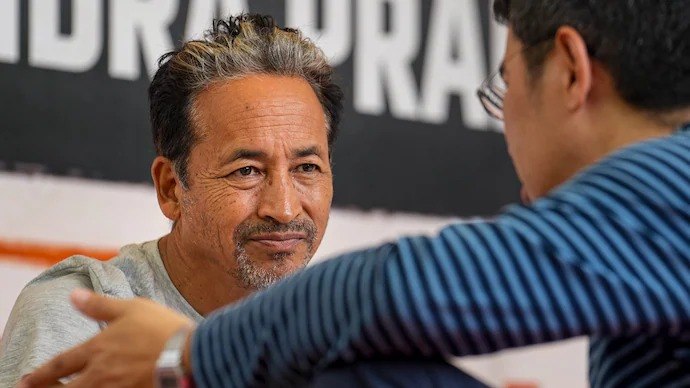
Activist Sonam Wangchuk has declared he will conclude his 20-day indefinite hunger strike on July 20, 2026, following a planned march to Parliament, intensifying pressure for Union Education Minister Dharmendra Pradhan’s resignation over alleged education system irregularities. His health has significantly deteriorated, with a 9 kg weight loss since the fast began.
This strategic timing, coinciding with the first day of Parliament’s Monsoon Session, underscores the protest’s critical juncture. Wangchuk humorously, yet pointedly, stated he would "come back as a ghost" if the July 20 mobilization fails to achieve its purpose, highlighting his unwavering commitment to the movement’s success beyond his physical endurance.
Wangchuk’s Resolve: The July 20 Deadline
Sonam Wangchuk, a renowned educationist and activist, has been on an indefinite hunger strike at Jantar Mantar, New Delhi, for 20 days. His primary demand is the resignation of Union Education Minister Dharmendra Pradhan, citing widespread irregularities within the education system.
Wangchuk announced his intention to end the fast on July 20, but only after participating in the "Sansad Chalo" (March to Parliament) organized by the Cockroach Janta Party (CJP). This date is significant as it marks the commencement of the Parliament’s Monsoon Session, providing a high-visibility platform for the protest.
Why July 20 Matters for the Protest
The decision to continue the fast until July 20 is a strategic move to maximize the impact of the CJP’s protest. By leading the march to Parliament on the opening day of its session, Wangchuk aims to draw national attention to the demands for education reform and accountability.
He has urged supporters to channel their energy into ensuring a massive turnout for the peaceful march, emphasizing that collective participation is more crucial than individual sympathy for his health. Wangchuk believes that ending the fast without a substantial response from the Narendra Modi-led government would send a detrimental message.
Deteriorating Health Amidst Growing Support
As Wangchuk’s hunger strike entered its third week, concerns over his health have escalated. Medical updates on Thursday revealed his weight had dropped to 56.65 kg, a loss of over 9 kg since the commencement of his fast. His blood pressure was recorded at 105/61 mmHg, blood sugar at 80 mg/dL, and oxygen saturation at 97%.
Despite his physical weakening, doctors confirm he remains conscious and mentally alert, though continuous medical monitoring is essential. The activist has consistently maintained his internal strength, urging supporters to focus on the movement’s goals rather than his personal well-being.
Medical Monitoring and Court Intervention
The deteriorating health of Sonam Wangchuk has prompted intervention from the Delhi High Court. The court directed both the Centre and the Delhi government to monitor his condition daily and provide necessary medical assistance if his health worsens.
In response, the Centre affirmed its commitment to closely monitoring Wangchuk’s health. Over the past week, numerous politicians, writers, actors, and civil society figures have visited Jantar Mantar to express solidarity, with many appealing to him to end his hunger strike.
The Cockroach Janta Party’s Journey
The Cockroach Janta Party (CJP) protest, which has been ongoing for 28 days, gained significant momentum following Sonam Wangchuk’s decision to join with an indefinite hunger strike. Initially, the CJP began as a satirical campaign, born out of outrage after Chief Justice of India Surya Kant referred to unemployed youth as "cockroaches" and "parasites."
Abhijeet Dipke, then in Boston, launched the satirical political movement. However, Wangchuk’s physical sacrifice transformed the protest from an online campaign into a movement with a profound moral centre, shifting public conversation beyond mere slogans.
From Satire to Moral Movement
Wangchuk’s fast provided the CJP protest with a new trajectory, attracting broader attention from prominent opposition leaders, writers, actors, and civil society figures. His personal sacrifice has become the defining point of the movement, drawing supporters to Jantar Mantar not just to protest education system failures, but to stand in solidarity with him.
The activist, however, insists that sympathy alone cannot sustain the agitation. For him, the true measure of success lies in the impact of the July 20 Parliament march, not merely the duration of his fast. His "ghost" statement serves as a powerful, albeit lighthearted, warning about the consequences of the movement’s failure to mobilize effectively.
The Path Ahead: Dialogue or Escalation?
Sonam Wangchuk has repeatedly stated his desire for a dialogue with the Centre while maintaining his demand for Dharmendra Pradhan’s resignation. The July 20 march to Parliament represents a critical juncture for both the protesters and the government.
The outcome of this mobilization will likely determine the future trajectory of the protest, either leading to a constructive dialogue and potential resolution or an escalation of the agitation if the demands remain unaddressed. The eyes of the nation will be on Jantar Mantar and Parliament as the Monsoon Session begins.
TL;DR
- Sonam Wangchuk will end his 20-day hunger strike on July 20, 2026, after leading a march to Parliament.
- He demands Union Education Minister Dharmendra Pradhan’s resignation over alleged education system irregularities.
- Wangchuk’s health has significantly declined, losing over 9 kg, with doctors monitoring his condition closely.
- The July 20 march coincides with the first day of Parliament’s Monsoon Session, marking a critical phase for the Cockroach Janta Party (CJP) protest.
- Wangchuk’s "ghost" statement emphasizes his commitment to the protest’s success, urging public participation over sympathy.