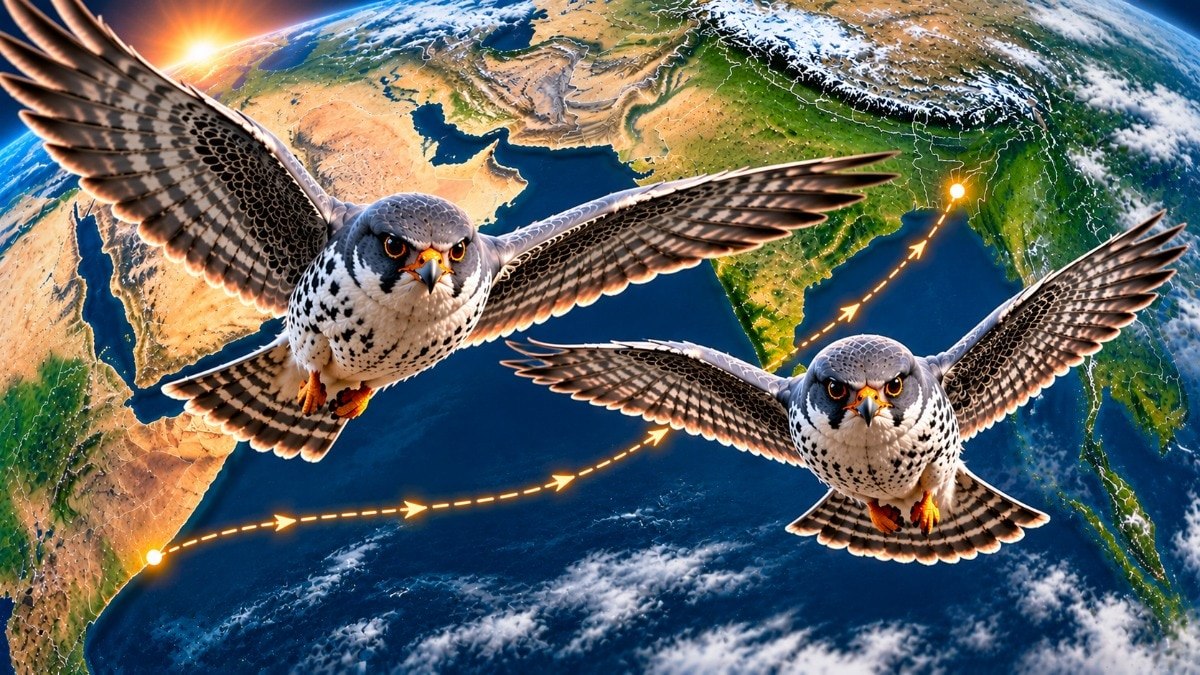
Thousands of Amur falcons gorge on termites in the hills of Manipur every autumn, building the fat reserves that carry them across a nearly 3,000-km nonstop crossing of the Arabian Sea.
Two satellite-tagged birds have just shown how far that fuel can go. Apapang, a male, reached Somalia on Monday, November 23, after flying 5,400 km nonstop from Tamenglong in Manipur. Alang, a young female, had covered 5,700 km in 101 hours and arrived there on November 21. IAS officer Supriya Sahu announced Alang’s arrival on X, and IFS officer Ramesh Pandey confirmed Apapang’s.
Why the birds feed so heavily in Manipur
The falcons stop in Manipur to eat. A 2022 Wildlife Institute of India technical report, based on 270 regurgitated pellets collected at Puching in Tamenglong, found that termites made up 65% of identifiable insect prey. Bugs and related insects accounted for 30%, beetles 4%, and grasshoppers and crickets 1%. The report identified the termite species Odontotermes feae as an important food source.
Timing matters. In October and November, winged termites swarm out of underground colonies, and the falcons catch them in flight. That feeding turns into fat, an energy-dense fuel that can sustain long flights when food and water are unavailable. The WII report says birds typically spend about 13 days at Manipur’s stopover sites, though stays vary. Apapang and Alang stayed nearly 25 days this year.
Wind and stored energy make the crossing possible
Fat alone does not explain the crossing. The WII study found that favourable winds help the falcons cross the Arabian Sea, so the feat depends on stored energy, flight efficiency and wind assistance together.
A loop migration across 23 countries
The Amur falcons’ route is a loop. They travel from breeding grounds in northeastern China to southern Africa and return by a different path, covering up to 22,000 km a year across 23 countries. After reaching eastern Africa, the birds keep moving toward their non-breeding grounds in southern Africa, so Somalia is a waypoint, not the end.
How Manipur’s villagers changed the story
Hunting once threatened the birds. Some estimates say more than one lakh falcons were killed in Tamenglong in a single season about a decade ago. In November 2018, a satellite-tagged falcon named Manipur was shot near Puching village, and authorities tightened hunting restrictions afterward. The WII report credits local communities, awareness campaigns and church-supported conservation efforts with curbing large-scale hunting.
Key Facts
Apapang flew 5,400 km nonstop from Tamenglong to Somalia, arriving on November 23, 2026.Alang completed a 5,700-km nonstop journey in 101 hours.Termites made up 65% of identifiable insect prey in the WII pellet study.The falcons complete an annual loop migration of up to 22,000 km across 23 countries.Both birds were satellite-tagged at Chiuluan, Tamenglong, in November 2025.How do the falcons survive without food or water on the crossing?
They build fat reserves by eating termites in Manipur, and that stored energy sustains them during the nonstop flight. Favourable winds also help them cross the Arabian Sea.
Where are the falcons headed after Somalia?
They continue toward their non-breeding grounds in southern Africa.
TL;DR
- Termites fuel the Amur falcons’ nonstop Arabian Sea crossing from Manipur.
- Satellite-tagged falcon Apapang flew 5,400 km nonstop from Tamenglong to Somalia on November 23.
- Alang covered 5,700 km in 101 hours, reaching Somalia on November 21.
- Termites made up 65% of identifiable insect prey in a Wildlife Institute of India pellet study.
- Favourable winds help the birds cross the Arabian Sea alongside their stored fat.
- The falcons complete an annual loop migration of up to 22,000 km across 23 countries.
Frequently asked questions
What do Amur falcons eat in Manipur?
Termites made up 65% of identifiable insect prey in a Wildlife Institute of India study of 270 regurgitated pellets collected at Puching in Tamenglong.
How far did the falcons fly nonstop?
Apapang flew 5,400 km nonstop from Tamenglong to Somalia, and Alang flew 5,700 km in 101 hours.
Where do Amur falcons migrate each year?
They follow a loop migration of up to 22,000 km across 23 countries, from northeastern China to southern Africa and back.