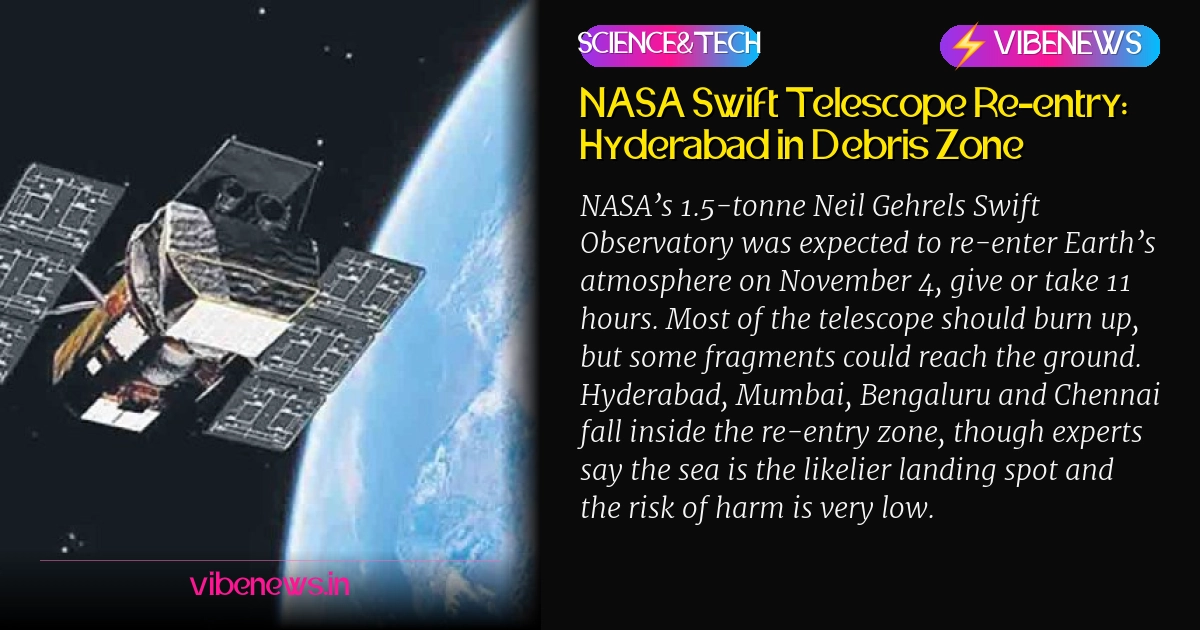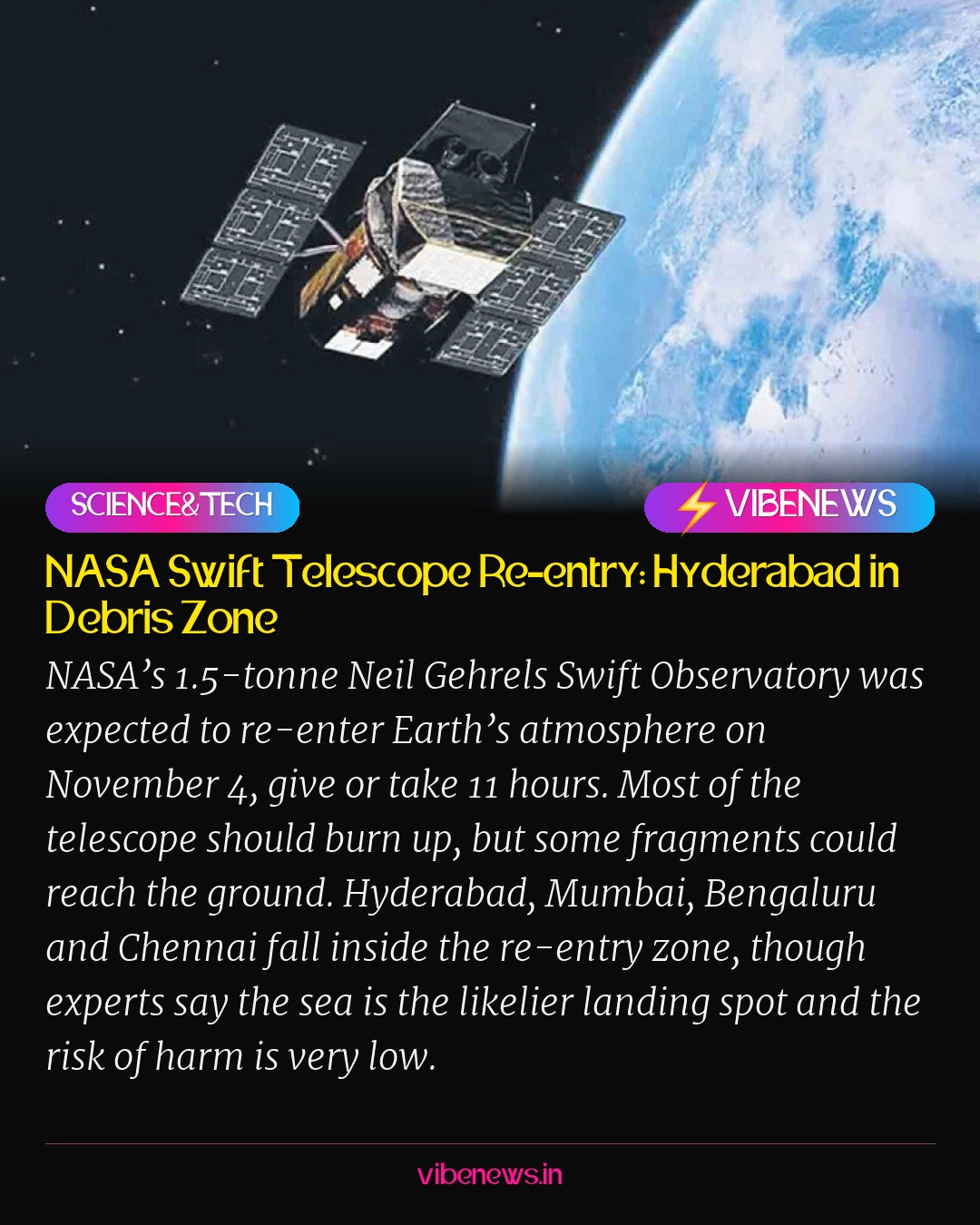

NASA’s 1.5-tonne Neil Gehrels Swift Observatory was expected to fall back into Earth’s atmosphere on November 4, and some of its pieces could survive the descent. The agency’s estimate put the re-entry at around 3:30 a.m. US time, which is 2 p.m. in India. But that was never a precise pin on a map. NASA said the timing could be off by roughly 11 hours in either direction.
The telescope was launched on November 20, 2004, and has been circling the planet for about 22 years. Its age and weight are the reasons it is now coming down. Most of the satellite is expected to burn up during its fall through the atmosphere. A handful of fragments, however, could land on the surface, and that small possibility is what has pushed the story into headlines.
Where the debris could fall. The telescope is expected to come down near the equator. To map the danger, imagine a straight line running from Daman on India’s western coast to Cuttack in Odisha on the eastern coast. Everything south of that line falls inside the re-entry zone. It is a wide stretch of the country, and it covers some of India’s biggest cities.
Why Hyderabad is on the list. Hyderabad sits inside that zone, along with Mumbai, Bengaluru and Chennai. For readers in Telangana, that is the detail that makes this story personal. Still, being inside the zone does not mean debris will land on your street, your roof or your city. Analysts say the sea is the more likely destination for whatever survives the trip down. The city’s exposure is a matter of geography, not a signal that a fall is coming.
How much could survive. The telescope weighs about 1,500 kilograms, and that number is the source of the unease. Space expert McDowell offered a sobering benchmark when he spoke about what might be left after the heat of re-entry has done its work.
If even 100 kilograms of the telescope’s total weight makes it through re-entry, that would be surprising.
That is a surprisingly low threshold for alarm. A quarter of a tonne of metal and hardware arriving intact would be a different story from a few scorched fragments. The point is not that such an outcome is expected. It is that the experts are watching for exactly that scenario and wanted the public to know the numbers.
A second possibility. Scientist Brad Tucker has said the telescope could come down on land rather than in the ocean. That contradicts the comfort offered by analysts who see the sea as the likelier target. The two views together explain why the story has such a tense edge. Nobody is claiming a crash is certain, but nobody can rule out a land landing either.
Why the uncertainty matters. A window of 11 hours either side of the estimate is a wide margin for a fast-moving object. It means that even the agency’s best prediction carries a large band of doubt. The re-entry zone is also broad, which means that a city can be inside it without being in the actual path of any surviving pieces. Those two facts, taken together, are why officials and scientists are speaking in terms of probabilities rather than certainties.
Where the risk stands. Scientists quoted in the reporting say the chance of harm to people is very low. That assessment matters, because it separates a rare event from a disaster in waiting. Still, rare does not mean impossible, and the spread of the re-entry zone across the subcontinent is what keeps the story alive.
What remains unconfirmed. The reporting available does not say whether the telescope came down within NASA’s estimated window, nor does it report any fragments being found. Those details are not part of this account. Readers looking for confirmation of a landing, a sighting or any damage will need updates from the space agency and from official Indian channels as they become available.
The bigger picture for space debris. The telescope’s descent is a reminder that old spacecraft do not simply vanish. After two decades in orbit, a satellite of this size eventually returns to the atmosphere, and the question becomes where its remains fall. That question no longer belongs only to scientists in control rooms. It reaches cities that have never thought about orbital mechanics, and it reaches them with little warning beyond a forecast window and a map.
For now, the facts are clear enough. A 1.5-tonne NASA telescope launched in 2004 was due back in the atmosphere on November 4. Most of it should have burned away. A few pieces might have survived. Hyderabad, Mumbai, Bengaluru and Chennai sit inside the zone where those pieces could have landed, and experts say the ocean is the more likely place for them to end up.
TL;DR
- NASA’s 1.5-tonne Neil Gehrels Swift Observatory was expected to re-enter Earth’s atmosphere on November 4.
- Launched on November 20, 2004, the telescope’s estimated re-entry was 3:30 a.m. US time, or 2 p.m. IST.
- NASA said the timing could be off by roughly 11 hours in either direction.
- Most of the satellite should burn up, but some fragments could reach the ground.
- The re-entry zone lies south of a line from Daman to Cuttack and includes Hyderabad, Mumbai, Bengaluru and Chennai.
- Experts say the sea is the likelier landing spot and the risk of harm is very low.