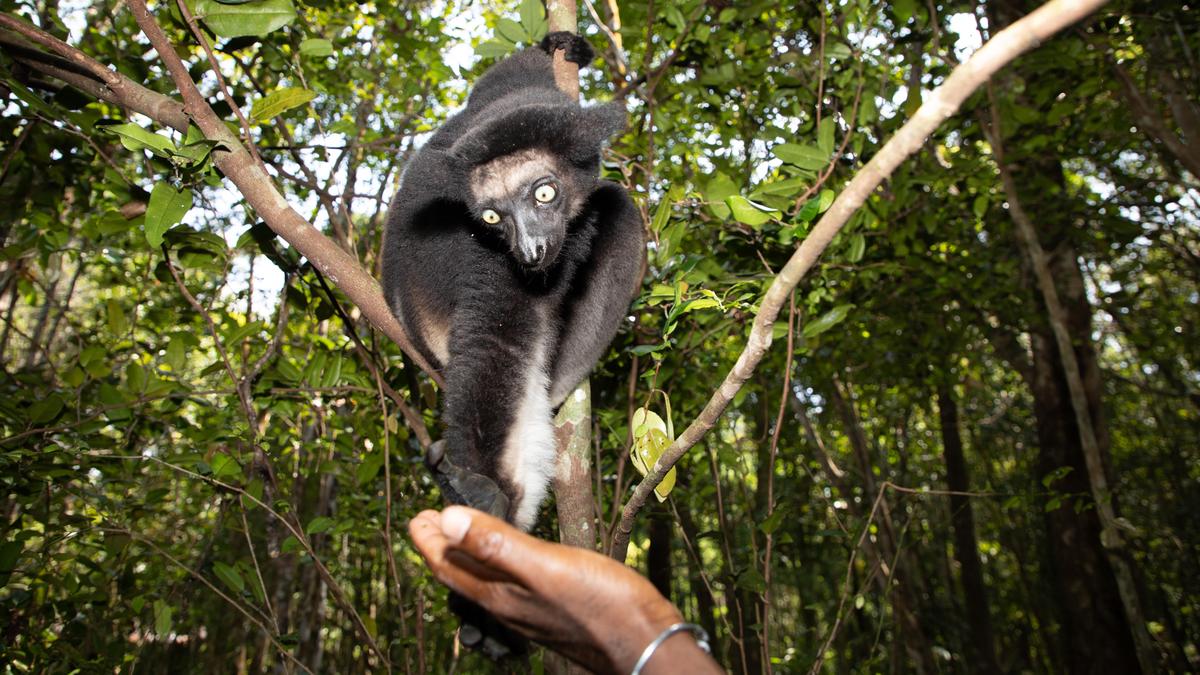
Wild indris, the only singing lemur in the world, open their mouths wider when they sing higher notes, a technique trained opera singers use. Researchers from the University of Warwick and the University of Turin reported the finding in PLOS Computational Biology.
How the Study Was Done
The research team analysed 83 video recordings of 19 wild indris, combining field audio with markerless motion-tracking technology. They tracked the upper and lower lip positions frame by frame and compared mouth-opening changes with changes in vocal frequency.
The results showed that the indris opened their mouths wider to project higher-pitched sounds through the forest. Dr Filippo Carugati of the University of Turin, an author of the study, said the method let the team study facial movement almost frame by frame, something that listening to audio alone cannot capture.
A Technique Known as Vocal Tract Tuning
Human singers widen their mouths as pitch rises, which aligns the resonant frequencies of the vocal tract with the harmonics of the voice and amplifies the sound. The technique is called vocal tract tuning, or formant tuning. For an animal calling through dense forest, the lead researcher said, that amplification could decide whether a song carries or fades.
"Every time the pitch of an indri’s song rose, we could see its mouth opening wider, frame by frame," said Dr Chiara De Gregorio, corresponding author and Honorary Research Fellow at the University of Warwick. "It’s the kind of fine-tuned coordination between voice and body that we usually associate with trained human singers, not with a lemur singing from the forest canopy."
Imagine finding the same technique being used in the middle of a rainforest in Madagascar.
Why It Matters for Biomusicology
Biomusicology studies music from a biological point of view. Dr De Gregorio said researchers want to understand the biological roots of music-making. Because every human culture has some form of music, scientists treat it as a biological trait. Singing primates offer a way to study where that trait came from.
Humans and indris last shared a common ancestor about 74 million years ago. The similarities in how the two species produce voice are therefore likely the result of convergent evolution, meaning both arrived at the same solution independently.
Conservation Concerns
Lemurs are endemic to Madagascar, and the International Union for Conservation of Nature considers them the world’s most endangered mammals. Habitat loss, hunting and unstable conservation efforts tied to political and financial instability are the main threats. While most lemurs can survive in captivity, the indri can survive only in its natural habitat, which makes protecting the forests essential.
Dr De Gregorio said the research may help draw attention to a threatened species. "These species do not survive in captivity," she said. "So there is no way to save them if we don’t preserve them."
Key Facts
The indri is the only singing lemur in the world and one of the larger lemur species.The study analysed 83 video recordings of 19 wild indris.The findings were published in PLOS Computational Biology.Humans and indris last shared a common ancestor about 74 million years ago.The International Union for Conservation of Nature classes lemurs as the world’s most endangered mammals.Are indris found anywhere outside Madagascar?
The sources describe lemurs as endemic to the island of Madagascar, meaning they are naturally found only there.
Can indris survive in captivity?
According to the sources, most lemurs can survive in captivity, but the indri can survive only in its natural habitat.
TL;DR
- Wild indris open their mouths wider on high notes, just like trained opera sopranos.
- The indri is the only singing lemur in the world and lives only in Madagascar.
- Researchers from the University of Warwick and University of Turin studied 83 videos of 19 wild indris.
- The study was published in PLOS Computational Biology.
- Humans and indris share a common ancestor from about 74 million years ago.
- The indri is endangered mainly due to habitat loss.
Frequently asked questions
What do singing indris and opera singers have in common?
Wild indris open their mouths wider as their pitch rises, a technique trained human singers use to amplify sound, according to researchers at the University of Warwick and University of Turin.
How many indris were studied?
The research team analysed 83 video recordings of 19 wild indris, combining field audio with markerless motion-tracking technology.
Why are indris at risk?
The sources say habitat loss, hunting and unstable conservation efforts are the main threats, and indris cannot survive in captivity.