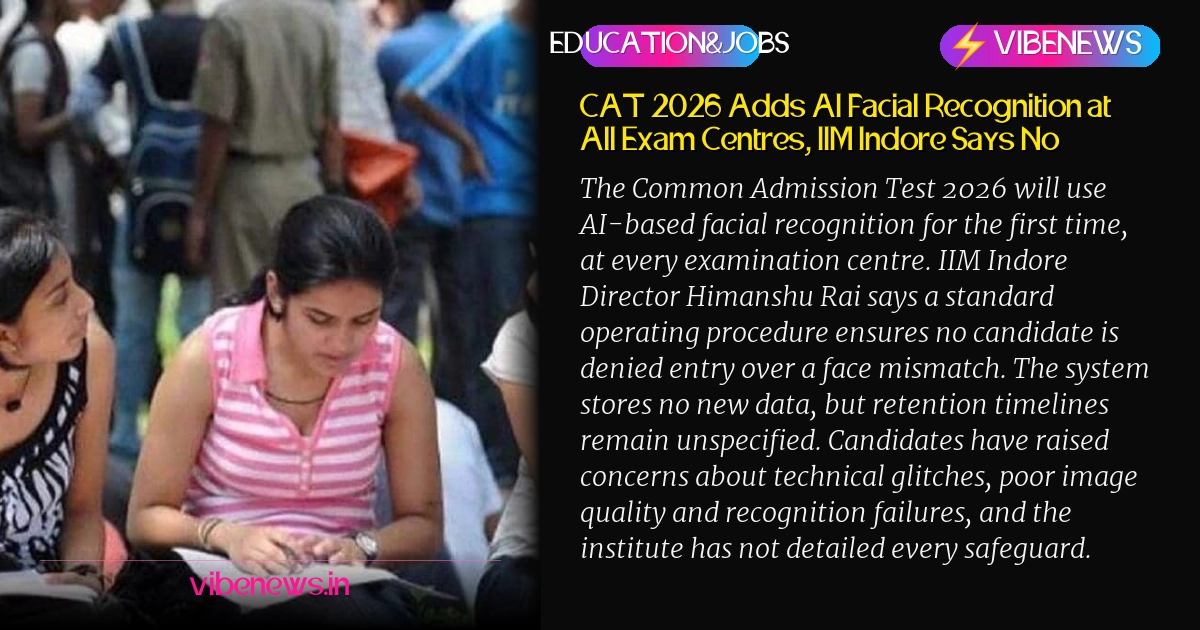
IIM Indore will deploy AI-based facial recognition at every CAT 2026 examination centre, the first time the Common Admission Test has used the technology. Institute director Himanshu Rai confirmed the move and said it is designed to check every candidate’s face against the photograph submitted during the application process.
The aim is straightforward. Organisers want to stop impersonation, where someone else sits the exam on a candidate’s behalf. Rai said the primary objective is to strengthen the examination’s identity verification mechanism and prevent impersonation, and the system will run at all centres rather than a handful of select locations.
For thousands of aspirants who have already spent months preparing for one of the country’s most competitive entrance tests, the announcement raises an obvious question. What happens if the machine does not recognise them at the door?
The institute’s answer to that fear
Rai acknowledged that candidates are worried about being refused entry because of technical glitches, poor image quality or the system failing to recognise a face. He did not dismiss those concerns. Instead, he said IIM Indore has put safeguards in place so that genuine applicants do not run into entry problems because of the technology.
The process ensures that this year no candidates are denied entry as a result of mismatch.
That is a strong assurance, and it is the line candidates will likely hold the institute to. Rai said a standard operating procedure has been developed to handle such situations. He did not publicly lay out the step-by-step details of that procedure in the material available, so the practical experience at a centre on exam day will be the real test.
How the check is supposed to work
The facial recognition system is meant to act as an extra layer of identity verification, not a replacement for existing checks. At the centre, the camera captures the face of the person presenting for the test. The software then compares that face with the photograph uploaded during the CAT application. If the two match, the candidate proceeds. The process is aimed at confirming that the person sitting the exam is the same person who applied.
Rai framed the technology as a way to protect fairness. The idea is that a candidate who applied honestly should not lose ground to someone who sends a substitute to take the paper. Seen that way, the system is less about catching cheats at the door and more about preserving the integrity of the score that admissions committees will later rely on.
The privacy question
Any system that captures faces raises questions about where that data goes and how long it stays there. The institute has addressed the matter in part. Rai said the mechanism will be used exclusively for identity matching and will not involve storing any new data. He put it plainly: the facial recognition mechanism is used solely to match the candidate present at the examination centre with the photograph submitted at the time of application, and no new data is stored.
That statement will reassure some candidates, but it leaves gaps. The director’s response did not specify a separate data-retention timeline. It also did not go into the technical safeguards that govern how candidates’ facial information is processed. Anyone who wants to understand exactly what happens to a captured image, and for how long, will need more detail from the institute.
Candidates who are uneasy about biometric checks may want to read that detail closely before the exam. The distinction between storing no new data and keeping no data at all is one that privacy-conscious applicants tend to notice.
Why CAT is the test under the microscope
CAT is the national-level entrance examination for admission to postgraduate management programmes at the Indian Institutes of Management and several other business schools. Because so many aspirants compete for a limited number of seats, even a small verification failure can carry real consequences. A candidate turned away at the gate does not simply lose a sitting. Depending on how the process is handled, they could face stress, confusion and a lot of questions about their rights.
That is why the verification rollout matters beyond IIM Indore’s own administration. It is the first time the technology has been introduced for CAT, which means the exam’s entire examination network will be testing the system at the same time. Problems that look minor in a pilot can become widespread when thousands of candidates arrive at dozens of centres within a short window.
The institute has said the move is aimed at curbing impersonation while making sure genuine candidates are not inconvenienced by technical failures during verification. Both goals sit in tension with each other. Tighten the check too much and honest candidates get caught in the net. Loosen it and the impersonation problem remains. The standard operating procedure is meant to resolve that tension on the day.
What candidates should keep in mind
For aspirants, the practical takeaway is simple. The photograph uploaded during the CAT application is now central to entry. Candidates should make sure their application photograph is a clear, recent image of themselves. Those who have concerns about the process can raise them with the institute before the examination rather than assuming the system will work without issue.
The institute has given a clear commitment that no candidate will be denied entry because of a mismatch this year. It has also been clear that the technology is being used only to match faces against application photos, with no new data stored. What remains less clear is the full retention timeline and the complete technical safeguards. Those details will matter to many applicants, and they are worth pressing for.
CAT 2026 will be the first real test of whether AI verification can run across a national exam network without turning the entry gate into a point of failure. Until the examination begins, the promise from IIM Indore stands as the main reassurance candidates have. Whether it holds will become clear only when the first candidates walk through the door.
TL;DR
- IIM Indore will use AI-based facial recognition at all CAT 2026 exam centres, the first time the test has used it.
- The system matches each candidate’s face with the photograph submitted during the CAT application.
- Director Himanshu Rai says a standard operating procedure ensures no candidate is denied entry due to a mismatch.
- The institute says no new facial data is stored, but a separate retention timeline has not been specified.
- Candidates have raised concerns about glitches, poor image quality and recognition failures at the gate.