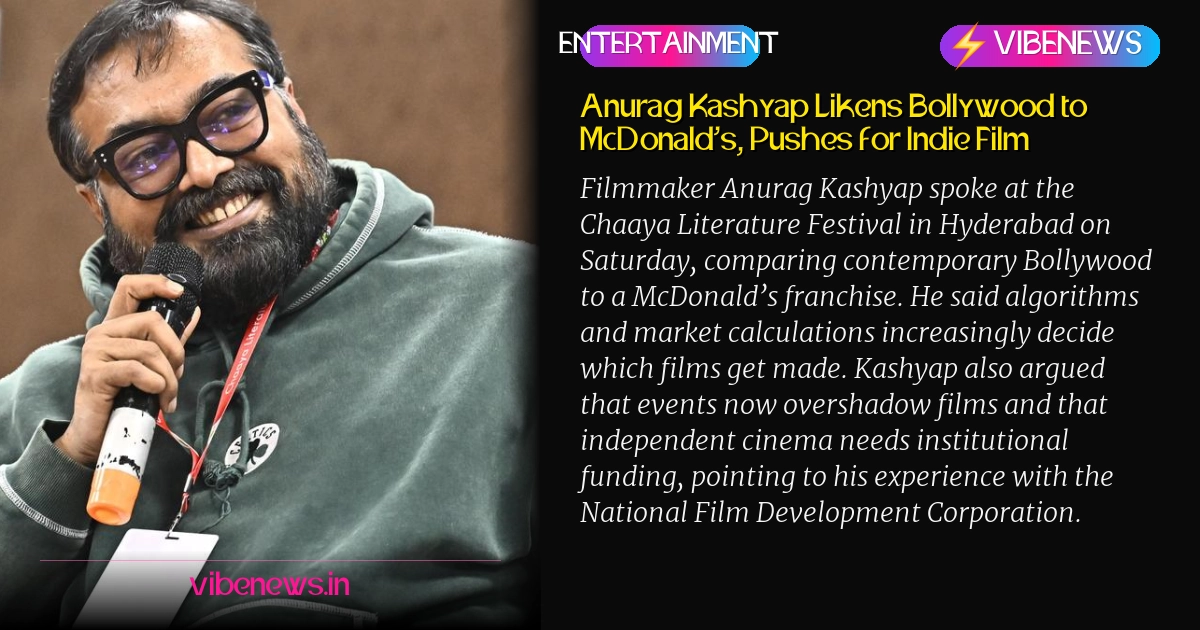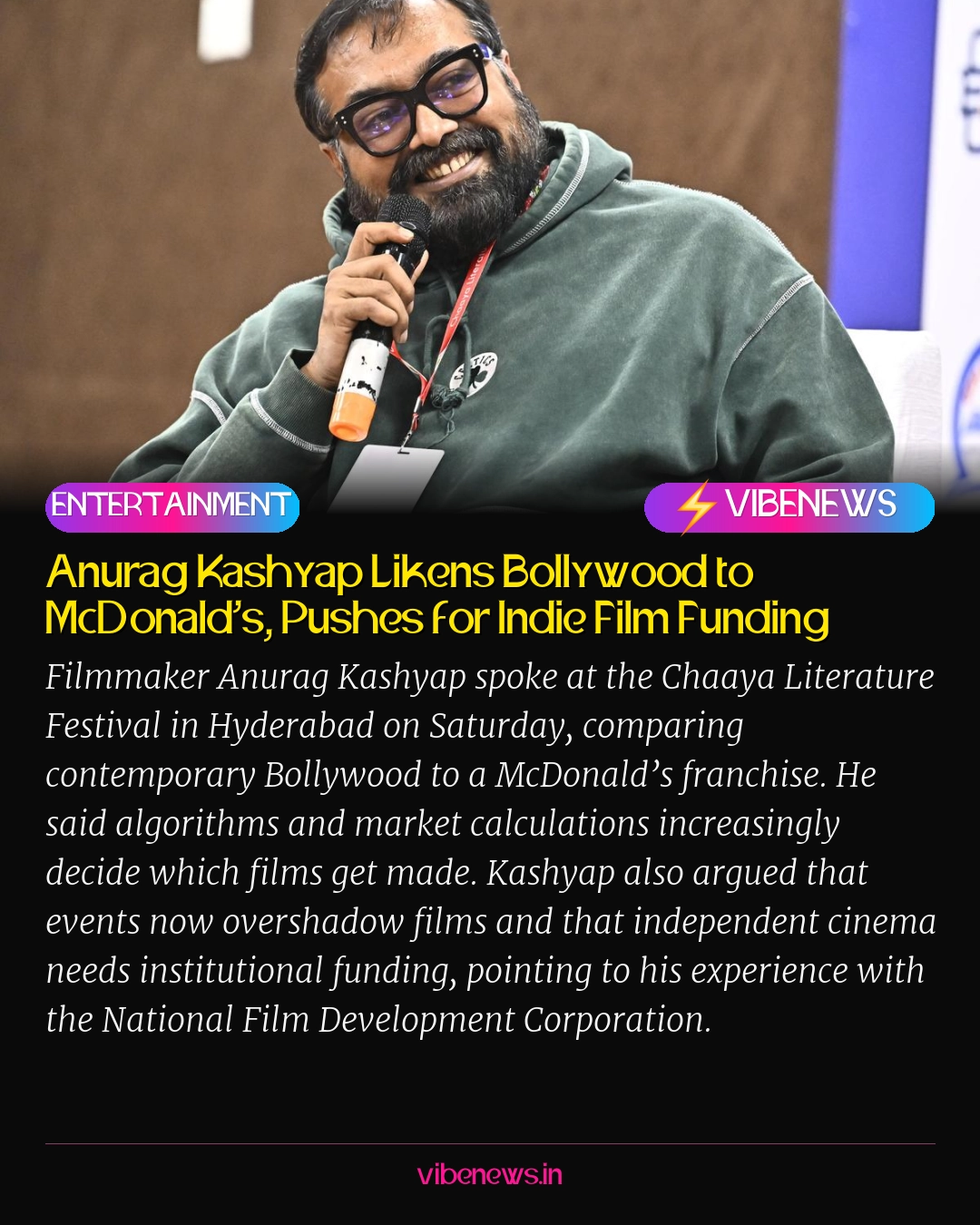
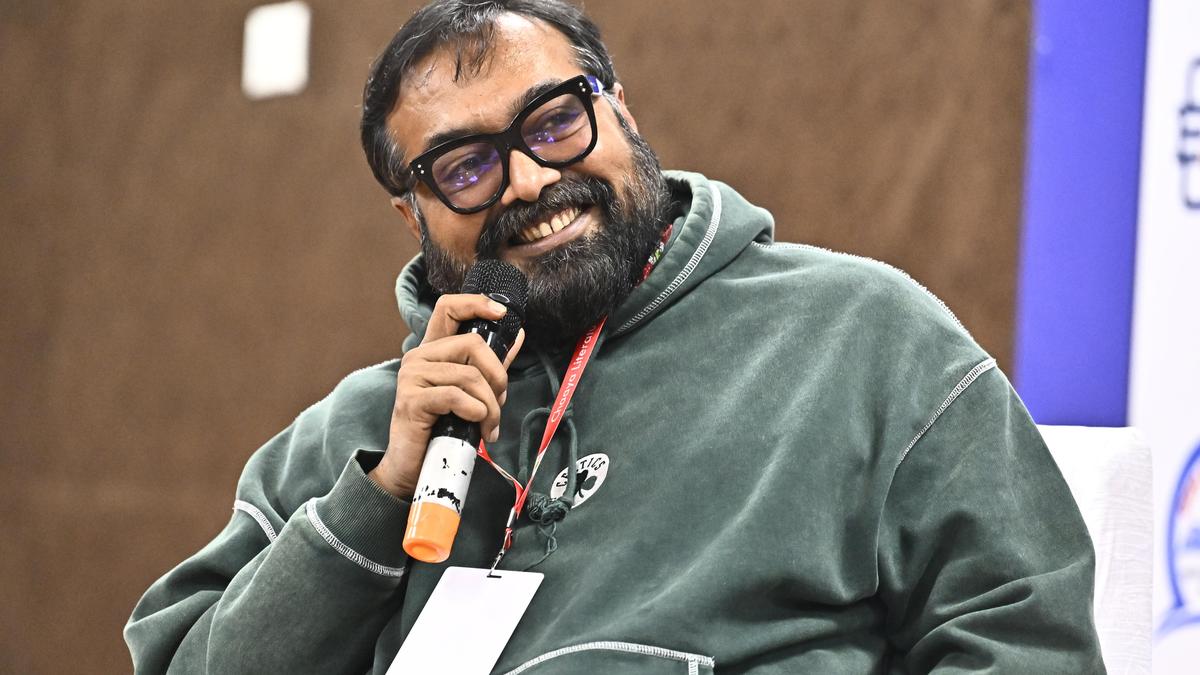
Filmmaker Anurag Kashyap said on Saturday that Bollywood has become a franchise, with algorithms and box-office arithmetic deciding which films get made. He made the remarks on day one of the two-day Chaaya Literature Festival at Dr. B.R. Ambedkar Open University in Hyderabad.
Kashyap did not soften the point. “Contemporary Bollywood is like a franchise of McDonald’s,” he said, drawing a line between fast food and filmmaking that leaves little room for experimentation. In his view, the industry now produces films that fit a formula, and unconventional stories struggle to find a place in that system.
When the release becomes the event
Kashyap said the focus of filmmaking has shifted away from stories and characters. Instead, studios build elaborate events around releases. “Events are bigger than films now,” he said, pointing to star appearances and spectacle that have become the main attraction. He observed that films are increasingly built around star entries, rather than letting characters carry the story.
He also took aim at the obsession with box-office milestones. Chasing collection targets, he argued, has created false benchmarks for what counts as success. Large productions take over screens, and smaller films are left fighting for theatrical space. A movie can be a good film and still disappear within days because it never got the screens to find an audience.
Kashyap questioned the phrase ‘pan-India cinema’ as well. He described it as a business-driven idea, noting that films had been dubbed and circulated across language markets long before the term became fashionable.
Why independent filmmakers need institutional backing
The sharpest part of his critique was about money. “Filmmaking is the only art form that costs money,” Kashyap said. Filmmakers who depend on commercial investors have to think about the returns their projects will bring, and that pressure shapes what gets made.
His answer was institutional funding, similar to the cultural funds that exist in other countries. Such funds would let filmmakers chase ideas without carrying the full weight of commercial recovery. “When there is institutional support, you will see the purest art, because the burden of money is not on the artist,” he said.
“When there is institutional support, you will see the purest art, because the burden of money is not on the artist.”
Kashyap spoke from personal experience. He recalled making his film That Girl in Yellow Boots with support from the National Film Development Corporation, which allowed him to work without commercial pressure. He also spoke about the earlier role of institutions such as the NFDC in backing projects that did not fit mainstream expectations. That kind of backing, he suggested, is far rarer now.
Censorship, collaboration and a lesson from Kerala
Kashyap also expressed concern about limits on public expression. Censorship, he said, does not stop at films. It reaches literature and the wider exchange of ideas. Artists and writers, in his view, have a duty to document the times they live in.
On the other hand, he praised Malayalam cinema for its collaborative culture. He cited actors such as Fahadh Faasil, who move between different kinds of films and support productions made by other filmmakers and actors. That kind of cooperation, he argued, helps smaller projects find backing and opens doors for more filmmakers. He also acknowledged the recent output of Tamil cinema.
Why the Hyderabad setting matters here
The remarks came in Hyderabad, at an event hosted by Dr. B.R. Ambedkar Open University, which places the debate on Telangana’s own cultural calendar. The city has long been a hub for Telugu and Hindi film work, and the question Kashyap raised about screens, funding and who gets to tell stories is one that filmmakers and audiences in the city feel directly. The festival is a literature event, but Kashyap used it to talk about what cinema is becoming.
Writing, reading and the time away from the camera
Kashyap spent part of his talk on literature, which he described as a steady influence on his work. Growing up, he read the Ramayana and the Mahabharata, which were readily available at home. He also recalled watching Vittorio De Sica’s Bicycle Thieves more than three decades ago. He singled out a scene in which a father struggles to recover his stolen bicycle while his son watches, a memory that connects to his own father, an engineer, who struggled during a strike during the Emergency.
He still writes by hand and can produce between 40 and 60 pages a day. “My writing is very instinctive,” he said. He described sitting down and writing without stopping. Shortly before arriving at the festival, he noted down a new story idea because he did not want to lose it.
Kashyap said he has not directed a film in two years. He is currently taking up acting assignments while preparing for his next projects. Acting, he explained, gives him financial stability, while filmmaking remains his real passion. It is a candid admission from a director who has spent years pushing against the system he now describes so bluntly.
TL;DR
- Anurag Kashyap called Bollywood a McDonald’s franchise at the Chaaya Literature Festival in Hyderabad on Saturday, November 14, 2026.
- He said algorithms and market calculations are deciding which films get made, leaving little room for experimentation.
- Kashyap argued that events and star entries now matter more to studios than the stories and characters themselves.
- He criticised box-office milestones as false benchmarks that push smaller films out of theatres.
- He called for institutional funding, similar to cultural funds in other countries, so independent filmmakers can work without commercial pressure.
- Kashyap said he has not directed a film in two years and is currently taking acting roles for financial stability.