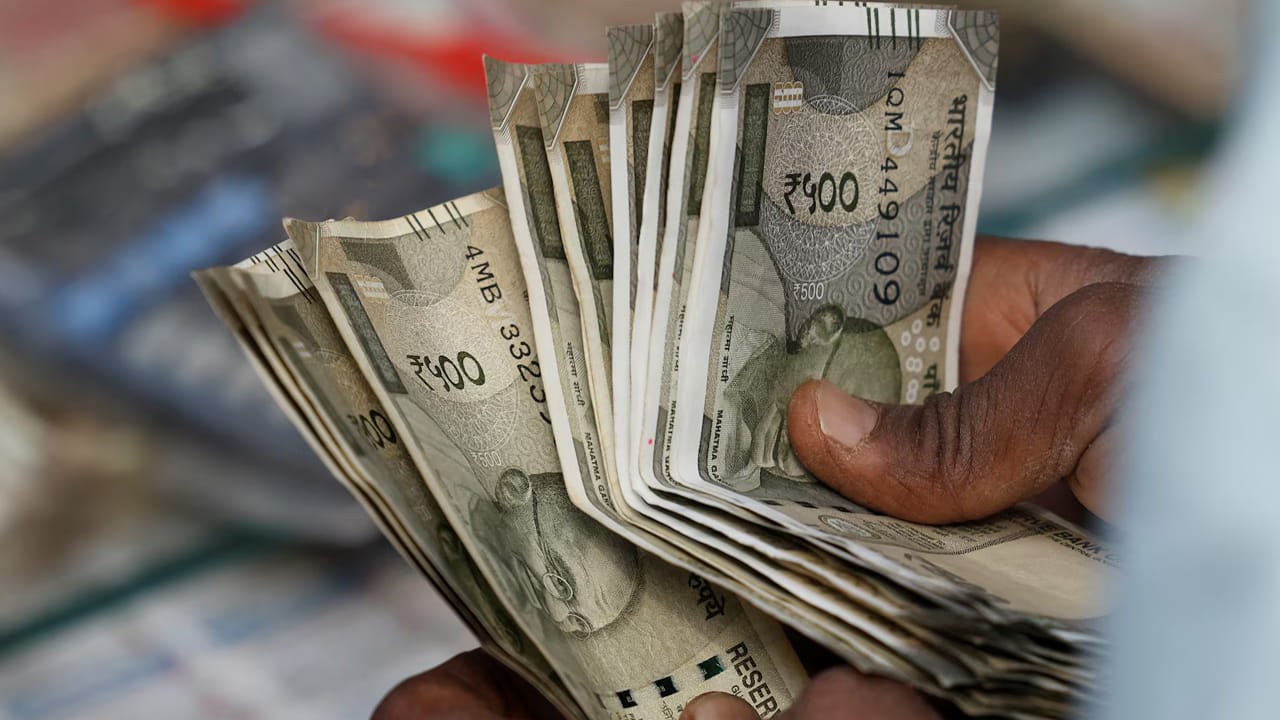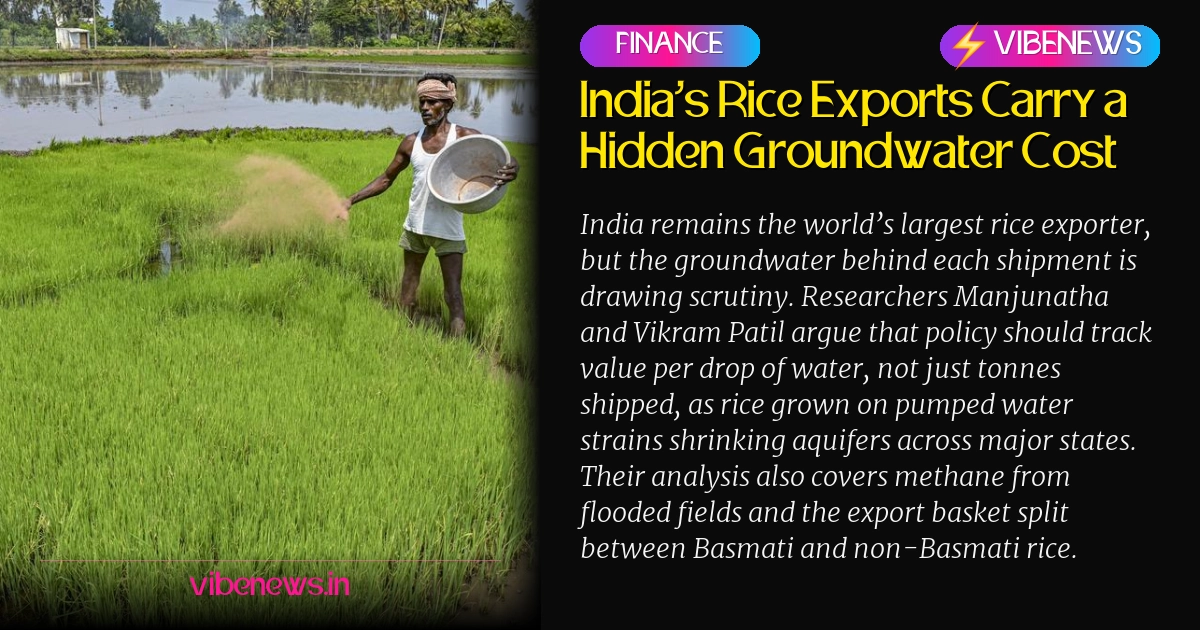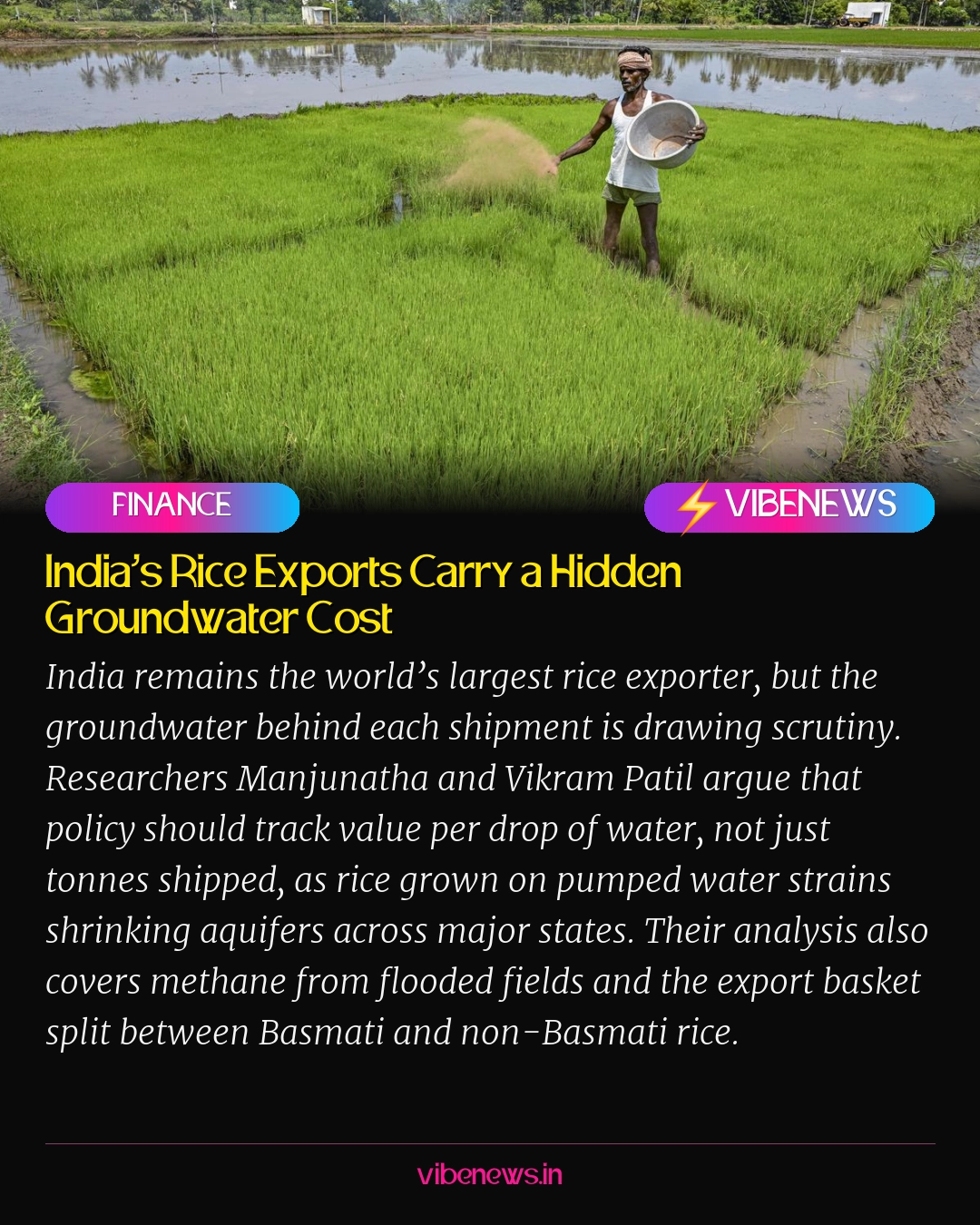
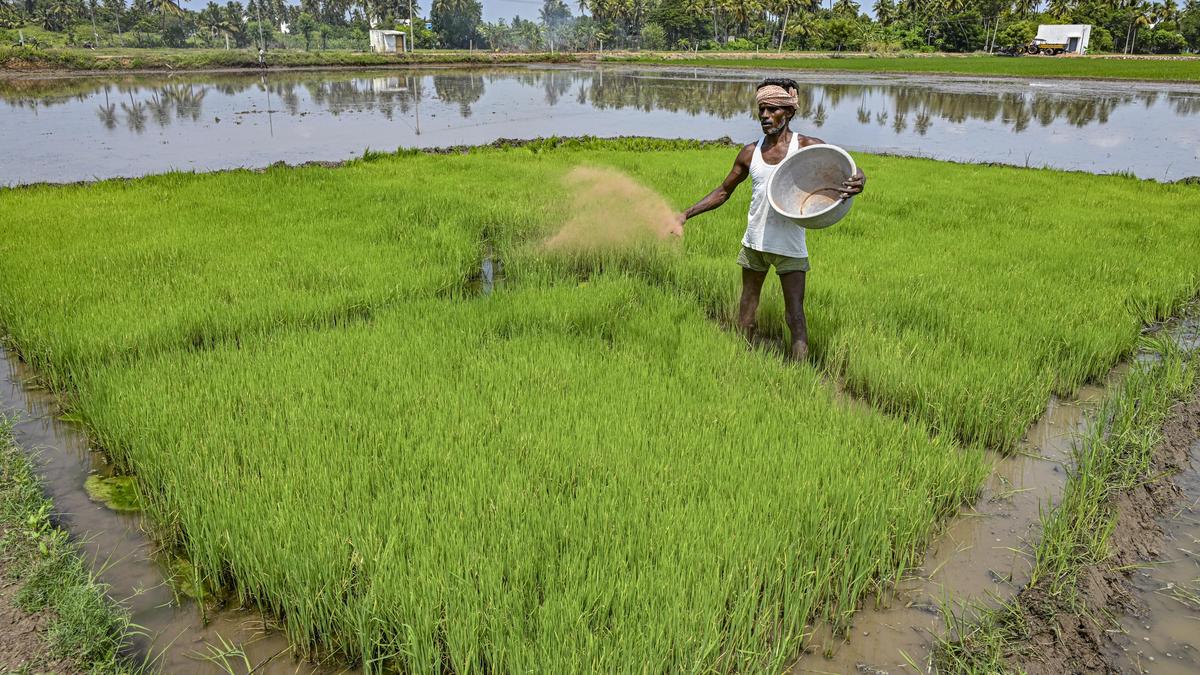
India shipped 21.57 million tonnes of rice in 2025-26, up from 17.73 million tonnes in 2020-21, and the country has been the world’s largest rice exporter since 2012. Two researchers now argue that the volume figures miss the most important cost, which is the water that goes into every grain sent abroad.
Manjunatha, Associate Professor and Head of the Centre for Ecological Economics and Natural Resources at the Institute for Social and Economic Change in Bengaluru, co-wrote the analysis with Vikram Patil, a Scientist in Agricultural Economics at the International Rice Research Institute, India. Their core point is simple. Export earnings alone cannot show whether rice exports are sustainable.
India produced an estimated 154.02 million tonnes of rice in 2025-26. Uttar Pradesh, Telangana, West Bengal, Punjab, Chhattisgarh, Odisha, Madhya Pradesh, Bihar, Andhra Pradesh and Tamil Nadu are among the leading producing states. India commands around 30-35 percent of global rice exports in recent years, and export value climbed from $8.82 billion in 2020-21 to $11.54 billion in 2025-26.
Volume and value tell different stories
The export basket has two very different halves. According to the Agricultural and Processed Food Products Export Development Authority (APEDA), India exported 6.52 million tonnes of Basmati rice in 2025-26, worth 50,138 crore rupees ($5.67 billion). Non-Basmati exports reached 15.04 million tonnes, worth 51,892 crore rupees ($5.86 billion).
That means non-Basmati rice moved more than twice the volume of Basmati, yet brought in only a marginally higher total. The pattern holds over a longer stretch. Between 2020-21 and 2025-26, Basmati exports averaged 5.16 million tonnes a year worth $4.97 billion. Non-Basmati averaged 14.74 million tonnes worth $5.71 billion. Bulk volume, in other words, does not translate neatly into money.
The hidden resource cost
Every tonne of exported rice carries the water used to grow it, a flow economists call virtual water trade. The catch is that not all water is equal. Rice grown on rainfall, which the authors call green water, puts little strain on local resources. Rice grown on water pumped from aquifers, rivers and reservoirs, known as blue water, draws down a stock that is scarce and shrinking.
The pressure is heaviest in Punjab, Haryana and western Uttar Pradesh. But groundwater-fed rice in parts of West Bengal, Bihar, Odisha, Chhattisgarh, Telangana, Andhra Pradesh, Tamil Nadu and Karnataka adds to the strain. For Telugu-speaking states, this is not an abstract concern. Groundwater-dependent paddy in Telangana and Andhra Pradesh sits directly inside the same export chain that the authors are questioning, which means decisions made about irrigation and crop choice here will be measured against the same scarce aquifers.
The authors want a different question at the centre of policy. It should not be how much rice India exports. It should be how much scarce blue water those exports embody.
The question for policy should therefore change: not how much rice India exports, but how much scarce blue water those exports embody.
Rice and the carbon problem
Rice farming also carries a climate cost. Flooded fields can generate methane. Overuse of nitrogen-based fertiliser and other intensive conventional farm practices add other greenhouse gases to the mix.
Several practices could cut those emissions while improving how efficiently farms use resources. The authors name alternate wetting and drying (AWD), direct-seeded rice (DSR), integrated nutrient management and other sustainable methods. The catch is that their benefits vary with climate and soil. Some reduce one gas while increasing another, so the authors call for assessments that are specific to each region rather than a single national fix.
A new metric for rice export policy
The authors argue that India needs to move from volume to value. In practice, that means more crop per drop of water, more income per tonne and less energy and resource use for every unit exported. Cultivation should match local agro-climatic conditions, water availability and groundwater status.
In areas already under heavy water stress, the authors favour incentives for crop diversification toward less water-intensive crops. Those incentives should go hand in hand with better irrigation efficiency. At the same time, they say the value of rice exports can grow through quality, branding, traceability, processing and geographical indications, rather than through larger shipments.
They are careful to say the goal is not to export less. The goal is to export better rice and reduce the water and environmental cost of every tonne shipped.
To make that measurable, the authors propose a water-carbon-value framework. It would track export value per tonne and per cubic metre of blue water, groundwater used per tonne, irrigation water productivity, emissions per kilogram of rice, farmer income per unit of water and groundwater trends in major rice districts.
India has already proven that it can compete in global rice markets, the authors note. The harder task is keeping that position sustainable. By their measure, success will not be counted in tonnes shipped. It will be counted in how much value the country creates from every drop of water, unit of energy and kilogram of carbon that goes into the crop.
TL;DR
- India exported 21.57 million tonnes of rice in 2025-26, but researchers say volume figures hide the real cost.
- Non-Basmati rice moved more than twice the volume of Basmati, yet earned only slightly more in total export value.
- Rice grown on groundwater pumped from aquifers draws down a scarce and shrinking resource, with pressure concentrated in Punjab and Haryana.
- Groundwater-fed rice in Telangana and Andhra Pradesh adds to the same strain on regional water stocks.
- Flooded paddy fields generate methane, and fertiliser overuse adds further greenhouse gases.
- The authors propose tracking export value per cubic metre of blue water rather than tonnes shipped.