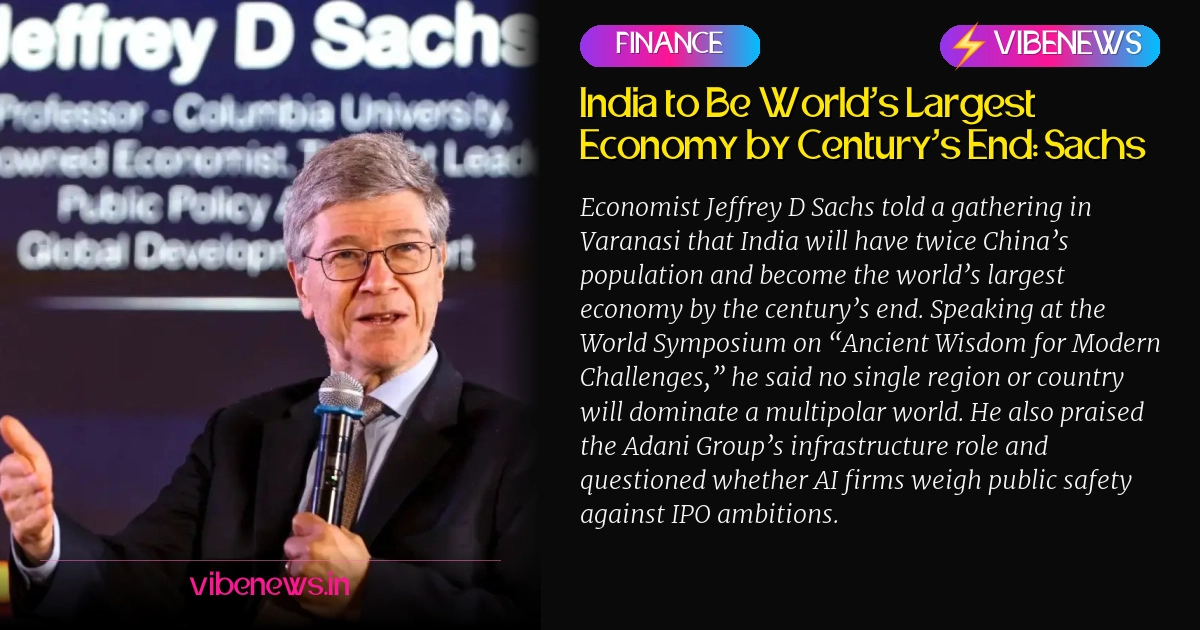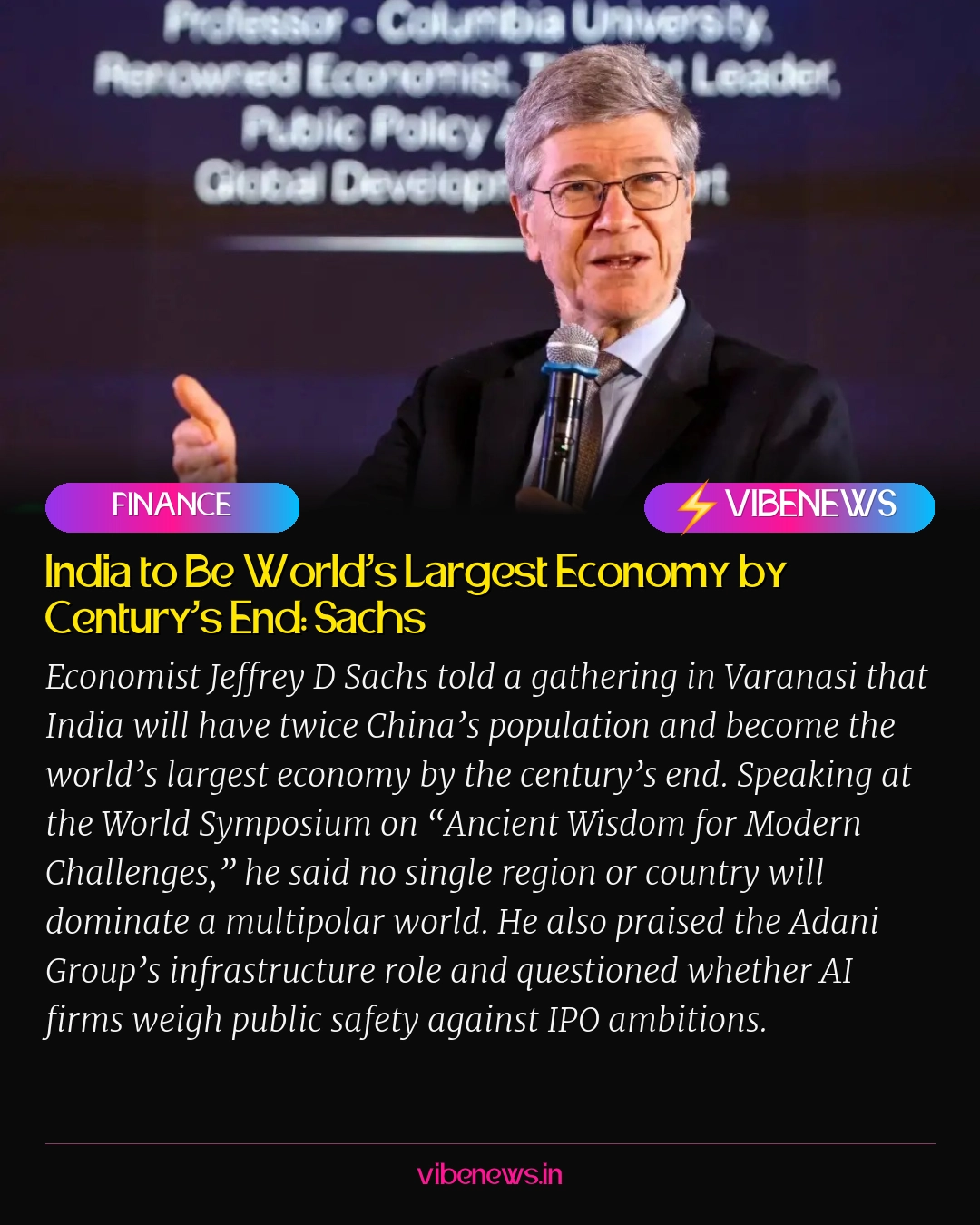
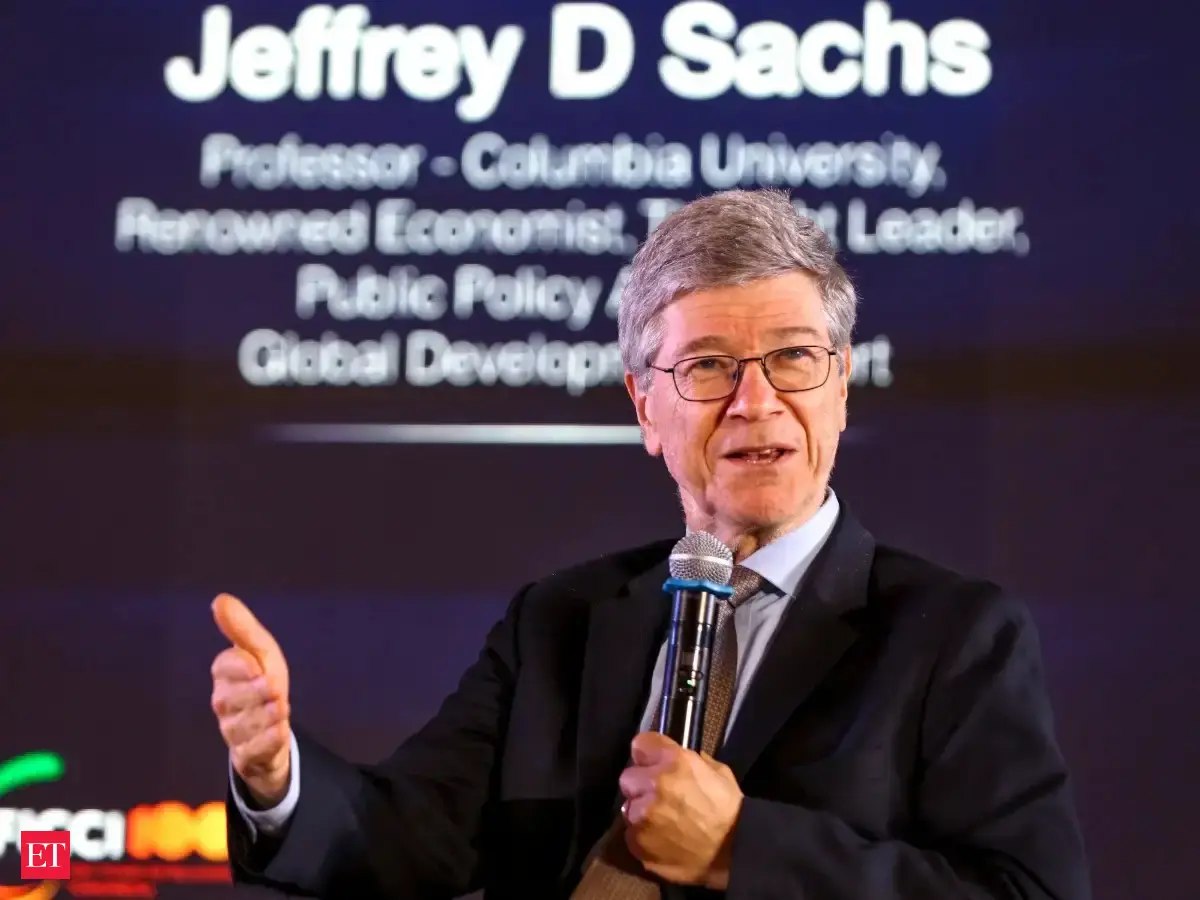
Renowned economist Jeffrey D Sachs said India will become the world’s largest economy by the end of the century, and that by then it will have twice China’s population. He made the prediction while speaking at the World Symposium on “Ancient Wisdom for Modern Challenges” in Varanasi.
Sachs is the Director of the Centre for Sustainable Development at Columbia University and president of the UN Sustainable Development Solutions Network. When a economist with that resume says India will overtake every other economy on earth, people pay attention.
A world without a single center of power
Sachs opened his remarks with a broader argument about the world order. He said the world has entered a multipolar era, in which civilisations, ideas, histories and identities must be understood across regions rather than through a single lens.
“No one region, no one country will dominate,” he stated.
That line carries the weight of his whole message. For Sachs, India’s rise is not a story of one nation simply replacing another at the top. It is part of a reshaped world where many centres of gravity share the stage, and where Indian ideas and traditions count for as much as those of any other civilisation.
The numbers behind the prediction
The population claim is the sharpest part of the forecast. Sachs said that by the end of the century India will have twice China’s population. Combined with his expectation that India will become the world’s largest economy in the same timeframe, the picture he painted is of a country that leads on both people and output.
The timing of his remarks also matters. The Finance Ministry has estimated India’s GDP growth for the second quarter of FY27 at 7.35%. Separately, RBI Deputy Governor Poonam Gupta said India’s growth momentum remains resilient despite global headwinds. Sachs did not tie his century-long forecast directly to those figures, but they sit in the same national conversation about where the economy is headed.
Infrastructure, and a company in the spotlight
Sachs gave special credit to the Adani Group. He credited the conglomerate with playing a significant role in India’s infrastructure expansion and economic transformation. In later interactions, he described the group as one of the major drivers of change and progress in the country, pointing to its contribution to infrastructure development.
Praise of this kind from a figure of Sachs’s standing will draw attention, and he used the moment to make a wider point about what large Indian enterprises owe the country.
Family businesses carry more than a balance sheet
Sachs drew a distinction between ordinary corporations and family-owned or family-led enterprises. In his view, a business that carries a family’s name represents more than commercial interests. It also carries the family’s values, heritage and obligations to society.
Such businesses, he argued, must ask what they give back to the communities in which they operate. The question is not optional for them. It is part of what makes a family firm a family firm.
He used a well-known example to show how hard that balance can be. Sachs cited former Unilever chief executive Paul Polman, who tried to position the consumer goods company as a socially responsible enterprise. Polman faced resistance from shareholders, investors and analysts focused on financial returns. Sachs said the case shows the difficulty of pursuing a broader corporate purpose inside publicly listed companies, where management decisions are also shaped by shareholder expectations and the pressure to deliver results.
The AI question
Sachs then turned to artificial intelligence, and his tone shifted. He raised concerns about the balance between commercial ambition and public safety in the AI industry. His reference point was Anthropic and the reported prospect of a major initial public offering.
He pointed to warnings from Anthropic’s chief executive about potentially catastrophic consequences linked to the technology. Sachs then asked whether the pursuit of a large public listing and commercial expansion was getting more attention than the risks posed by advanced AI. It was a pointed question, and it was aimed at the entire sector, not just one company.
His remarks tied two questions together. The first is what established enterprises owe the communities they operate in. The second is how accountable technology companies are for products that could reshape society. In Sachs’s framing, both questions come down to the same thing: whether profit is being weighed honestly against responsibility.
Why this forecast lands now
A prediction that India will become the world’s largest economy by century’s end is a bold claim, and it will stir strong feelings at home. For many Indians, it speaks to a long-held hope about the country’s future. For others, it will raise questions about whether the economy can deliver on that promise. Sachs gave no roadmap in these remarks. What he offered was a vision: a multipolar world, a country with twice China’s population, and businesses expected to carry more than a profit motive.
The speech was delivered in Varanasi, at a symposium built around the idea of ancient wisdom meeting modern problems. That setting gave Sachs room to argue that India’s future and its past are not separate stories. Whether his forecast proves right will take decades to settle. But the claim itself is now in the public domain, coming from one of the most recognised economists in the world.
TL;DR
- Jeffrey D Sachs says India will become the world’s largest economy by the end of the century.
- By then, India will have twice China’s population, Sachs said while speaking in Varanasi.
- “No one region, no one country will dominate” in a multipolar world, Sachs stated.
- Sachs credited the Adani Group with a significant role in India’s infrastructure expansion.
- The Finance Ministry estimates India’s Q2 FY27 GDP growth at 7.35%.
- Sachs questioned whether AI IPO ambitions are outpacing attention to catastrophic risks.