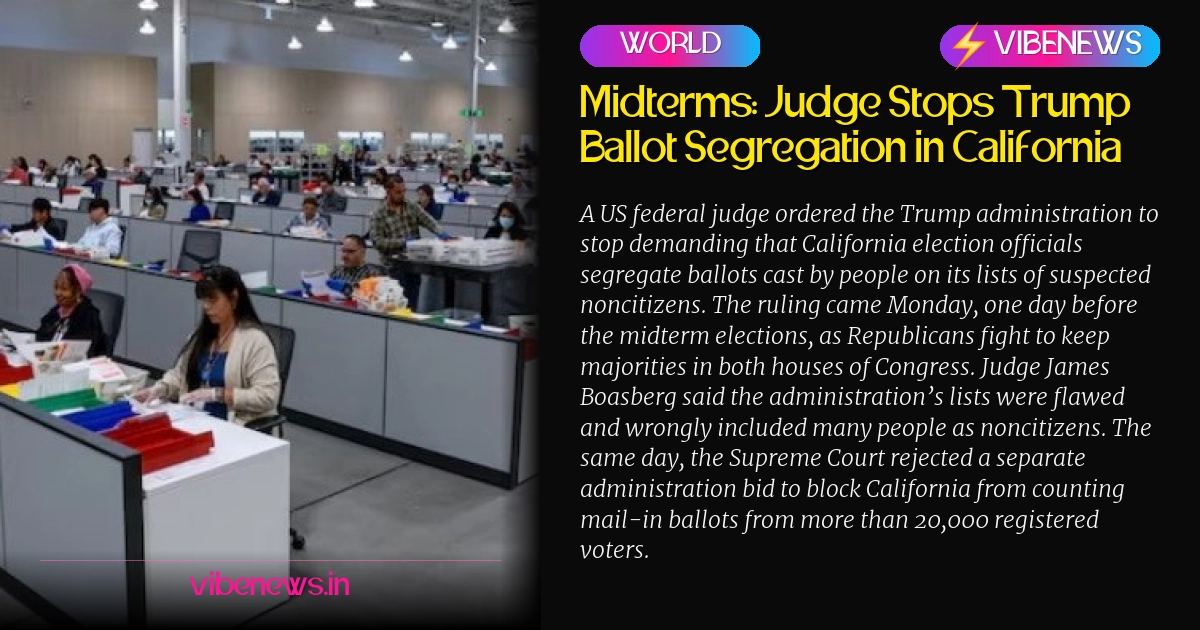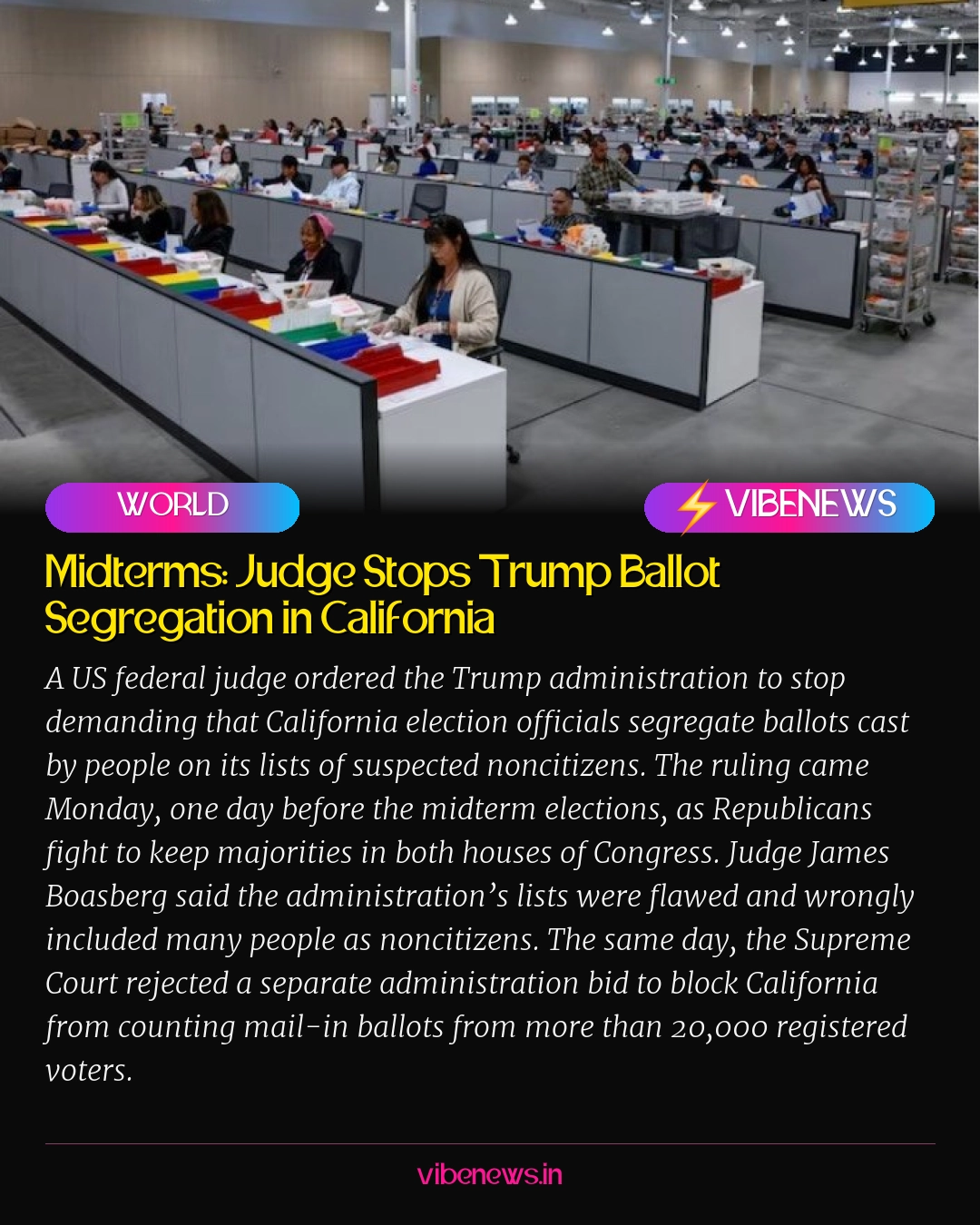
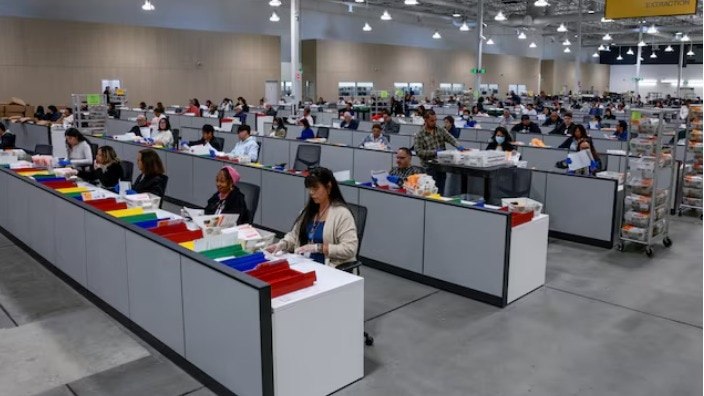
A US judge has ordered the Trump administration to stop demanding that California election officials segregate ballots cast by people on its lists of suspected noncitizens. The ruling came on Monday, one day before the midterm elections, while President Donald Trump’s fellow Republicans are fighting to hold majorities in both houses of Congress.
US District Judge James Boasberg issued the order. He is based in Washington and was appointed by Democratic President Barack Obama. His finding was blunt: the lists the administration had compiled were flawed, and they included many people who were wrongly listed as noncitizens.
That detail matters more than it might seem. The administration was not asking for a light procedural tweak. It wanted California to pull certain ballots out of the pile and set them apart, based on lists that the court has now said cannot be trusted to separate eligible citizens from everyone else. A voter who was wrongly flagged would have been treated as a suspect because of a government database error.
The core legal question
Boasberg did not leave much room for interpretation. In his written ruling, he said the state holds the power to make these decisions for itself. His words were direct:
"California may decide for itself what procedures to use for verifying the citizenship of registered voters."
He went further, drawing a hard line around federal power. "The Executive Branch lacks authority to unilaterally impose its preferred procedures," he wrote. In other words, Washington cannot simply declare how a state must check who is allowed to vote and then demand that election officials follow it on the eve of a national election.
That language goes to the heart of the fight. Elections in the United States are run largely by states and counties, and the ruling affirms that California has the authority to determine its own voter citizenship verification procedures. The judge’s reasoning rests on the idea that the federal government cannot override that authority through its own preferred process, especially when the lists driving the process are, by the court’s own reading, flawed.
A second blow on the same day
The Boasberg order was not the only defeat for the administration on Monday. The Supreme Court also rejected a bid by the Trump administration to temporarily block California from counting mail-in ballots from more than 20,000 registered voters. Federal officials had alleged that these voters are likely non-US citizens.
Two separate legal efforts, both aimed at the same state’s voting process, ran into a wall within the same 24 hours. The administration’s push targeted ballots that had already been cast, and the court filings and rulings show how aggressively federal officials pursued the issue right up to the start of the election.
Who gets caught in the middle
The human cost here is easy to lose in the legal language. Behind the phrase "suspected noncitizens" are real registered voters. The judge’s finding that the lists included many people who were wrongly listed as noncitizens means that some of the people targeted by this effort were, on the court’s view of the evidence, not noncitizens at all. Their ballots were the ones at the center of a demand to be physically separated from everyone else’s.
That is the part that should anger voters across the political spectrum. A process built on flawed lists puts eligible citizens under suspicion. A demand to segregate their ballots, if enforced, would have singled them out before a single vote was counted. The judge’s ruling stops that demand from being enforced in California, at least for now.
What the ruling means right now
The timing is impossible to ignore. The decision landed as voters across the country were preparing to cast ballots in the midterms, a contest that will shape control of both chambers of Congress. Republicans are fighting to maintain their majorities, and this fight over California’s ballots played out in the final hours before polls opened.
For California election officials, the ruling settles the question of who holds authority over citizenship verification procedures, at least as far as this order goes. The judge made clear that the state decides its own methods, and that the federal executive branch cannot impose its own procedures unilaterally. For the administration, the double defeat on Monday is a serious setback in a battle it had pursued directly into the election.
What stands out is the sequence. Federal officials relied on lists that a federal judge has now found to be flawed, pushed for ballots to be segregated, and then saw both the district court and the Supreme Court refuse to let them proceed on that path. Voters are left to wonder how many people were swept into a process built on mistakes, and how many were wrongly treated as suspects before the courts stepped in.
TL;DR
- A US judge ordered the Trump administration to stop demanding that California election officials segregate ballots cast by suspected noncitizens.
- Judge James Boasberg ruled Monday, one day before the November 3 midterm elections.
- Boasberg found the administration’s lists were flawed and wrongly included many registered voters as noncitizens.
- He wrote that California may decide for itself how to verify the citizenship of registered voters.
- On the same day, the Supreme Court rejected a Trump administration bid to block California from counting 20,000-plus mail-in ballots.