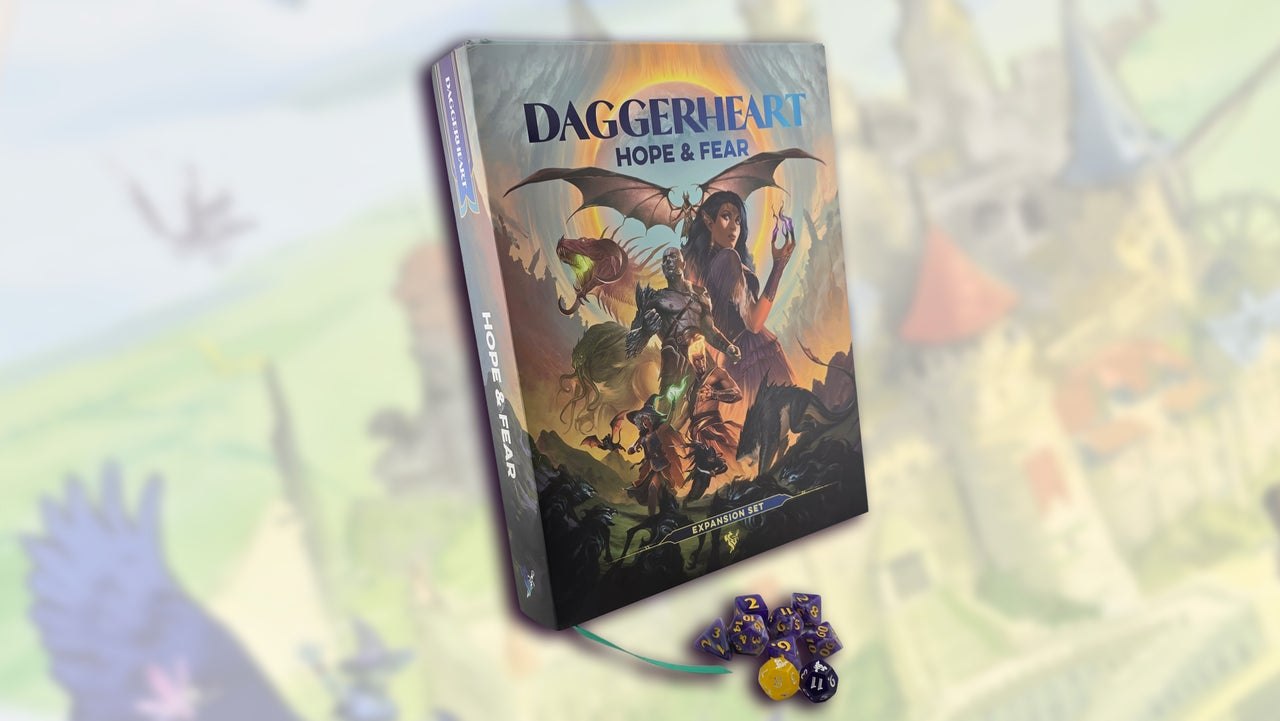
Critical Role’s Daggerheart has its first expansion, and it’s called Daggerheart: Hope & Fear. The book arrives a year after the core rulebook came out, and it gives players and Game Masters a new set of tools for telling their stories.
The system already leans harder on storytelling than many of its rivals, so the expansion is mostly about giving tables more things to play with. It’s a nearly 200-page book, and most of that space goes to new options for both sides of the GM screen.
For players making new characters, the expansion brings four new classes, each with two subclasses. It also adds six ancestries and communities, more than 100 new pieces of gear and loot, and a brand-new domain.
Game Masters get their own haul. There are more than 130 new enemies spread across 28 environments, along with four campaign frames. Think of those frames as rough foundations you can build a campaign around.
Why the Hope and Fear dice matter here
Anyone new to Daggerheart needs one detail first. The system uses two twelve-sided dice, one for your Hope value and one for your Fear value. Whichever die rolls higher during a check decides what happens next. If Hope wins, the player earns a Hope resource that can fund extra special actions. If Fear wins, the GM gets a Fear point to spend. It’s a built-in wrench in the gears, and the expansion takes its name from that tension.
The Dread domain turns the tables on the GM
The new Dread domain is probably the most interesting thing in the book, at least for players who are tired of a GM stacking the deck. Abilities like Avatar of Terror make a character stronger the more Fear the GM has. The spell Dire-Strike goes further and takes some of the GM’s Fear away outright.
The reviewer found the idea of a party ganging up to shut down the GM’s tricks hard to resist, and said it immediately pushed the domain to the top of their list for the next character they plan to make.
Two of the new classes use the Dread domain. The Warlock makes a pact with something for cool powers, while the Witch hexes enemies to mess with them. The other two new classes, the Assassin and the Brawler, rely on the domains from the core book. The Assassin is a standalone, stabby-focused rogue, and the Brawler is Daggerheart’s punchy, monk-like class.
Transformations are the real headline
The reviewer’s favorite addition is the Transformations system. Players can become a demigod, a werewolf, a vampire, or even a ghost in the style of Danny Phantom. There are six transformation options in total, and each one comes with a bonus or ability alongside a downside.
The Danny Phantom-style ghost form is a good example of the trade-off. The character takes less physical damage but double magic damage, and can pass through solid objects at the cost of picking up some Stress.
Transformations don’t count against any domain or character limit. The one real restriction is that a character can only hold a single transformation at a time, though the reviewer notes that a house rule can fix that if a table wants more.
New ancestries and classes that feel overdue
The new ancestries will feel familiar to anyone who has played a high-fantasy TTRPG. The Aetheris are winged, angel-like beings. Elemental Kin come in Earth, Ember, Sky and Tide varieties and are descended from powerful elementals. Gnomes are, as the reviewer put it, simply gnomes. Their Flicker Step feature lets them teleport around, which the reviewer called silly fun.
The reviewer also questions why some of these staples were left out of the core release. Both the ancestries and some of the classes feel like basic fantasy building blocks, so it seems odd they waited for an expansion. They are here now, though, and that is what matters at the table.
Four campaign frames for different tables
The campaign frames give Game Masters room to run games for hesitant new players or for veterans who want a real challenge. The reviewer’s favorite is also the simplest one. Castle High imagines a modern-day wizard school where teenagers fly around on brooms, scroll through their phones and take classes on giant floating islands in the sky. The reviewer hasn’t played or run it yet, but swapping swords for pencils and sneaking out of school instead of raiding dungeons sounds like a fun change of pace.
Reign of the Weredragon offers the classic dragon fight, with a weredragon tyrant as the target. Journey to Horizon is the most complex of the four, and it asks heroes to work toward resurrecting a goddess.
The catch for newcomers
The reviewer’s overall take is that Hope & Fear is a good first expansion, though it plays it safe. It adds a lot of material for players and GMs, and some of it fills gaps the core book should have covered.
The biggest concern isn’t in the new content. Since launch, Daggerheart has struck the reviewer as far more intimidating for people who aren’t comfortable with improvisation and narrating their own actions. Hope & Fear doesn’t really change that. If the core game already overwhelmed a group, this expansion won’t rescue it.
The reviewer thinks the system is still young in comparison to older games and would like to see a well-designed starter kit or a more hand-holding expansion aimed at new players. For now, the expansion is a sturdy addition that rewards tables that already know what they are doing, while leaving the onboarding problem where it was.
“Daggerheart: Hope & Fear is a good first expansion, though it feels like a safe one.”
TL;DR
- Daggerheart: Hope & Fear is the system’s first expansion, arriving a year after the core rulebook.
- The book adds four new classes, six ancestries and communities, and more than 100 new gear and loot items.
- Game Masters get 130-plus new enemies across 28 environments and four campaign frames.
- The new Dread domain lets players shut down the GM’s Fear with abilities like Dire-Strike.
- Six new transformations add bonuses and downsides, including a Danny Phantom-style ghost form.
- The reviewer says the expansion does little to ease the intimidation newcomers feel with the core game.