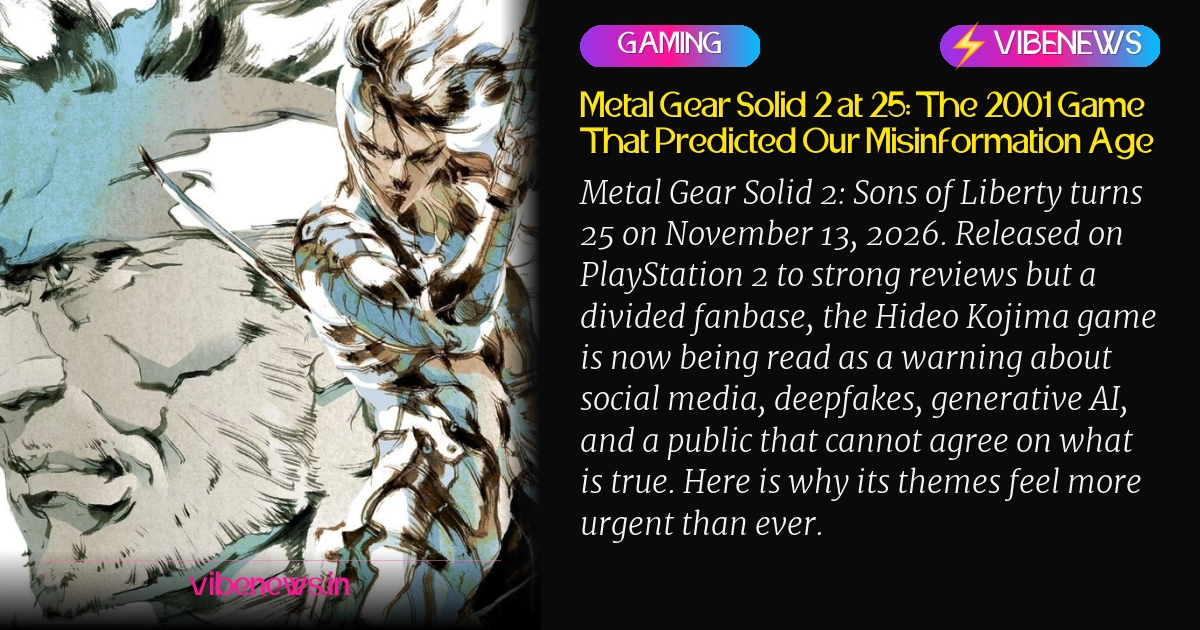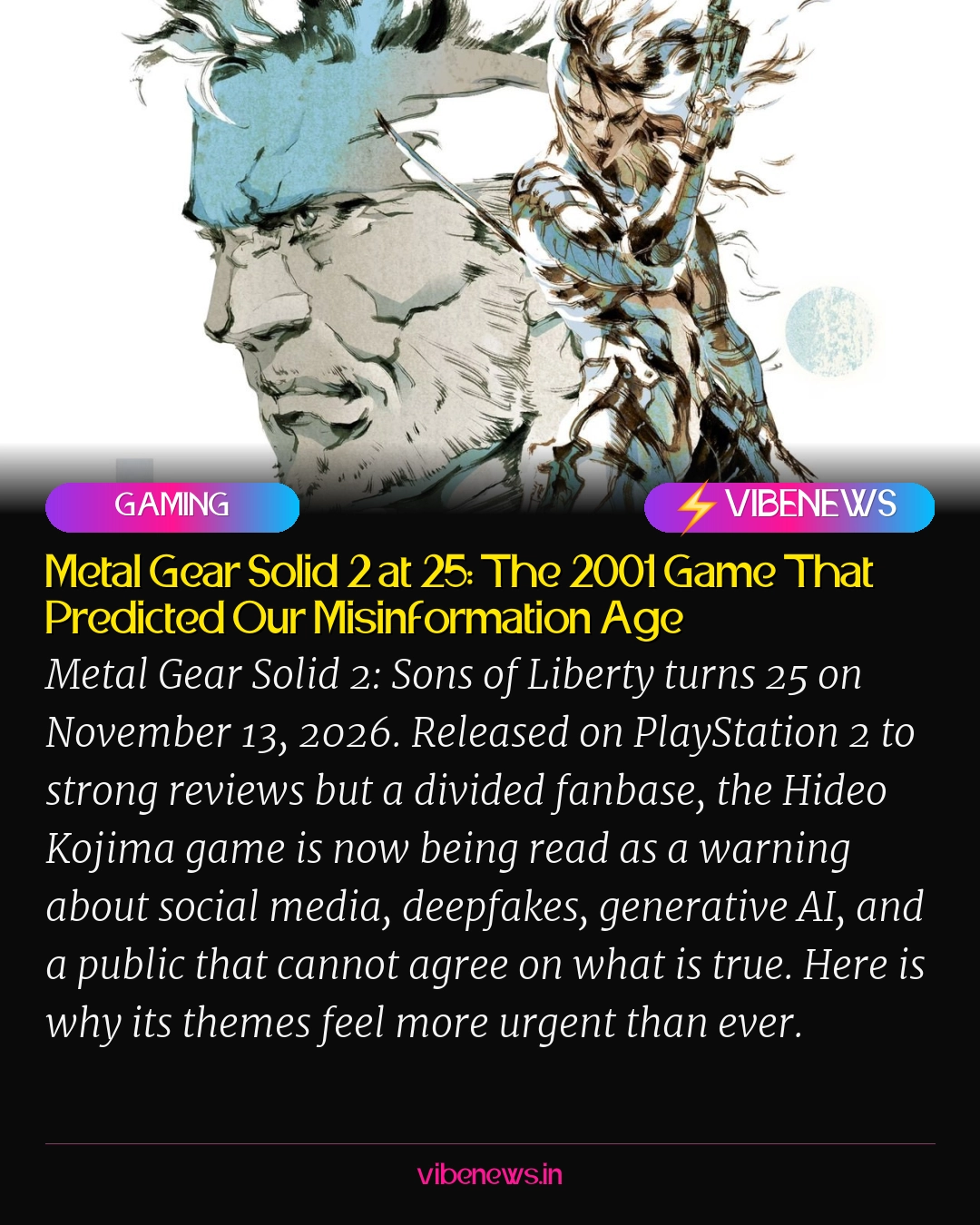

Metal Gear Solid 2: Sons of Liberty marks its 25th anniversary today, and a fresh look at the game argues that Hideo Kojima’s 2001 PlayStation 2 release has aged into something close to a prophecy. The game first hit shelves on November 13, 2001, and it was divisive from the start.
That divide is easy to forget now. MGS2 earned excellent reviews and sold more than seven million copies. It also drew heavy criticism. Many fans were angry that most of the game was spent playing as a new hero, Raiden, rather than Solid Snake. Others objected to the long cutscenes and Codec calls, where characters talked at length about philosophy and sociology. Back in 2001, the internet was becoming a constant presence in daily life, and nobody was sure what the digital age would do to society. Many players, and many critics, simply did not know what to make of the game.
Even critics who wrote about the series later struggled with it. The author of the piece points to a 2004 review of Metal Gear Solid 3: Snake Eater, which said the story of MGS2 was of little interest “unless you really want to spend a couple of late, smoky nights going over the details and putting all the pieces together.” The same review admitted the pieces do fit together. It just felt like hard work to get there.
Time has been kind to the game, though. The author, Carlos Morales, a long-time fan of the franchise and an advocate for video games as an art form, argues that many of the themes Kojima explored have only grown sharper. Social media, the spread of digital misinformation for political purposes, automated warfare, deepfakes and generative AI all show up in the story. Kojima’s script anticipated how these forces could turn divisions between groups into chasms and leave people unsure what reality even is.
Raiden has also grown on fans. He is now widely accepted as a worthwhile protagonist in his own right, and Morales notes that Metal Gear Solid 4 may have helped by turning him into a cyborg ninja. The game’s thematic depth gets most of the credit, though. Critics and players who care about games as art often point to its exploration of social engineering, digital censorship, cyberwarfare and a post-truth society. Players who only wanted a tactical espionage thriller with big twists, stealth gameplay and epic boss fights still got exactly that.
The story opens with Solid Snake infiltrating a tanker in the Hudson River to gather evidence on a new Metal Gear prototype called Ray. The mission goes badly. The ship sinks, Metal Gear Ray is stolen by the recurring villain Revolver Ocelot, and Snake is assumed dead.
Two years later, a facility called the Big Shell stands where the tanker went down. Terrorists known as Dead Cell, backed by an army of Russian mercenaries under Solidus Snake, one of Snake’s evil clones, have taken the President hostage and are threatening a nuclear strike. Raiden, a new FOXHOUND agent, is sent in to rescue the hostages. The setup sounds routine. It doesn’t stay that way for long.
Raiden’s mission mirrors Snake’s infiltration of Shadow Moses in the first Metal Gear Solid. The plot events, scripted sequences and character appearances repeat on purpose. The player slowly learns that the whole incident was orchestrated by a shadowy group called the Patriots, who have secretly controlled the United States government for decades. They have also been steering Raiden’s life. His girlfriend, Rosemary, who also handles saving the game, turns out to be a Patriot agent.
Those Shadow Moses echoes are part of a larger reveal. The repetition is the work of an artificial intelligence simulation system built to control human behavior and produce desired outcomes. Morales reads this as a metaphor for players themselves. In linear, story-driven games like the Metal Gear Solid series, people have little real choice. They do what the developers intend, often without noticing.
A Structure That Breaks the Fourth Wall
Morales argues that the game’s most impressive trick is how it uses game design as part of the story. He says Kojima’s metatextual approach came before similar attempts in BioShock and Spec Ops: The Line, which also tied player agency, or the lack of it, into their narratives. MGS2 draws attention to the constructed nature of games in later levels. The Colonel that Raiden takes orders from for most of the adventure is revealed to be one of the Patriots’ AIs. A major elevator fight tries to trick players with a fake Mission Failed screen. Arsenal Gear, the flying fortress at the center of the plot, feels less solid the deeper Raiden goes. Its design and color scheme echo the VR training missions from the first game, and the room where Raiden fights a fleet of Metal Gear Rays seems to stretch on forever.
The Part That Feels Like 2026
Morales says the game is at its most relevant when it reflects the distorted reality of the mid-2020s. He describes it as strange to play a 2001 game and see it predict the last decade of social upheaval. In his reading, information control and cultural mythology have become some of the most powerful weapons available to those in charge. The Patriots restrict the flow of information through their AI system, GW. Real institutions, he argues, have used social media, digital news distribution and automated misinformation to make it harder to tell what is real.
The Patriots themselves are nameless, and that anonymity is the point. Morales says they are powerful enough to pick a President and set the terms of human history, and yet hard to pin blame on. Public punching bags exist among the billionaires, he writes, but the real power often sits with faceless corporations and private donors. The system keeps perpetuating itself. That is what makes the President’s insistence that Raiden keep fighting Solidus even after the Patriots’ deception is exposed so telling. Solidus wants to destroy the Patriots, and in the game’s logic, that could push the world into chaos.
What unsettles Morales most is how sensible parts of the Patriots’ argument sound. Near the end of the game, the AI Colonel claims the Patriots don’t censor information for power’s sake. They do it for the greater good of a society drowning in data. The Colonel describes “all this junk data preserved in an unfiltered state, growing at an alarming rate,” which has broken people’s shared sense of what is real. Morales points out that the internet rewards polarization and insular thinking more readily than objectivity or context. Then comes the line that he says is hard to dismiss in 2026: “the different cardinal truths neither clash nor mesh. No one is invalidated, but nobody is right.”
“the different cardinal truths neither clash nor mesh. No one is invalidated, but nobody is right.”
Morales says the game does not end with the Patriots’ defeat. It ends with Raiden, a man who has just learned that much of what he was taught was a lie, asking what he is supposed to believe. Snake tells him to “find the meaning behind the words, then decide. You can find your own name, and your own future.” Morales sees that as the emotional heart of the story. Raiden chooses to take Rosemary back and believe her when she says she truly fell in love with him, even though she was a Patriot agent. The message is that no matter how much the powerful try to shape society, people can still make their own choices and decide what matters to them.
Morales says that message feels especially resonant as people try to get through an unsettled period. He also notes that a game about existentialism, built around a military action framework, ends by essentially telling the player to go touch grass. For him, that is one more reason Kojima ranks among the best to ever do it.
TL;DR
- Metal Gear Solid 2: Sons of Liberty turns 25 today, and critics now read its warnings about misinformation and AI as eerily accurate.
- The PS2 game launched on November 13, 2001, to excellent reviews and sold more than seven million copies.
- At launch, many fans were upset by its protagonist, Raiden, and its long cutscenes and Codec conversations.
- The game’s story predicted social media division, deepfakes, generative AI and a society unsure what is real.
- A central line from the Patriots’ AI Colonel is now seen as hard to dismiss in the current internet era.