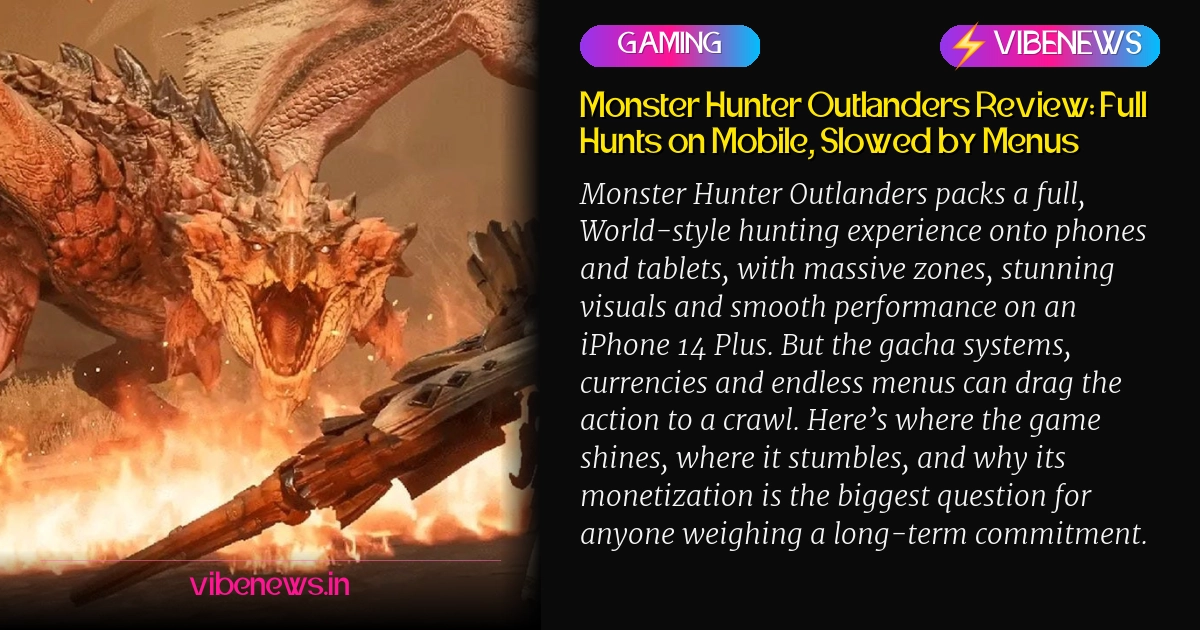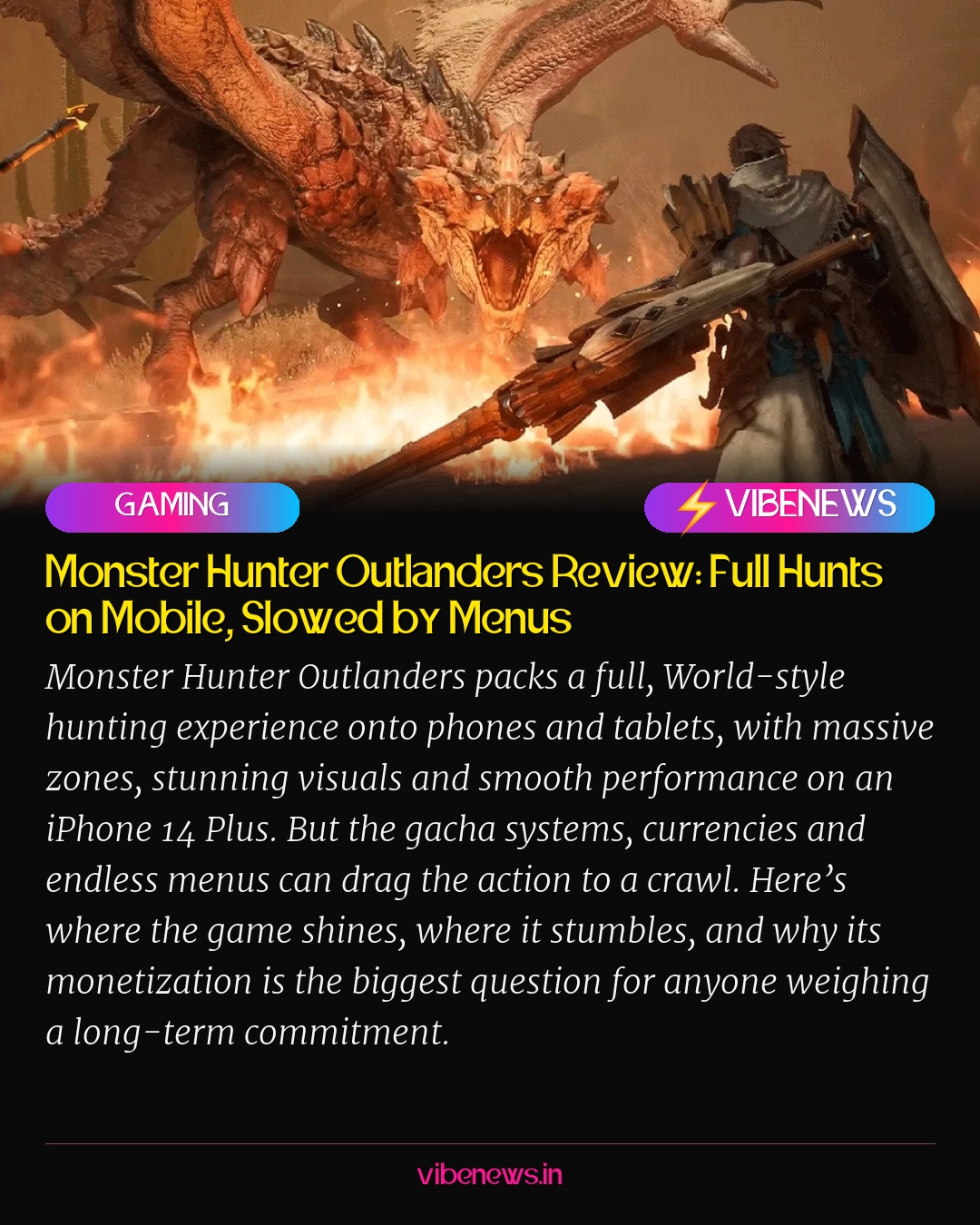
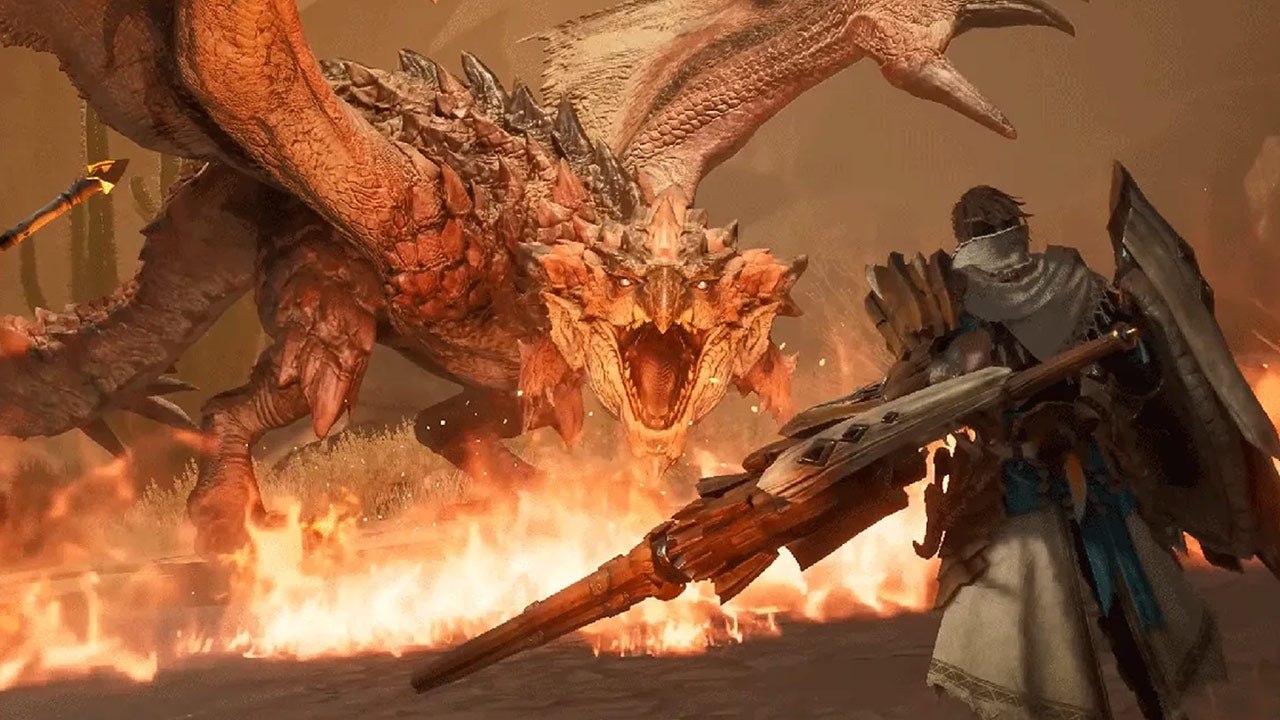
Monster Hunter Outlanders is a full-scale Monster Hunter game squeezed onto phones and tablets, and it proves the series’ hunting formula travels well. The catch is that the mobile wrapping brings a pile of currencies, gacha pulls and menus that often get in the way of the fights players came for.
The series has always been built on repetition. Capcom’s franchise has thrived since its PSP debut because it turns grinding into a loop that feels good to repeat. So a gacha format, with timed gauges and collection mechanics, was always going to be a test. Outlanders passes that test longer than expected, though it eventually stumbles.
The story sends members of the Adventurer’s Guild to the uncharted island of Aesolan. Their job is to look into a mineral called Radiantate and figure out how it is changing various breeds of monsters. The plot is thin and a little generic, but that matters less than you might expect, because the game hands you a lot of space to play in.
The opening hours are another matter. The first 20 or so hours are heavily guided and layered with tutorials. Because this is a mobile game, it also has to introduce half a dozen modes, several pull systems and currencies for powering up your Adventurer. Players who are patient will get through it. Players who want to start hunting right away may find the early stretch frustrating.
Once the training wheels come off, the comparison to Monster Hunter World becomes hard to avoid. Think of Outlanders as World with its combat streamlined and packed into a phone.
I almost cannot overstate how closely Outlanders resembles World in every way, even right down to the general structure and story.
The world itself is where the game feels most like a mainline entry. It is not a traditional open world, but it uses the same framework as World and Wilds, with massive zones to explore. You can hunt monsters without triggering missions, gather resources, play small minigames and take on sidequests. One minigame has you stealing a flying monster’s treasure in a rhythm-based sequence.
Getting around is easier than it might be. Camps unlock fast travel points and places to rest. Catapults launch your Adventurer on a glider at high speed, and resource collectors keep pulling in the materials you need. These systems make traversal and gathering feel less like chores, which matters when you are spending a lot of time in the field.
On an iPhone 14 Plus, the game ran on High settings at a stable 45 frames per second, with almost no slowdown even during intense battles. It looks sharp and runs smoothly, which is a big part of why the world feels as convincing as it does on consoles.
Combat still revolves around timing and the push and pull of attack and defense. Winding up attacks at the right moment and knowing when to pivot is what has always set the series apart from other action games, and that rhythm is still here. The limitations show up in the details of control and in the many systems used to boost your Adventurer’s stats.
Outlanders gives players two control schemes. Adventure mode reduces everything to three buttons: Attack, React and Burst. The buttons change based on context. The Bowgun swaps ammo to suit the moment, and the React button can become a guard rather than a dodge. Classic mode offers more precise control with dedicated buttons, closer to a traditional Monster Hunter setup. It works on a touchscreen, perhaps better than expected, but Classic is a lot to juggle without a gamepad-style accessory. The best way to play, according to the review, is Classic with a controller, though that is not an option for everyone at all times.
The partner characters add real personality. Each one has their own moveset, Ultimates and abilities. Keres fights with dual blades that are actually a set of claws, which gives her a separate skill set that includes a Wolverine-like drill attack. Luxheart wields a two-handed sword he can rev up to launch fireworks, so each attack looks like a small show. Their designs lean into a tokusatsu style that suits the series’ goofy side. They also break up the monotony of repeat hunts.
The monster roster holds up well. There is a good range of creatures from across the series, and each one gets a souped-up Radiant form with new attacks and behaviors. The game also keeps the emergent moments that World and Wilds made famous, where a bigger predator might wander into your fight and force you to adapt.
The streamlined system does cost something. You can still climb walls by running at them, but there is no dedicated jump. That keeps most fights on the ground. Ultimates from partners, such as cannons that fire nets, add to the ground game, yet the reviewer admits to wishing they could leap onto a Rathalos’ tail. The trade-off works for the kind of play Outlanders is built for: short bursts of satisfying combat, like a single quest on the train or while waiting in line.
Weapon variety takes a hit as well. Outlanders has eight weapon types, fewer than the last few mainline games. The Hunting Horn and Insect Glaive are notable absences. Many of the dynamic world elements, like using a Flashfly to stun a monster, appear as simple on-screen icons when you are nearby. The game is a simplified World in that sense, trimming the more dynamic systems.
The biggest problem is the systems layered on top of the hunting. The currencies alone can be hard to track. Equipment and partners such as Palicos each need upgrades. Charms must be leveled and then ascended. Raising the maximum level requires increasing your Ecological Rank, which has its own requirements. Partners have a separate leveling system. Then come the Insight system, the Visage system where you paint monster cards after defeating them, Adventurer Rank, Proof of Mastery and Investigation Notes. Seasonal rewards and launch initiatives each have their own currencies, and many include optional paid passes.
Modes add to the load. The main story lets you explore the world at your own pace. Free Hunts target specific monsters. Hunt Requests use rechargeable Stamina to earn leveling items. Trial Expedition asks you to take on 150 battles of rising difficulty. Guild Clash and Guild Carnival bring different guilds together. There is a lot to do, and the reviewer says new modes, tutorials and options keep unlocking even after 30 hours. When these systems support the hunt, they add depth. Too often, they slow the action to a halt.
On monetization, the review is more balanced than critics of gacha games might expect. The reviewer says they never felt pressured to spend money in the first 30 hours and had more materials than they needed. That changes as you unlock more gacha characters and need to power them up. Real money can make the experience smoother, and the grind becomes steeper when chasing special costumes or characters tied to events.
Progression can also stall. You may need to grind activities to continue the story, or wait a day for more daily rewards. Advancing requires improving Adventurer Rank, Ecological Level and more before you can reach the next main story quest. The review describes the structure as a strong start that gets slowed by monotony, which is the opposite of many Monster Hunter games that open up after a few dozen hours. The reviewer also estimates that nearly 20 percent of their time went to sifting through menus and tapping past screens to collect currencies. Series fans already know menu surfing is part of the package, so Outlanders doubles down on it.
Monster Hunter Outlanders is ambitious and often impressive, with a strong combat formula and a surprisingly complete version of the hunt. It is also buried under mobile-style systems that are hard to track and frequently get in the way. It does not reach the heights of its console counterparts, but players who go in with realistic expectations will still find the heart of Monster Hunter here.
TL;DR
- Monster Hunter Outlanders packs a full Monster Hunter hunting experience onto phones and tablets, with stunning visuals and smooth performance.
- The game’s combat holds up, especially when you play Classic with a controller.
- The Adventurer’s Guild heads to the island of Aesolan to investigate Radiantate, a mineral changing monster breeds.
- The first 20 or so hours are heavily guided, and the game is packed with currencies, pulls and menus.
- The partner characters, such as Keres and Luxheart, bring distinct moves and a playful tokusatsu style.
- The reviewer says nearly 20 percent of their time went to menus, which slows the action considerably.