
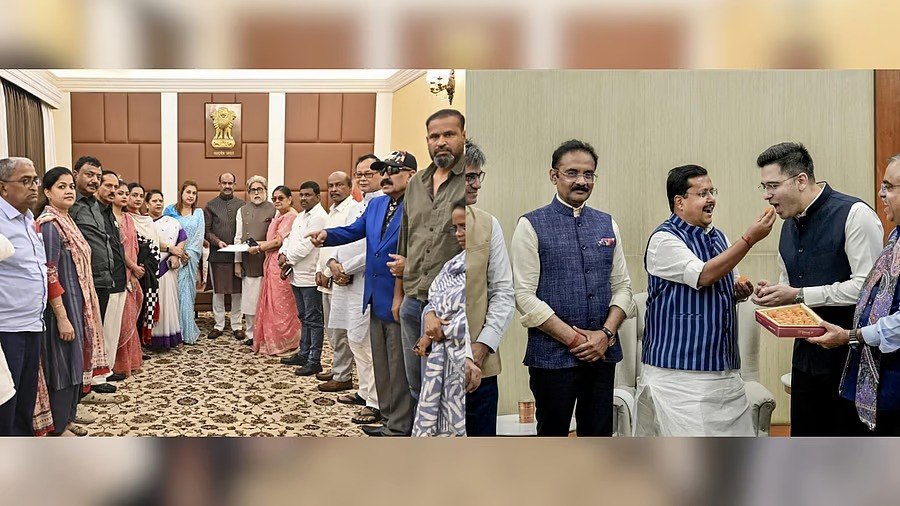
A notable shift is underway in India's political arena, marked by a series of defections from prominent opposition parties, including the Aam Aadmi Party (AAP), Trinamool Congress (TMC), and Shiv Sena (Uddhav Balasaheb Thackeray), to the ruling Bharatiya Janata Party (BJP). This pattern of cross-party movement is drawing significant attention, particularly as it unfolds amid crucial legislative discussions.
These movements are not merely isolated incidents but are widely seen as part of a broader strategy by the BJP to consolidate its parliamentary strength. Political observers suggest the ruling party is actively working to achieve a two-thirds majority in both houses of Parliament. This critical threshold is essential for passing constitutional amendment bills, which require the assent of at least two-thirds of the members present and voting, in addition to a simple majority of the total membership of each house.
The specific legislative goal reportedly driving this push is a proposed constitutional amendment that would alter the contours of delimitation. Delimitation is the process of redrawing boundaries of Lok Sabha and state assembly constituencies to represent changes in population. It ensures that each constituency has roughly the same number of voters, maintaining the principle of 'one person, one vote' across the nation.
The last major delimitation exercise in India was based on the 2001 Census, with its recommendations implemented in 2008. However, the freeze on the number of Lok Sabha seats, which has been based on the 1971 Census to encourage population control in states, is set to expire in 2026. Any significant change to this framework, especially one that reallocates seats based on more recent population data, would necessitate a constitutional amendment, thereby requiring the BJP to secure the formidable two-thirds majority.
For the opposition parties, these defections represent a significant challenge, eroding their numerical strength and potentially their morale. The loss of members from AAP, TMC, and Shiv Sena (UBT) not only diminishes their presence in legislative bodies but also complicates their ability to form a united front against the BJP. Such shifts can destabilize regional political dynamics and weaken the collective voice of the opposition on national issues.
The Shiv Sena (UBT), in particular, has faced internal strife and splits in recent years, making any further defections particularly impactful on its organizational integrity and political standing. Similarly, the Trinamool Congress, a dominant force in West Bengal, and the Aam Aadmi Party, which governs Delhi and Punjab, are seeing their ranks thinned, albeit in varying degrees, raising questions about their long-term resilience.
This current wave of defections signals a 'new politics' where individual switches are perceived less as opportunistic moves and more as calculated steps within a larger parliamentary strategy. Unlike past instances driven primarily by personal ambition or local grievances, the current speculation points to a national-level objective tied to fundamental constitutional changes, elevating the stakes involved.
From the BJP's perspective, securing a supermajority would provide unparalleled legislative flexibility, allowing it to push through its agenda without significant resistance. A constitutional amendment on delimitation could have profound implications for political representation, potentially shifting power dynamics between states based on their population growth and demographic trends.
States that have successfully controlled population growth might see their parliamentary representation diminish, while those with higher growth rates could gain seats. This makes the delimitation exercise a highly sensitive and politically charged issue, requiring either broad consensus across the political spectrum or, failing that, a robust parliamentary majority to enact changes.
The ongoing speculation surrounding these defections and the BJP's alleged pursuit of a two-thirds majority underscores the high stakes involved in India's legislative future. As the 2026 deadline for the delimitation freeze approaches, the political manoeuvring is expected to intensify. The ability of the BJP to attract more opposition members, and the resilience of the opposition to stem these losses, will be critical factors determining the ease with which such a significant constitutional amendment could be enacted.
The coming months will likely reveal whether these defections are indeed part of a grand design to reshape India's electoral map or if they are simply a continuation of the country's dynamic political churn. Regardless, the trend highlights the constant flux within India's multi-party democracy and the strategic importance of parliamentary numbers in shaping national policy.
TL;DR
- Defections from opposition parties like AAP, TMC, and Shiv Sena (UBT) to the BJP are becoming a notable trend in Indian politics.
- This pattern fuels speculation that the ruling BJP is aiming to secure a two-thirds majority in Parliament.
- The primary strategic objective behind this push is reportedly to pass a constitutional amendment bill related to delimitation.
- Delimitation is the process of redrawing electoral constituency boundaries, with the current freeze on Lok Sabha seats set to expire in 2026.
- Achieving a two-thirds majority would grant the BJP significant legislative power to enact fundamental constitutional changes without strong opposition.
- These defections weaken the numerical strength and morale of opposition parties, complicating their ability to challenge the ruling party.
- The potential constitutional amendment on delimitation could significantly alter political representation across states based on population changes.