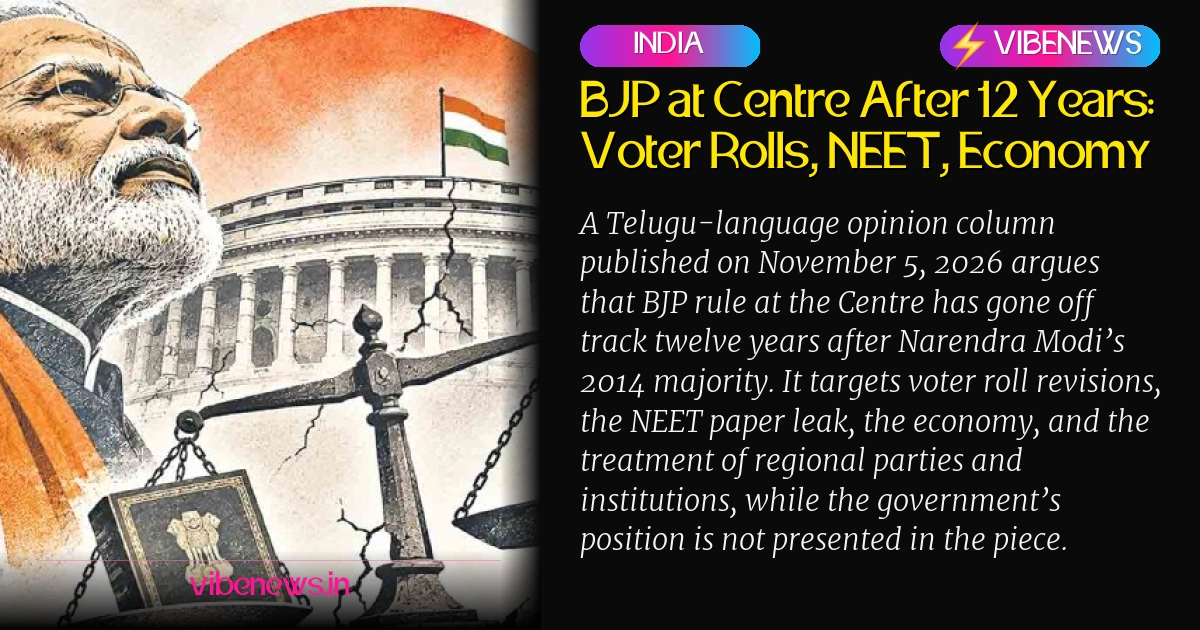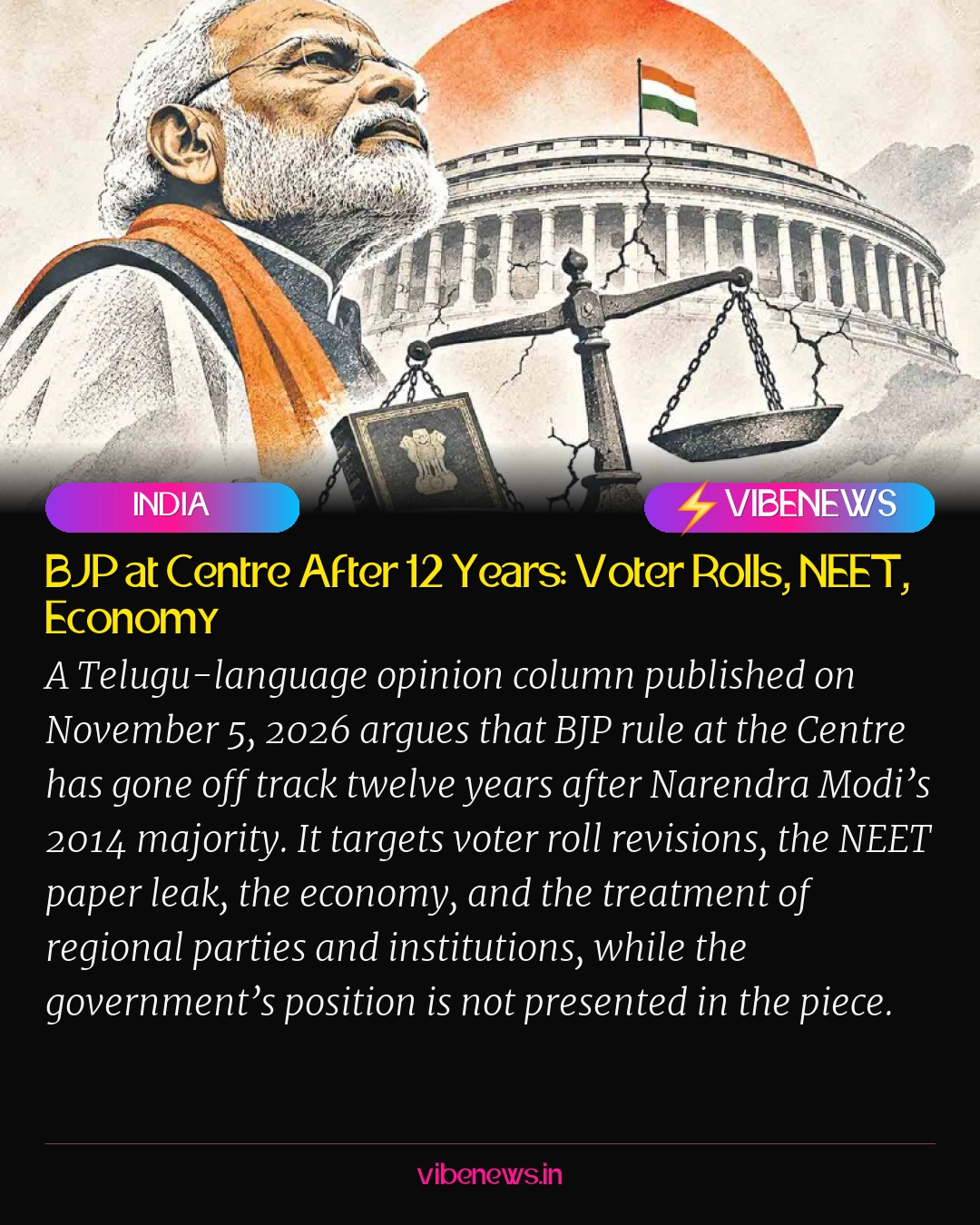

A Telugu-language opinion column published on November 5, 2026 argues that the BJP government at the Centre, which took charge after the 2014 Lok Sabha election, has completely lost its way, and that public hopes placed in Narendra Modi have turned to dust over the past twelve years.
The BJP rule that began at the Centre twelve years ago has now completely gone off track.
The piece is a sharp political critique, not a news report, and it makes its case through a long list of allegations. The author writes that people are now recognising the failure is not of the central government alone, but of the Indian Constitution under its watch. The column recalls the 2014 campaign promise of ‘Sabka Saath, Sabka Vikas’, meaning development for all, and says that promise has been exposed as empty words.
Questions over the voter rolls
The column’s central charge concerns the Election Commission and the nationwide revision of voter lists. It says a comprehensive revision of voter rolls began last year, before assembly elections in five states including West Bengal, and is now being carried out unevenly in other states.
According to the column, the revised rolls helped the BJP win the Bihar assembly elections held in October of that year and other recent state polls. It alleges that lakhs of minority voters were removed from the lists in states such as West Bengal and Assam, and that the BJP benefited as a result. The author states that so far 13.2 crore voters have been removed from the lists.
The column also points to changes in Form 6 and a 2023 amendment to the law. It argues that the amendment paved the way for the Election Commission to remove voter names while shielding those responsible from court trials and punishment. It adds that the Supreme Court is currently hearing the legal protections the Centre put in place. Chief Election Commissioner Gyanesh Kumar is named in the piece as the official driving the process forward, despite objections raised by his fellow commissioners. The column says two commissioners’ objections came to light through the media after the removals had already taken place.
Institutions under pressure
The author argues that almost every constitutional body has been weakened under Modi and Home Minister Amit Shah. The column says there is a suspicion, unprecedented in its view, that pressure from the ruling party may lie behind some decisions announced by the judiciary. It also argues that the 75-year-old democratic system is being run in ways that serve narrow political interests rather than the Constitution.
The NEET paper leak and the minister’s exit
The column devotes significant space to the National Eligibility cum Entrance Test, the national exam for medical college admissions, whose question papers leaked again. It describes the leak as deeply unsettling for the country. The author writes that a protest led by the Cockroach Janta Party (CKP) and a youth group pushed the government hard on the issue. It claims the government, which it says prides itself on resisting pressure, forced Union Education Minister Dharmendra Pradhan to resign after threats from the CKP. The column presents this as a sign of how the government’s image has suffered.
Economic strain and business ties
On the economy, the column says the financial crisis has deepened since the BJP came to power at the Centre. It raises the question of whether the government’s goal is to benefit a few industrial families linked to Gujarat. The piece lists ports, large airports and other sectors where it says actions have favoured the Adani group and the Ambani companies over the past twelve years. It also says the internal crisis at the Tata Group has not been resolved, and alleges that the government has contributed to making it worse for some parties.
The column further claims that thousands of micro, small and medium enterprises have shut down in Gujarat and other states, and that the Centre has done little to reopen them or reduce unemployment. It frames the domestic slowdown within a wider global shock, citing the Israel-Iran conflict and wars in West Asia, which it says are hurting the world economy and, in turn, India. It also argues that India’s stance supporting Israel during Israeli and American strikes on Iran has harmed the United States economically, and that a recent trade agreement with Washington, signed under pressure and threats from Donald Trump, has damaged the government’s standing.
Where the Telangana angle fits
The column notes that BJP leaders have made a habit of making harsh remarks about regional parties, naming the BRS, which has governed states in its own right, as one such target. For readers in Telangana, where the BRS has been a major force, this is one of the few direct references in the piece that connects the national argument to the state’s politics. The column does not discuss the party’s current standing in the state.
Rahul Gandhi and the opposition
The column also turns to Congress leader Rahul Gandhi, who entered the Lok Sabha in 2004. It says he was long dismissed as a naive ‘Pappu’ lacking political maturity and sharp strategy, and that he has since begun attacking the ruling party more aggressively as the government’s missteps mount. According to the author, Rahul Gandhi says the Modi-Shah duo fears him, and promises that anyone guilty of wrongdoing, including the Chief Election Commissioner, will not be spared if his party comes to power. He has repeatedly challenged Modi to a public debate, the column notes.
The author draws a historical parallel, saying the crisis now facing Modi’s government resembles the one the first UPA coalition faced during its second term. The column argues that anger over governance failures, economic trouble and the NEET leak has pushed both Rahul Gandhi and young voters to direct sharp criticism at the prime minister.
The piece does not include a response from the Election Commission, the Union government or the BJP. Its claims are the author’s own analysis and allegations, and they remain contested political arguments rather than established findings.
TL;DR
- The column argues BJP rule at the Centre has gone off track twelve years after Modi’s 2014 majority.
- The author links voter roll revisions to electoral gains, alleging lakhs of minority voters were removed.
- The column says 13.2 crore voters have been removed from the rolls so far.
- It claims the NEET paper leak forced Education Minister Dharmendra Pradhan to resign.
- The author alleges economic strain and favours to large business groups, a claim the BJP has not answered here.