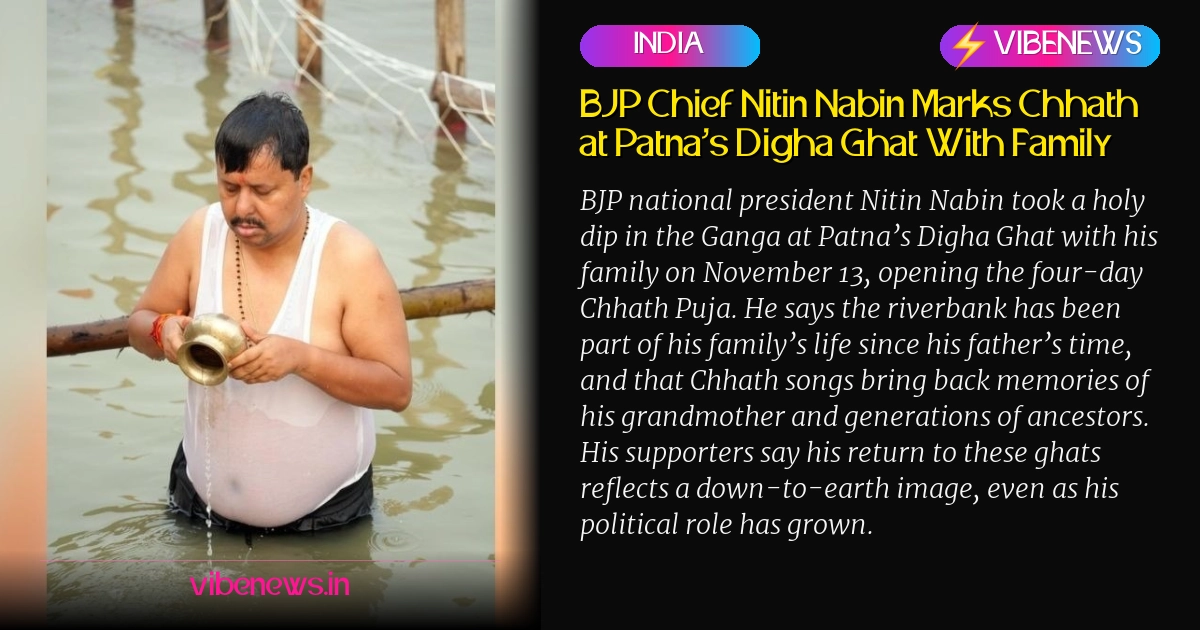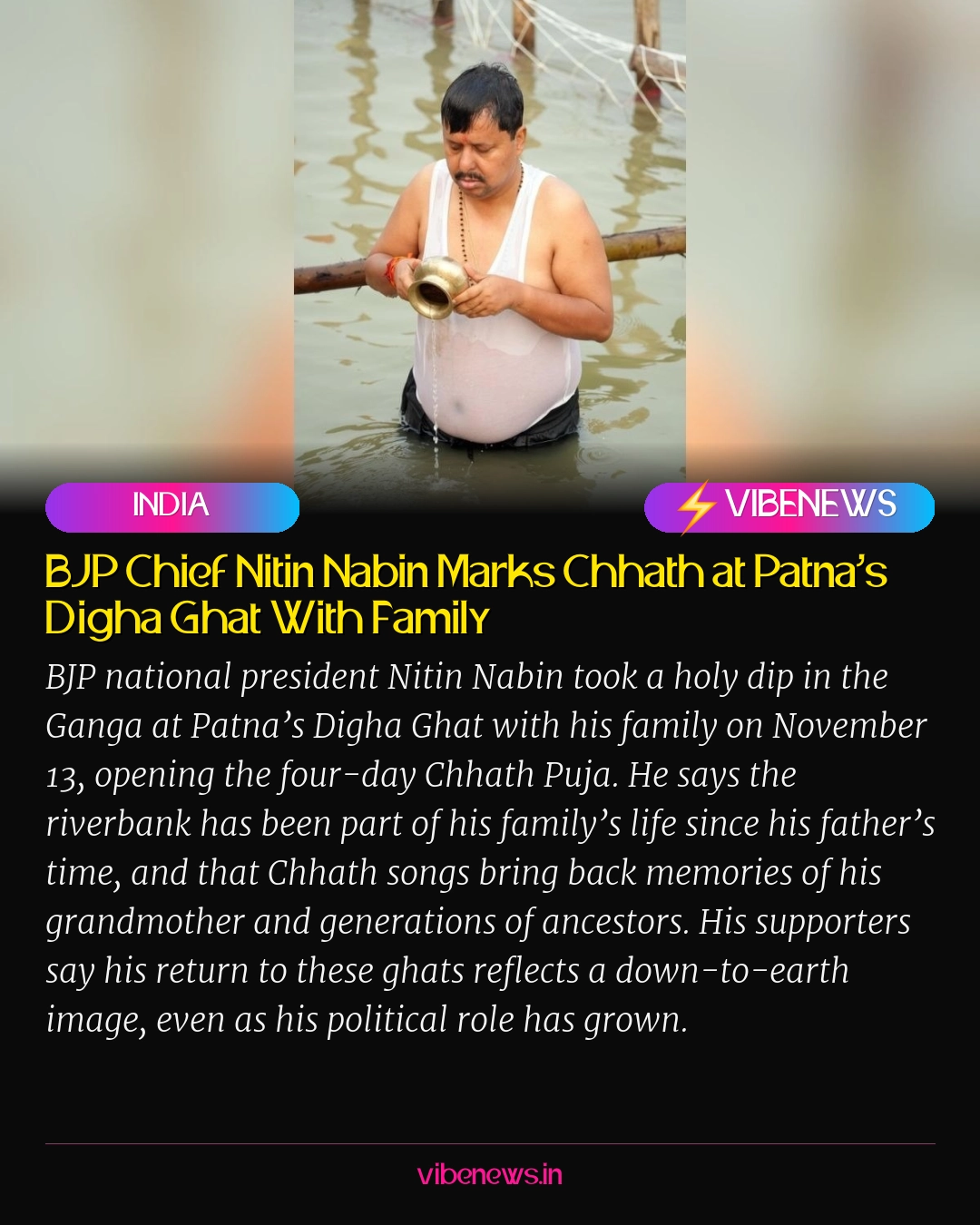
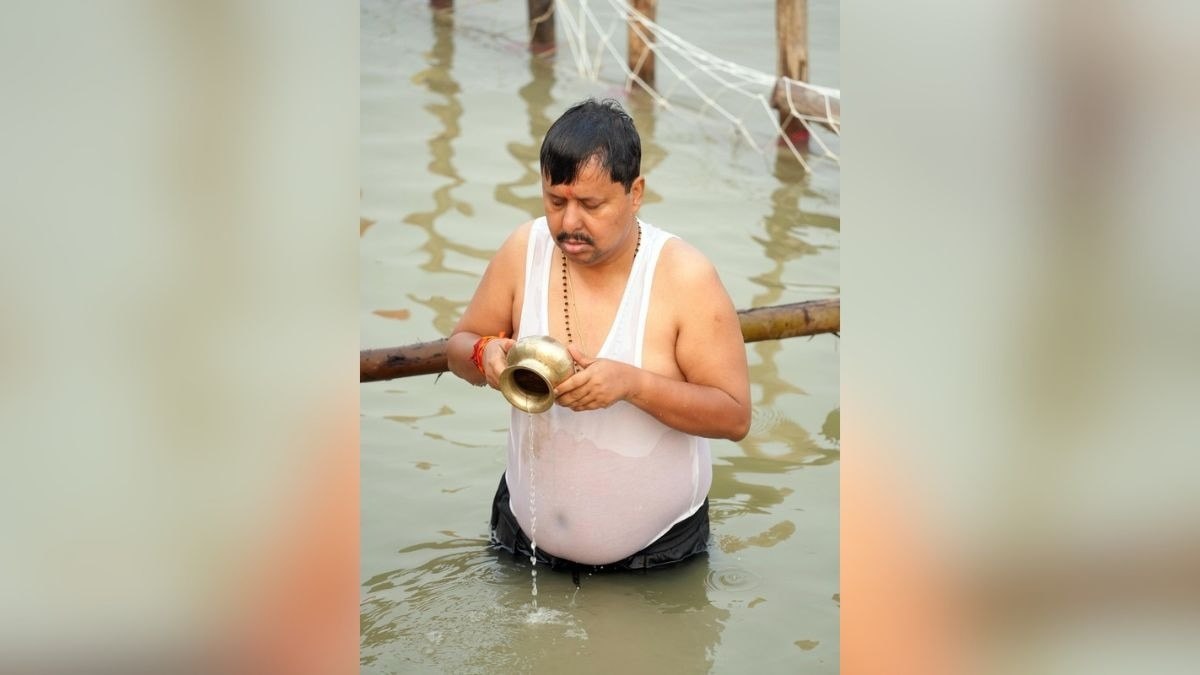
BJP national president Nitin Nabin took a holy dip in the Ganga at Patna’s Digha Ghat with his family on November 13, marking the start of the four-day Chhath Puja in Bihar.
There was no elaborate political setting. It was a return to a riverbank Nabin says has been part of his family’s life since his father’s days. He recalled that the Ganga ghats along Patliputra were where the family came to offer Arghya, and where his childhood memories, family traditions and faith continue to meet.
Nabin now holds one of the most prominent posts in the BJP. Still, he spoke less about the political weight of Chhath and more about what the festival means to him as a person. Chhath songs, he said, bring back memories of his grandmother, other women in the family and generations of ancestors who observed the festival. Few forms of worship, he suggested, build such a strong bond between family members.
For Nabin, the festival is an inheritance.
“We have seen this festival since childhood and grown up with this tradition,” he said.The family has kept visiting the same ghats, and that gives the ritual a link across generations.
In a political life that is increasingly shaped by national responsibilities, the familiar sights and sounds of Chhath offer him a connection to home. Nabin’s supporters say his willingness to keep returning to these ghats, despite the demands of high office, gives him the image of a down-to-earth and unassuming politician.
Chhath, though, is much bigger than one family’s ritual. It is one of Bihar’s most distinctive festivals, dedicated to the Sun god, also known as Bhagwan Bhaskar, and to Chhathi Maiya. It is observed with extraordinary discipline. There are no temples at its centre and no elaborate ceremonies led by priests. Riverbanks, household kitchens and family courtyards become the places of worship, and devotees perform the rituals themselves, often after a strict fast and rules of cleanliness and purity.
The festival unfolds over four days. It begins with Nahay-Khay, when devotees bathe, clean their homes and prepare a simple vegetarian meal. The second day, Kharna, involves a full day of fasting, which ends in the evening after prayers with offerings such as kheer. On the third day, devotees gather at rivers, ponds and other water bodies to offer Sandhya Arghya to the setting sun. Before sunrise the next morning, they return to offer Usha Arghya to the rising sun. The fast ends only after that final offering.
The worship of both the setting and the rising sun gives Chhath its distinctive character. It is an expression of gratitude that does not separate the fading from the emerging. The rituals honour the sun as the source of life and energy, and prayers are offered for the well-being of children and family members.
Nabin also draws attention to the festival’s link with nature and farming. Chhath, he said, is not only devotion to the Sun god and the Ganga. It is also a way of thanking the farmers who grow the food people eat. The offerings include fruits, sugarcane and thekua, a traditional sweet, and he says those items reflect the bond between the festival and the land. In his view, the emphasis on cleanliness, purity, discipline and respect for nature is what sets it apart.
Preparations begin well before anything reaches the riverbank. Homes are cleaned, ingredients are chosen with care, and traditional food is cooked according to prescribed rituals. Folk songs, passed down through generations, accompany the work. For Nabin, those songs are more than music. They are reminders of how earlier generations observed the festival and handed it on.
That sense of belonging has travelled well beyond Bihar. Nabin pointed out that wherever people from Bihar have settled, they have carried Chhath with them. The festival now has a presence from New York and New Jersey to Mumbai’s Girgaon Chowpatty and the banks of the Yamuna in Delhi.
That journey, in many ways, is the point. For people from Bihar living away from home, Chhath is a way to recreate a part of their cultural world. The river may be different, the city unfamiliar and the community smaller, but the rituals, songs and offerings remain recognisable. Chhath, in that sense, goes wherever its devotees go.
Nabin also spoke about the energy the four days bring. The faith, discipline and collective participation, he said, give people renewed strength to handle everyday responsibilities through the rest of the year. He presented this as a personal view, but it points to something larger about the festival’s appeal. Devotion does not end when the rituals end. It stays with people and shapes their ordinary lives.
Chhath also brought a political note into the family celebration. On November 14, Bihar chief minister Samrat Choudhary visited Nabin’s residence for Kharna prasad. The visit reflected the festival’s spirit of sharing and community, and it also showed the personal warmth between two BJP leaders.
Even with political friends and associates in the house, the occasion stayed rooted in family customs. Nabin’s office has taken him to the national stage, but Chhath keeps pulling him back to a familiar riverbank, to memories of his father and grandmother, and to a tradition that has shaped his life. For him, and for many people from Bihar, the Ganga at Chhath is more than a place of worship. It is where faith, family and the idea of home meet.
TL;DR
- BJP national president Nitin Nabin marked the start of Chhath Puja with a holy dip at Patna’s Digha Ghat on November 13.
- Nabin says his family has offered Arghya at the Ganga ghats since his father’s time.
- He described Chhath songs as a link to his grandmother, his family and generations of ancestors.
- The four-day festival, dedicated to the Sun god and Chhathi Maiya, centres on riverbanks and home kitchens, not temples.
- Bihar chief minister Samrat Choudhary visited Nabin’s residence for Kharna prasad on November 14.