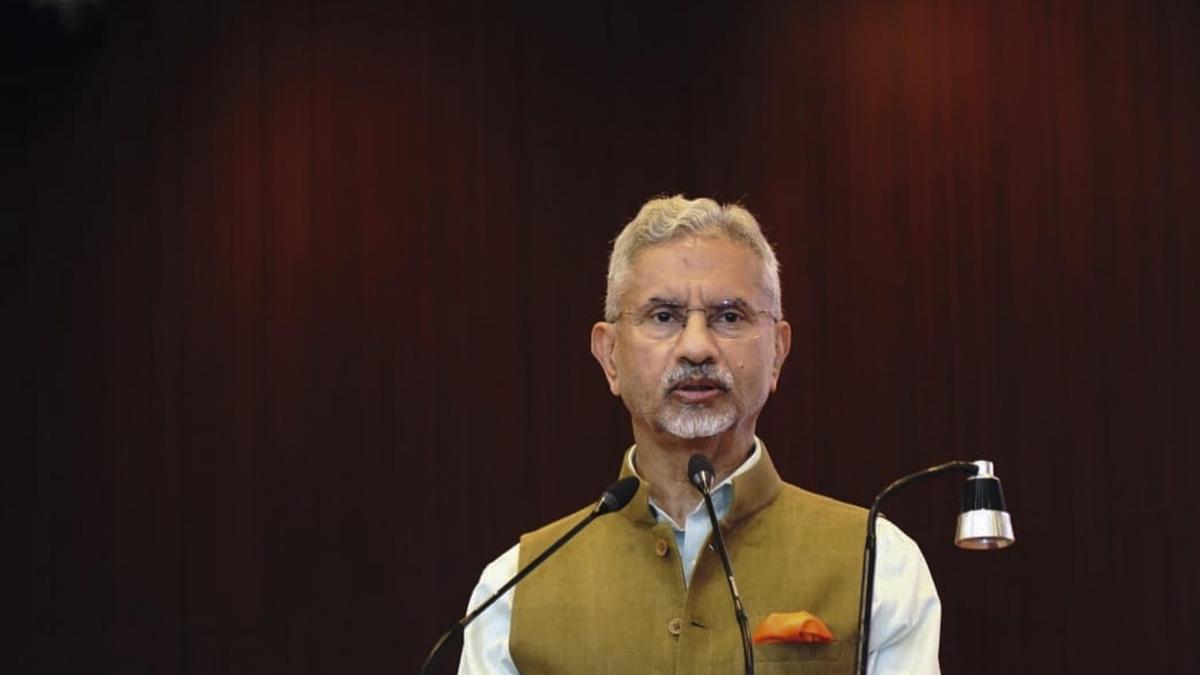
External Affairs Minister S. Jaishankar said on Saturday, November 14, 2026, that the India-China border has become ‘more alive’ and now requires a much greater commitment of Indian troops on a sustained basis.
Speaking at an interactive session at a leadership summit, Jaishankar laid out New Delhi’s approach to building infrastructure along the frontier. He also said India has strengthened its military capabilities along the Line of Actual Control (LAC) since the deadly clashes in Galwan Valley in eastern Ladakh in 2020.
"What has happened today is the border with China has become more alive in a way. It has required a much greater commitment of troops on a sustained basis."
The remarks come as New Delhi and Beijing work to normalise ties that were badly strained by the over four-year border face-off in eastern Ladakh. The thaw began after Prime Minister Narendra Modi met Chinese President Xi Jinping in the Russian city of Kazan in October 2024, after the standoff had ended.
The two leaders discussed a range of issues, including reducing their trade deficit, tackling challenges such as terrorism, and ensuring fair trade in multilateral platforms.
Roads, tunnels and airfields
Jaishankar pointed to a change in the pace of development that he said ordinary people can now see. He asked listeners to think about how often they now read that a new tunnel has been built, a new bridge completed, or another airfield commissioned. The news, he said, is arriving with greater and greater frequency.
He argued that the infrastructure push is a recent shift. In his view, border infrastructure was neglected until about a decade ago. People talked about it and drew up plans, but the follow-through was missing. Jaishankar said the real change came in the last ten years, when attention, resources and policy push were directed at the frontier.
He tied the build-up to what the armed forces can now do. Jaishankar said the work already completed allowed India to deploy the current number of troops along the border, and that continued work would keep those numbers in place. He described India’s ability to deploy troops in the region as having improved markedly.
He also invited anyone doubtful to check the record on the ground. Going year by year and counting kilometres of roads, tunnelling and force positioning, he said, would show the truth to anyone familiar with the sector, especially those working with the armed forces.
The economic gap and the ‘missed the bus’ remark
Jaishankar also took on a question about economic asymmetry between India and China. He went back to the 1960s, 1970s and 1980s, when many developing countries were industrialising. He recalled that when Rajiv Gandhi visited China in 1988, the two economies were roughly the same size.
China, he said, pushed hard on modernisation and industrialisation in the 1980s. That is where his most quoted line came from. "I’m sorry to say India in the 1980s simply missed the bus," he said. India carried out some corrections and reforms in the 1990s, but he argued they were not carried through sector by sector.
He was quick to add that he did not mean the point as a political jab. Jaishankar listed the Modi government’s efforts in manufacturing and industrialisation as the current response.
Catching up, he said, will not work by following the same path. India, in his words, has to leap-frog. He said the country must build on its particular strengths to deal with the asymmetry.
On the border and on the economy, Jaishankar’s message was that India cannot match China on every front at once. "In asymmetry, you don’t go toe-to-toe on every issue," he said. "You pick the issues where you feel you have the ability to make a big change. That’s really what we think we’re doing right now."
Jaishankar’s comments came while relations are still being rebuilt. The remarks offered a clear view of how New Delhi sees its position: investing heavily on the frontier, while choosing its battles on the economic side.
TL;DR
- Jaishankar says the India-China border has become ‘more alive’ and needs a much greater, sustained commitment of troops.
- He said new roads, tunnels, bridges and airfields are now being reported with increasing frequency.
- The remarks come as India and China work to repair ties strained by the over four-year eastern Ladakh standoff.
- Jaishankar said India ‘simply missed the bus’ in the 1980s while China pushed industrialisation.
- He said India must leap-frog and pick issues where it can make a big change rather than match China on everything.