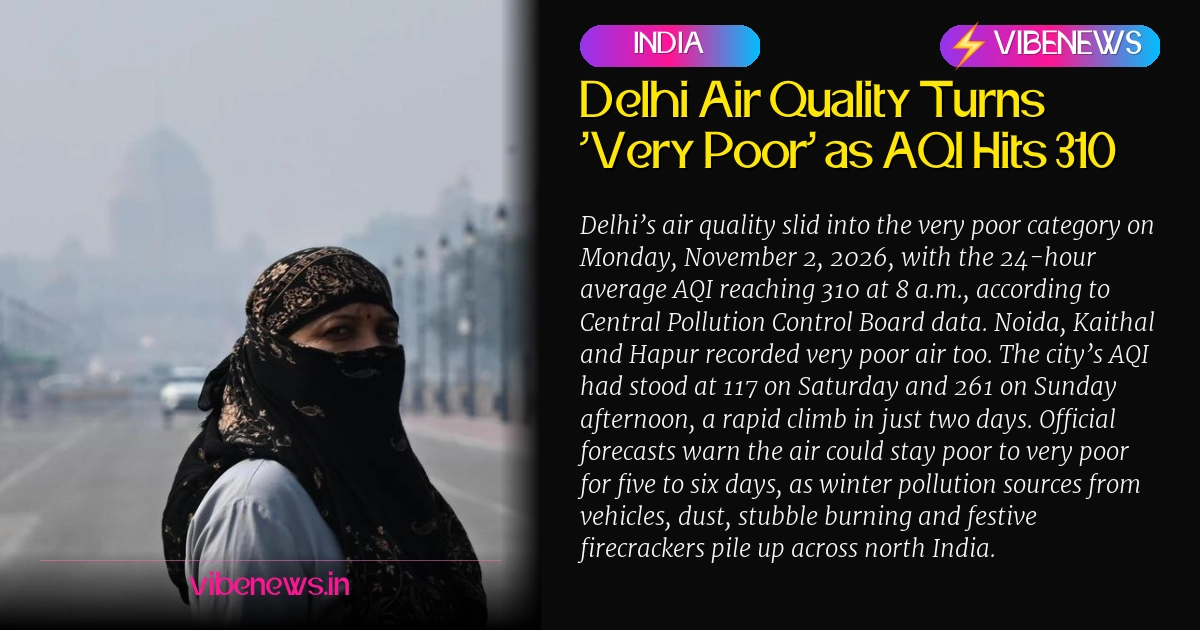
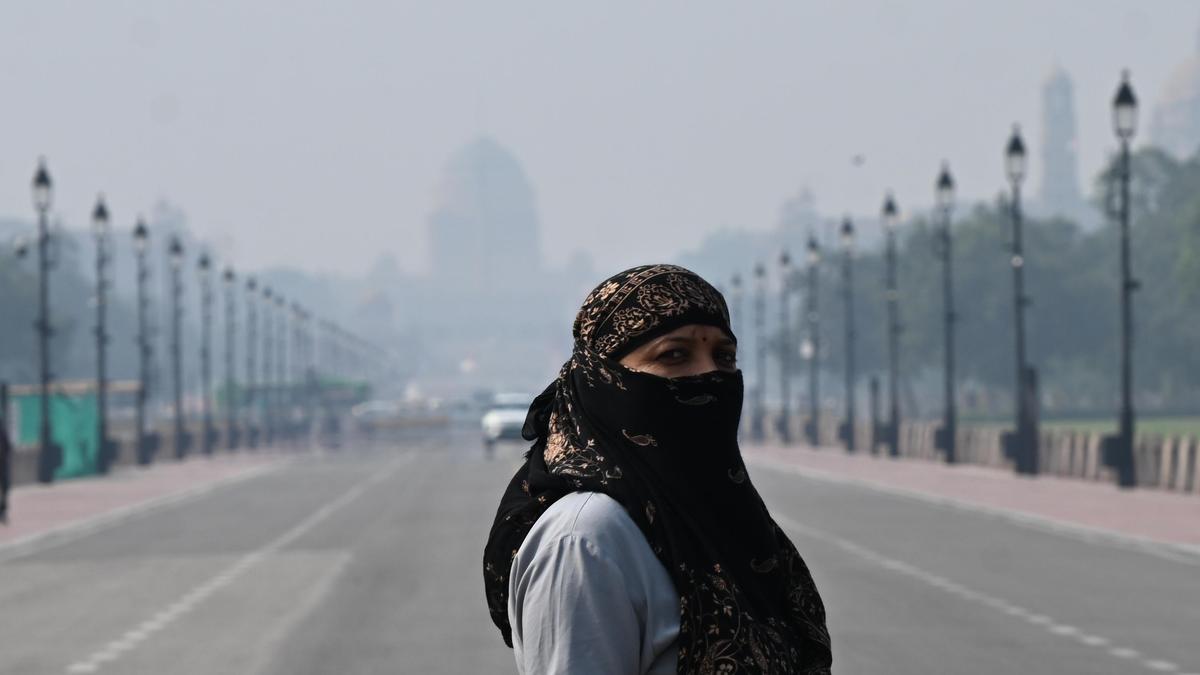
Delhi’s overall air quality dropped into the ‘very poor’ category on Monday morning, November 2, 2026, with the city’s 24-hour average Air Quality Index standing at 310 at 8 a.m., according to Central Pollution Control Board data.
The air is not only bad in the capital. Noida, Kaithal and Hapur also recorded very poor air quality on Monday morning, pointing to a problem that is spreading across a wide stretch of north India rather than sitting in one city.
A Two-Day Slide From Moderate to Very Poor
The speed of the change is what should worry residents. On Saturday, Delhi’s 24-hour average AQI stood at 117, which is in the moderate range. By 4 p.m. on Sunday, the Central Pollution Control Board’s daily bulletin, which is the figure treated as the day’s AQI, had pushed the reading to 261, placing the city in the poor category.
By the next morning, the number had climbed again to 310, crossing into very poor territory. In the span of roughly two days, the reading moved from moderate to very poor. The source data makes one point clear: a higher AQI means worsening air quality, and Delhi’s reading has been climbing steeply.
The numbers behind the alarm
The Saturday reading of 117 and the Monday morning reading of 310 are separated by a single weekend. That gap is the story. Air quality does not usually swing this far this quickly without a set of conditions piling on top of one another, and this week those conditions are lining up.
Why the Air Turns Toxic Every Winter
Every winter, air pollution spikes in Delhi-NCR and across much of the larger Indo-Gangetic Plains. The main drivers, according to the data, are meteorological. Lower wind speeds and a drop in temperature trap pollutants close to the ground, so the air that people breathe does not get cleared out.
On top of that weather pattern, human activity adds fuel. Pollution from stubble burning during October and November pushes smoke into the region’s air at exactly the time when winds are weakest. Bursting of firecrackers during the festive season adds another layer of smoke and particles. Vehicles and dust, which are present all year, make the problem worse when the atmosphere cannot disperse them.
Put together, the situation is a classic winter squeeze. Weather stops the air from moving, and emissions keep arriving. The result is what Delhi is seeing now.
A Forecast Measured in Days, Not Hours
The outlook is the most important part of this story for anyone planning their week. According to the Central government’s Air Quality Early Warning System for Delhi, the air quality is likely to remain in the poor to very poor category for about five to six days.
The air quality of Delhi is likely to be in the ‘poor’ to ‘very poor’ category for about five to six days, as per the Central government’s ‘Air Quality Early Warning System for Delhi’.
That is not a single bad morning. It is a stretch of several days in which the city’s air is expected to stay in the danger zone or close to it. For families, schools, workers who spend long hours outdoors and anyone with a respiratory condition, that window matters more than any one reading.
North India Feels the Same Pressure
Delhi is not alone. Many other cities and towns in north India, including Noida, Kaithal and Hapur, also recorded very poor air quality on Monday morning. Those names show how far the pollution reaches beyond the capital’s borders. The shared winter conditions, weak winds and seasonal emissions that build up in the Indo-Gangetic Plains do not stop at a city limit.
The spread across multiple cities means the response cannot be limited to a single municipal area. The pollution sources described in the data, from vehicles and dust to stubble burning and firecrackers, are regional in nature, and so is the weather that keeps them in place.
What This Means for People Living Here Right Now
For residents, the practical question is simple: how bad is it where you are, and how long will it last? The official data gives a clear answer for Delhi. The air is at a very poor level this morning, and the early warning system expects poor to very poor conditions for five to six days.
Check the AQI for your own area before heading out, especially for children, older adults and people with asthma or heart conditions. Keep an eye on the daily bulletins, because the readings in this episode have shifted sharply within hours, not weeks.
The bottom line
Delhi’s air has moved from moderate on Saturday to very poor on Monday morning, with neighbouring cities following the same downward path. The causes are well documented and recurring: weak winds, cold temperatures, stubble burning, festive firecrackers, vehicles and dust. The official forecast does not offer quick relief. For the next five to six days, the air over Delhi is expected to stay poor or worse, and that is a warning people should take seriously.
TL;DR
- Delhi’s air quality worsened to the very poor category on Monday morning, November 2, 2026, with the 24-hour AQI at 310.
- The AQI had been at 117 on Saturday and 261 by Sunday afternoon, a steep climb in about two days.
- Noida, Kaithal and Hapur also recorded very poor air quality on Monday morning.
- Official early warning data says Delhi’s air could stay poor to very poor for five to six days.
- Winter weather, stubble burning, festive firecrackers, vehicles and dust are all adding to the pollution.