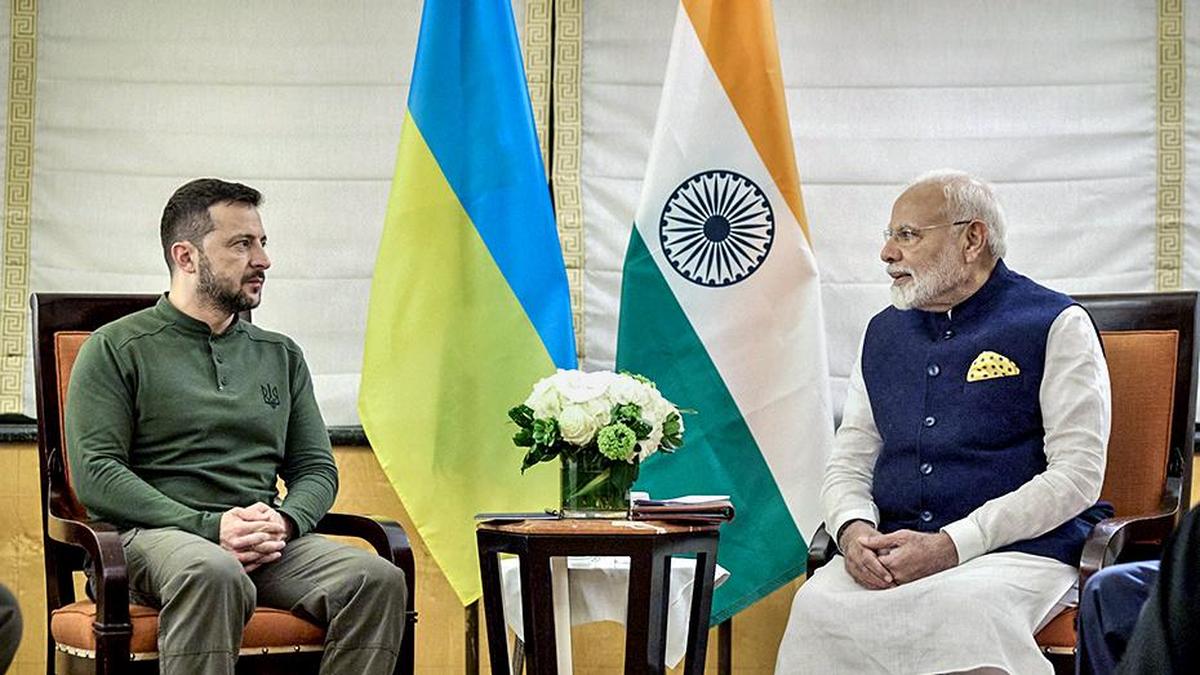
India is ready to mediate between Russia and Ukraine to set up food corridors, Ukrainian President Volodymyr Zelenskyy said on Monday, after a telephone call with Prime Minister Narendra Modi. The call came just before Ukraine-Russia peace talks set to begin in Abu Dhabi on Tuesday, and it lands at a moment when New Delhi’s role between Moscow and Kyiv is becoming harder to ignore.
Modi conveyed India’s “readiness” to help with all initiatives aimed at ending the conflict, which is now nearly five years old. The Ministry of External Affairs said in a statement that Modi reaffirmed India’s human-centric approach and its consistent position that the conflict must be resolved through dialogue and diplomacy. He also said India was ready to contribute to all efforts aimed at a peaceful resolution.
Zelenskyy was far more direct in his own account. In a post on social media, he said he had briefed Modi on the latest developments and stressed that Modi had told Putin the war must end. He then pushed India to go further. Zelenskyy said Russia needs to understand that the global economy and hundreds of millions of people are suffering because sea routes in the Black Sea are blocked. He asked India to spell out what steps it can take and what dialogue it can pursue with other leaders.
“India is ready to mediate in establishing food corridors, and we are counting on these efforts to continue,” Mr. Zelenskyy wrote.
Food was the opening he wanted. Zelenskyy said food security could be one area where India helps, and he specifically pointed to Russia’s blocking of grain exports through the Black Sea. That is the piece of India’s proposal that has been taking shape for months.
The call from Delhi was not a stand-alone move. Within a couple of hours of the Modi-Zelenskyy announcement, Jaishankar posted that he had also spoken to Lavrov. He said their conversation focused on the Ukraine conflict and ongoing diplomatic initiatives. Taken together, the two calls are the clearest sign yet of the mediating role India is now playing. The timing matters because the calls came in the days before a crowded diplomatic calendar.
The proposal has been building for weeks. Jaishankar had first laid out India’s ideas during a visit to Poland and Ukraine in September. Those ideas cover a grain export agreement or a food corridor in the Black Sea, the safety of sea mariners, and safe passage for energy shipments. He has been discussing these points with both countries.
On October 22, during a visit to Delhi by Polish Prime Minister Donald Tusk, Indian officials said New Delhi had reached out to both the Russian and Ukrainian governments with a “four-point proposal.” The plan would stop attacks on civilians, allow grain and energy exports from both countries through the Black Sea, and end the targeting of ships and seafarers. Many of those seafarers are Indian nationals, which gives the proposal a direct stake for India beyond geopolitics.
Highly placed officials told The Hindu that New Delhi was in close contact with both sides on the specific proposal. The government had hoped to hear back from Moscow and Kyiv at the earliest opportunity. The Modi-Zelenskyy and Jaishankar-Lavrov calls now suggest that those conversations have moved from quiet exchanges to something more public.
The wider diplomatic map is crowded. US President Donald Trump’s negotiators, including his son-in-law Jared Kushner and special envoy Steve Witkoff, are set to restart negotiations on Tuesday with Russian and Ukrainian representatives. The talks are meant to discuss security guarantees that would be required for a possible ceasefire. That is the first restart in three months, which makes the Abu Dhabi round a notable reset.
India’s timing also sits inside a busy schedule of leader meetings. Modi and Trump are expected to meet on the sidelines of ASEAN-linked summits in Manila, about a week after the calls. Later this month, Trump is expected to travel to Shenzhen for the APEC summit in China. Russian President Vladimir Putin is also expected to attend that summit. Each of these meetings could shape how the Ukraine conflict is discussed, and India is positioning itself at the center of several of them.
The open question is how far India will go. It remains to be seen whether India will join the dialogue already underway with the US and the UAE. It is also unclear whether New Delhi plans a bigger role, such as mediating or hosting talks between Russia and Ukraine in the future. For now, India has offered a specific tool, a Black Sea food corridor, and both capitals have been asked to respond. The answer from Moscow and Kyiv will show whether that offer has real traction.
TL;DR
- India says it is ready to mediate between Russia and Ukraine to set up Black Sea food corridors.
- Zelenskyy welcomed the offer after a phone call with Prime Minister Narendra Modi on Monday.
- Jaishankar spoke with Russian Foreign Minister Sergey Lavrov shortly after the Modi-Zelenskyy call.
- India’s four-point proposal covers civilian attacks, grain and energy exports, and seafarer safety.
- US negotiators restart Ukraine-Russia talks in Abu Dhabi on Tuesday after three months.