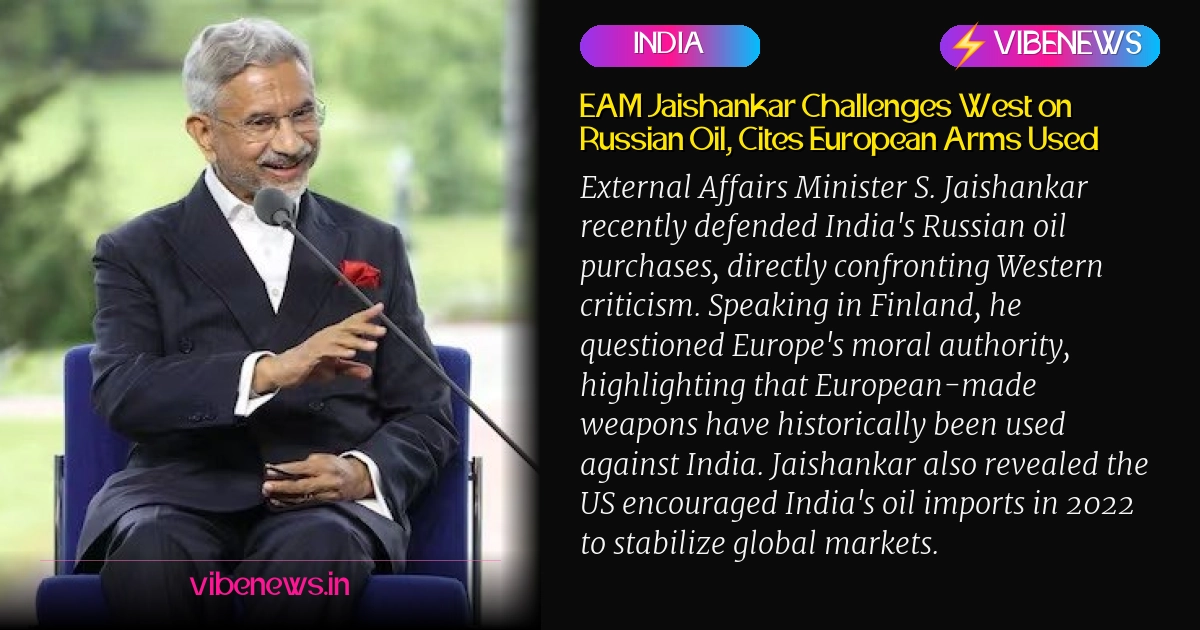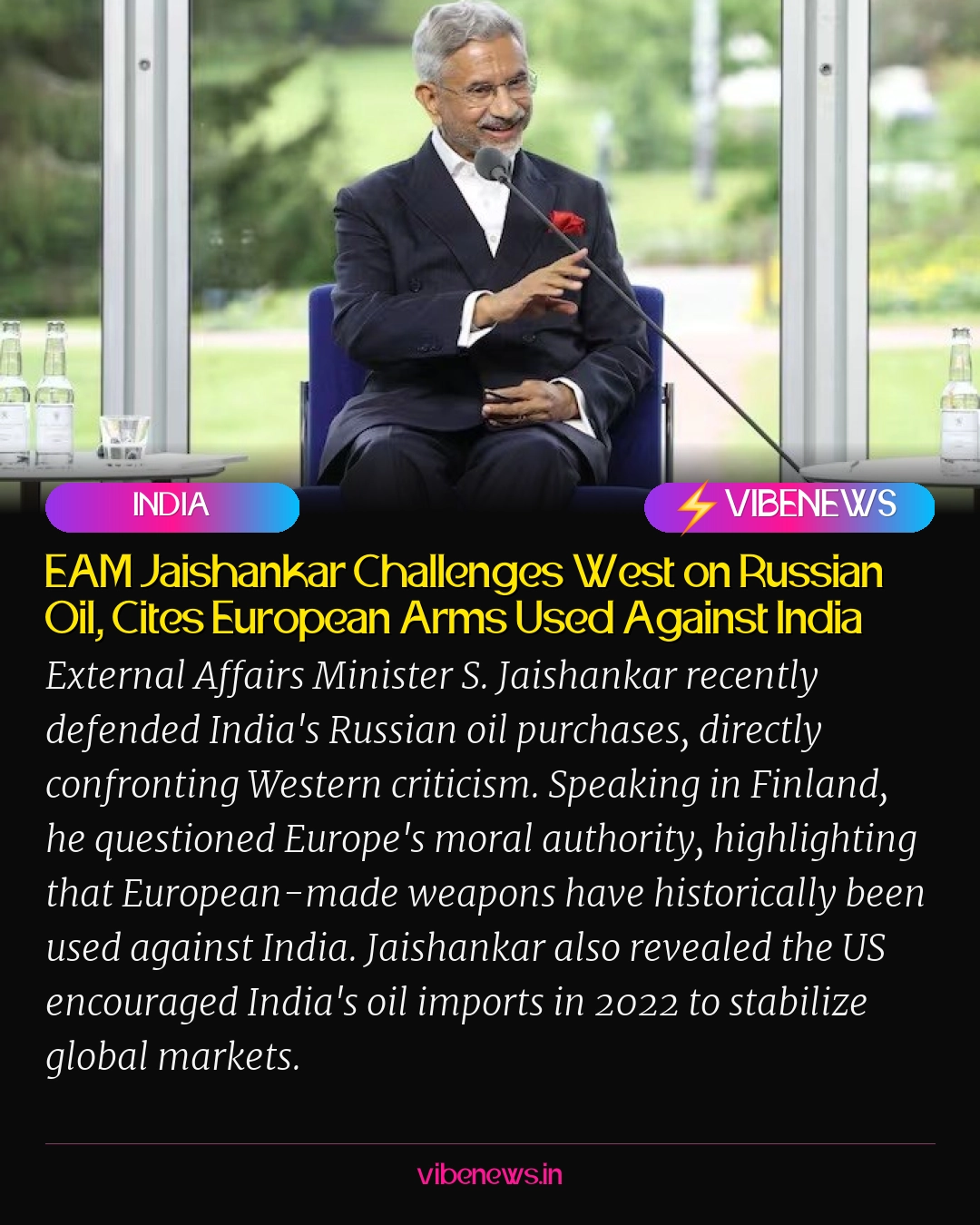
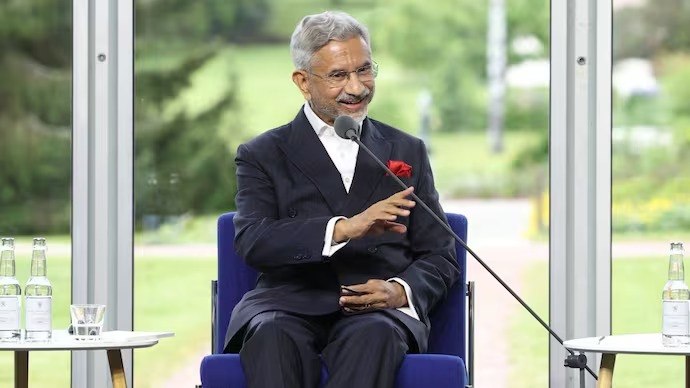
External Affairs Minister S. Jaishankar has pushed back against criticism from Western countries over India's continued purchase of Russian oil, asserting that New Delhi's decisions are guided by national interest, energy security and economic realities rather than external pressure. Speaking during an interaction in Finland, Jaishankar highlighted what he described as inconsistencies in the positions taken by several Western governments regarding Russia, energy trade and global security. He argued that India's decision to import Russian crude emerged from practical considerations following the disruption of global energy markets after the Russia-Ukraine conflict intensified in 2022.
According to Jaishankar, Russian oil was available, competitively priced and helped India manage the energy needs of its large population during a period of uncertainty. He also revealed that the United States had, at one stage, encouraged India to continue purchasing Russian oil to help stabilize international energy markets after sanctions disrupted supply chains. The remarks add a new dimension to the debate surrounding India's energy relationship with Russia and the broader geopolitical impact of the Ukraine conflict. During his comments, Jaishankar questioned why some European nations criticize India's oil purchases while continuing policies that serve their own strategic interests. He pointed to arms exports from Europe that have ultimately affected India's security interests, arguing that such concerns are often overlooked when discussions focus on India's ties with Russia.
The minister's comments reflect India's long-standing position of strategic autonomy in foreign policy. Successive governments have maintained that international partnerships and economic decisions should be based on national priorities rather than alignment with any single geopolitical bloc. Since the start of the Ukraine war, India has sought to balance its relationships with Western nations and Russia while protecting its energy requirements and economic growth. India's increased imports of discounted Russian crude have attracted attention from Western governments, particularly as sanctions on Moscow expanded. However, Indian officials have consistently maintained that ensuring affordable energy supplies for consumers remains a key priority. Analysts note that India's stance reflects the broader challenges facing emerging economies as they navigate a rapidly changing geopolitical environment.
Rising energy demand, supply chain disruptions and shifting global alliances have forced many countries to make pragmatic decisions that do not always align with the expectations of major powers. Jaishankar's latest remarks are likely to resonate beyond the immediate debate over Russian oil. They underscore India's effort to project an independent foreign policy while reinforcing the message that decisions affecting the country's economy and security will be determined in New Delhi rather than influenced by external pressure. As geopolitical tensions continue to shape global trade and diplomacy, India's position on energy security and strategic autonomy is expected to remain a central element of its foreign policy approach.
TL;DR
- External Affairs Minister S. Jaishankar has forcefully defended India's continued purchase of Russian oil, directly challenging Western nations on their criticism by pointing to European weapons that have historically been used against India. Speaking at the Kultaranta Talks in Finland, Jaishankar asserted that the West holds no moral authority to dictate India's energy choices.
- The seasoned diplomat made his remarks during a discussion on 'Emerging Powers and the New Geopolitical Competition,' where a journalist questioned India's stance on the Russia-Ukraine conflict and its oil imports. Jaishankar responded by highlighting that India's decision to buy Russian crude after the 2022 conflict was primarily driven by affordability and availability. He further revealed that the United States had, in fact, encouraged India to continue these purchases in 2022 to help stabilize volatile global markets.
- India's reliance on Russian energy significantly increased following the outbreak of the Russia-Ukraine war and subsequent Western sanctions. This shift occurred as European consumers began sourcing oil en masse from India's traditional Middle Eastern suppliers. "I buy oil based on cost and availability," Jaishankar stated, explaining the practical necessity that guided India's policy. By August 2025, Russian imports reached approximately 2 million barrels per day, establishing Moscow as India's largest crude supplier.
- Beyond the economic rationale, Jaishankar launched a pointed critique regarding Europe's moral standing. He explicitly stated that many weapons supplied by European nations over decades have found their way into the hands of countries that subsequently used them to attack India. "No European country has been attacked with Indian weapons. I wish I could say that for Europe weapons vis-a-vis India," he remarked, drawing a stark contrast.
- Expanding on this, Jaishankar reiterated India's long-standing security concerns about Western arms supplies to the region. He explained, "Europe sells weapons, which are used to attack India. Not just now but for many years." This historical context is crucial for understanding India's perspective. For instance, India's neighbor, Pakistan, has maintained a significant arsenal of European hardware, including French-made Mirage jets, Swedish-made Saab 2000 Erieye Early Warning Aircraft, and German rifles. French-made Daphne class submarines were also part of Pakistan's naval fleet, with one sinking the Indian Navy frigate INS Khukri during the 1971 India-Pakistan war.
- Jaishankar underscored that India has never contributed to threats against European security, nor has any Indian-made weapon been used against a European country. This argument frames India's foreign policy as one of strategic autonomy, prioritizing its national interests and energy security without compromising its non-aligned principles. The EAM's statements signal India's firm resolve to navigate complex geopolitical landscapes based on its own assessment of circumstances and historical grievances, rather than succumbing to external pressures or double standards.