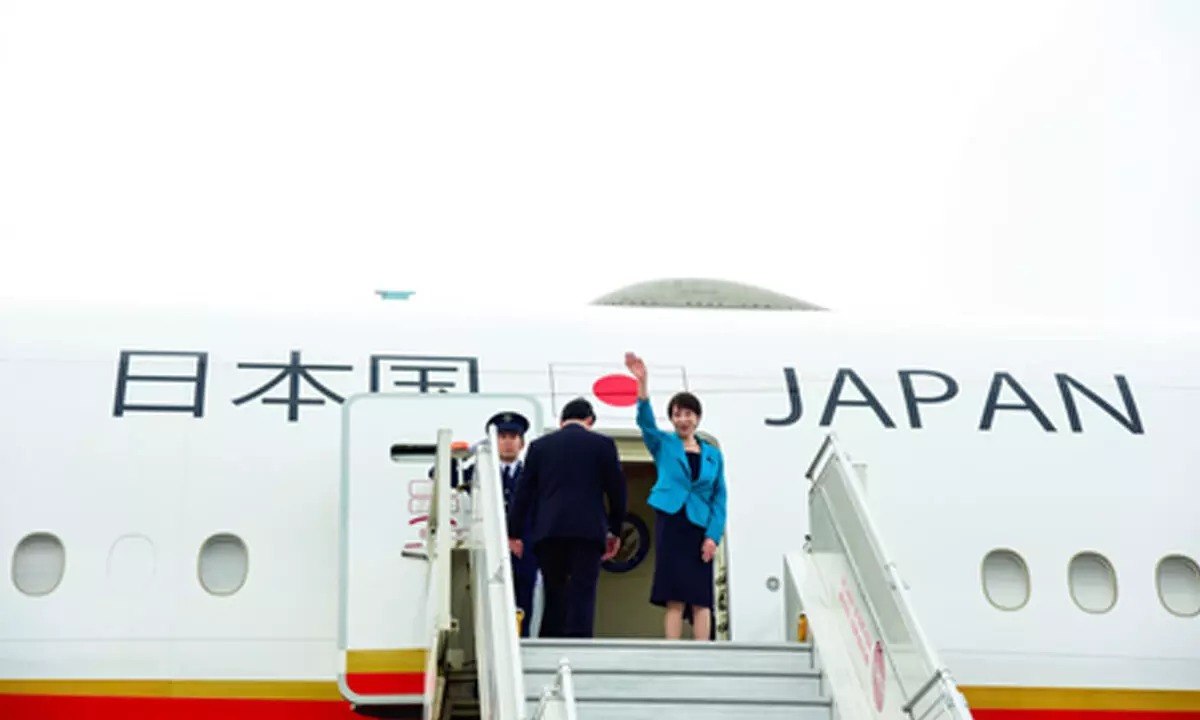
Japanese Prime Minister Sanae Takaichi departed from India on Friday, concluding a three-day official visit that significantly advanced the strategic partnership between New Delhi and Tokyo. Her trip culminated in the 16th India-Japan Annual Summit, where she and Prime Minister Narendra Modi engaged in extensive discussions aimed at strengthening bilateral ties across multiple domains.
Union Minister of State for Science and Technology, Jitendra Singh, saw off Prime Minister Takaichi at the airport, marking the end of what the Ministry of External Affairs (MEA) described as a "highly successful" visit. MEA spokesperson Randhir Jaiswal highlighted on X that the visit reaffirmed both nations’ commitment to a partnership pivotal for shared growth, prosperity, and as an anchor for promoting peace and stability in the Indo-Pacific and beyond.
This marked Prime Minister Takaichi’s inaugural visit to India since assuming office, underscoring the importance both countries place on their relationship. During the summit held at Hyderabad House in New Delhi, the leaders delved into the full spectrum of bilateral cooperation, encompassing trade, investment, economic security, energy, emerging technologies, defence, and people-to-people exchanges. They also addressed regional and global developments of mutual interest, reflecting a shared vision for a stable and prosperous international order.
A key outcome of the summit was the adoption of three landmark documents: a Joint Declaration on Economic Security, a Joint Statement on Cooperation in the field of Artificial Intelligence, and a Joint Statement on Energy Resilience. These agreements lay a robust framework for future collaboration in areas vital for national development and global competitiveness. The focus on economic security, for instance, aims to build resilient supply chains and protect critical infrastructure from disruptions.
Beyond these declarations, both leaders witnessed the exchange of several Memoranda of Understanding (MoUs) and agreements. These pacts specifically targeted cooperation in economic security, clean energy initiatives, critical technologies, and joint research and development. Such collaborations are essential for fostering innovation and ensuring sustainable growth, particularly as both nations navigate complex technological landscapes and global energy transitions.
Prime Minister Modi also hosted a dinner for Prime Minister Takaichi on Thursday evening, fostering a relaxed atmosphere for candid discussions. Takaichi expressed her gratitude for the warm hospitality, noting that their conversations extended beyond formal talks to include the cultures, cuisines, and personal sentiments towards each other’s nations. This personal engagement helped deepen mutual trust, a crucial element in high-level diplomatic relations.
Addressing the India-Japan Joint Economic Forum, both Prime Ministers reaffirmed the pivotal role of industry in advancing their Special Strategic and Global Partnership. Discussions at the forum centered on expanding investment, strengthening resilient supply chains, and advancing manufacturing partnerships with the objective of ‘Make in India for the World’. This initiative aims to position India as a global manufacturing hub, leveraging Japanese expertise and investment.
The visit’s emphasis on clean growth and deepening cooperation in critical and emerging technologies further highlights a forward-looking agenda. As the two nations approach the 75th anniversary of the establishment of diplomatic relations next year, Prime Minister Takaichi expressed confidence that the cultivated trust would elevate Japan-India relations to even greater heights. This strategic alignment is not merely transactional; it represents a shared commitment to democratic values and a rules-based international order.
The successful conclusion of Prime Minister Takaichi’s visit solidifies a critical alliance in an increasingly complex geopolitical landscape. The agreements forged, particularly in economic security, AI, and clean energy, position India and Japan to collectively address shared challenges and capitalize on emerging opportunities. This partnership is vital for fostering regional stability and driving technological and economic progress across the Indo-Pacific and beyond.
TL;DR
- Japanese Prime Minister Sanae Takaichi concluded a three-day ‘memorable visit’ to India, culminating in the 16th India-Japan Annual Summit.
- The visit significantly advanced the strategic partnership between India and Japan, with discussions covering trade, investment, economic security, energy, emerging technologies, and defence.
- Three landmark documents were adopted: a Joint Declaration on Economic Security, a Joint Statement on Cooperation in Artificial Intelligence, and a Joint Statement on Energy Resilience.
- Key MoUs and agreements were exchanged, focusing on economic security, clean energy, critical technologies, and research and development.
- Both leaders addressed the India-Japan Joint Economic Forum, emphasizing expanded investment, resilient supply chains, and the ‘Make in India for the World’ initiative.
- The visit underscored the commitment of both nations to promote peace, prosperity, and stability in the Indo-Pacific region.
- Prime Minister Takaichi expressed gratitude for Prime Minister Modi’s hospitality, noting that personal discussions deepened mutual trust, setting the stage for future collaboration.